On this Valentine’s Day, if you are celebrating with a significant other, consider effective listening as a gift more valuable than chocolates or jewelry. (And that really means something, at least coming from the author of Listen Like a Lawyer.)
A few specifics that might make this day more romantic. These are inspired by some of the tweets and retweets from Listen Like a Lawyer:
Keep your focus on your partner.
Cognitive control, being able to #focus on one thing that’s important, is essential to every step toward that larger…http://t.co/Hk83rNMyF6
Listen Like a Lawyer spent last week sheltering in place during the Atlanta snow debacle. It was a good week to make crock-pot chili and spend some time re-reading a good book—Wolf Hall by Hilary Mantel.
The main character is not Henry VIII or Thomas More or Anne Boleyn, but Thomas Cromwell. Cromwell was a commoner of uncommon distinction: a mercenary, a wool merchant, a lawyer, a politician, and Master Secretary to the king. This powerful and adept “nobody” earns the fear, if not the respect, of the English nobility at this “disordered” historical moment involving Henry VIII’s quest to father a male heir.
In reading and re-reading Wolf Hall, I was struck by Cromwell’s listening. The different ways he listens, and how he fails and succeeds by his listening, have much to teach lawyers.
Listening to his client’s spoken and unspoken instructions
As portrayed in Wolf Hall, Cromwell listens to what the king says as well as what he really means. Cromwell well understands that the king wishes to view himself as perfect although his desires and actions are certainly not. Thus there is a mismatch in what he says and what he wants to have done. “Sometimes it is a solace to me,” Henry says to Cromwell, “not to have to talk and talk. You were born to understand me, perhaps.”
Listening to his client’s mood
When Henry “rages,” Cromwell responds not with words but with quiet: “He sits quietly, watching Henry, trying by stillness to defuse the situation; to wrap the king in a blanketing silence, so that he, Henry, can listen to himself. It is a great thing, to be able to divert the wrath of the Lion of England.”
Listening to what cannot be written
At one point Cromwell is sent by the king to check on the former queen, Katherine, and their daughter, Mary. For Cromwell—by then the Master Secretary of the kingdom—this seems like a waste of time. Yet as he perceives the situation at Katherine’s lodgings, he understands why the king sent him in person: “The things that are happening cannot be put in a letter.”
The new queen, Anne Boleyn, seeks to make the old queen’s life miserable through her instructions to Katherine’s servants. The king does not want to contradict her openly yet does not want to bring misery to Katherine and Mary either. Only by in-person presence and careful listening to the servants’ statements of their orders can Cromwell comprehend the situation accurately and help the king avoid direct harm to Katherine while also appeasing Anne Boleyn.
Listening to everyone, not just the powerful
Cromwell speaks many languages and is a master “code-switcher,” able to converse with anyone of any station. He is always collecting bits of information about the common people’s mood toward the king. In one scene, Cromwell takes off his fine ring and helps the cook to chop meat as he learns what the people are saying about Katherine of Aragon and Anne Boleyn.
At times Cromwell listens to what he was not meant to hear, such as what people really think of him. He passes by a doorway and hears a sycophantic musician discussing not only his own desire to see Cromwell’s execution but also the musician’s belief Anne Boleyn was not a virgin when she married Henry VIII. This information helps Cromwell first assist the king in marrying Anne Boleyn and later to prosecute her.
A failure of listening
Despite Cromwell’s many strengths as a listener, he fails at one crucial moment. For years early in his career, Cromwell served Cardinal Wolsey, who became his mentor. Wolsey is a powerful man, handling much of the kingdom’s business including arranging marriages among nobles. In an early scene in Wolf Hall, Wolsey meets with Anne Boleyn’s father, brother to the powerful Duke of Norfolk. Cromwell stands in the corner.
The cardinal and Monseigneur Boleyn discuss Anne Boleyn’s unsanctioned decision to enter a marriage contract with a young nobleman. Cromwell says nothing as Wolsey insults the entire Boleyn family as lowborn, and attacks Anne Boleyn in particular, calling her “spoiled goods.” This is not, as it turns out, a good career move for him. Later, in privacy, Cromwell shares with the cardinal the rumors from London about the king’s growing alignment with the Boleyn family. He has already begun an affair with Mary Boleyn (popularly depicted in The Other Boleyn Girl). Cromwell’s action–or really, his inaction–during this crucial meeting has helped to set in motion the cardinal’s downfall. “Why did you not speak up?” the cardinal asks. “How could I have introduced the topic?” Cromwell replies.
The Boleyns later take revenge; the cardinal loses everything and dies alone. Cromwell manages not to go down as well, instead transitioning to the king’s service, where he helps the king refute Anne Boleyn’s supposed marriage contract. Cromwell then masterminds the legal and political strategy to separate England from the Catholic Church.
Wolf Hall is a worthwhile read for lawyers, especially those with an interest in literature, history, or politics. If you have read it, please share thoughts in the comments here. The second book in the series, Bring Up the Bodies, narrates Cromwell’s actions during Anne Boleyn’s reign and fall. (In an early scene in Bring Up the Bodies, one of the queen’s courtiers tries to share gossip about her with Cromwell, who is distracted and inattentive. “You are usually such a good listener,” she says.) Hilary Mantel’s third and final installment in the series, The Mirror and the Light, is forthcoming in 2015.
Patti Richardsis a tax attorney practicing independently in Atlanta. She lost some hearing in her right ear after contracting measles at age 5. She had experimental surgery as a child and went on to teach high school, attend law school, and practice law for ten years until 1999.
At that point, when she was 50, her hearing had become severely degraded. Her left ear did not hear at all, and the hearing in her right ear was weakening. Richards had surgery on the right ear to reconstruct the deteriorating bone structure. The damage turned out to be too extensive. “Since then,” Richards said, “it has been a process of constant reinvention.”
Richards began the process of fitting a hearing aid. Her experience was typical in that several readjustments were necessary: “The first time I left the audiologist’s office, the elevator bell dinged on my floor—then it dinged two more times.” She has since gotten good adjustments on a Phonak hearing aid. She does not need a special cell phone that cuts feedback; she holds a regular cell phone so as to reduce feedback in the hearing aid, or she uses speakerphone.
The nature of her hearing loss does not lend itself to cochlear implants. Her remaining hearing is compromised by allergy symptoms, so she takes an aggressive course of allergy shots.
Richards is a tax attorney. For listening to clients, she uses the auditory input with help from the hearing aid, as well as other inputs: “You can listen other ways by reading what they say, their gestures and body language.” But she noted that with a tax practice, what her clients need most of all is help understanding tax jargon and tax consequences. Thus her practice leans more heavily on her speaking and writing skills in explaining how tax law works.
“I’ve been fortunate my whole life,” she said. She recalled the sacrifice her parents made for her have the experimental surgery as a child; thinking about that sacrifice made it easier for her to accept the hearing loss and move on. “For a long time, I didn’t have to tell people about it, but now I do,” she said. “But I won’t let it drag me down and stop me.”
Dave Thomashas a “tremendously personal” practice as an executive-compensation attorney with Wilson Sonsini in Silicon Valley. At age 40, he suffered substantial hearing loss in his right ear after a sinus infection.
Thomas worked with doctors for three months to determine whether the hearing loss was permanent. A hearing test, CT scan and MRI revealed that the problems with his hearing weren’t structural. The doctors said there was a chance the hearing would return, but Thomas faced a choice: “You can have diminished hearing and hope it comes back, or you can treat it.”
The choice wasn’t difficult for Thomas. He had seen his own father struggle with hearing loss, caused by service as an artillery officer, in his older years. “It took forever to convince him to get hearing aids,” Thomas said, and when his father did begin using hearing aids, “it was like night and day watching him be be able to engage in conversation again and engage in life again.”
After the battery of tests, Thomson got a hearing aid, which—as is the case for many if not all hearing-aid users—has required some adjustments. Thomas had lost the middle auditory tones, which led to difficulty tracking conversation in groups and hearing what direction speech is coming from. The hearing aid provides valuable amplification of these tones, but too much amplification sometimes means Thomas can hear ceiling fans. He has worked hard with his audiologist to amplify the tones where he has trouble while avoiding the distraction of amplifying other tones.
Other strategies including positioning himself to put his “good side” toward the room. If it’s a boardroom negotiation, that means sitting on the corner of the table. When he speaks on panels, he asks to sit on the far right of the panel. Thomas describes himself as a “right ear person” until the hearing loss; now he uses a headset in his left ear for phone conferences. Many people struggling with hearing loss describe wearing their hear longer to cover the hearing aids, but Thomas said he had already started wearing relatively longer hair before the hearing loss. Regardless of hairstyle, he said, the hearing aid is small enough to not be noticeable unless you’re looking for it.
Thomas has some advice to other lawyers who think they may have hearing loss. “My advice is that number one, they figure it out. Go see an audiologist or ENT and have a hearing test. As lawyers, we don’t ever give our clients advice without making sure know the facts, but with personal health we’re often willing to make assumptions and avoid fact gathering.”
He also praised the technology and various cost options for handling hearing loss. Hearing aids can be pricey, but Costco is one option for reducing the cost and gaining flexibility with adjustments and returns, he said.
Thomas could do well as a coach if he decides to transition out of his executive-compensation practice. “If you need a hearing aid, own it. Deal with it,” he said. “The hearing aid lets me sit back in board meetings and go back to listening and thinking instead of worrying about hearing.”
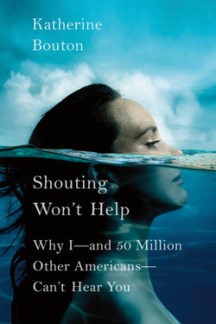
Hearing is necessary for effective listening. Thus, hearing loss is a critical issue for professions that require listening, such as lawyering. In her frank and informative book, Shouting Won’t Help: Why I–and 50 Million Other Americans–Can’t Hear You, former newspaper editor Katherine Bouton describes her struggle with hearing loss while trying to do a job comparable in many ways to lawyering.
As her hearing was declining—always in conjunction with personal stress such as her father’s death—Bouton was faced with boisterous editorial meetings and intense individual conversations. She tried to hide her deteriorating hearing for many years but ultimately began to accept help via hearing aids and other technology. Bouton tells her story in such an honest way; I can’t recommend this book enough. For further praise of the book, see Seth Horowitz’s New York Times review.
Yet hearing loss is “an invisible disability”: “There’s no white cane to signal a problem, no crutches, . . . no bandages or braces,” Bouton writes. The lack of outward signals can mask various efforts to compensate. “Most hearing-impaired people quickly learn to nod or smile or respond in a noncommittal way, taking their signal from the speaker and the people around them.” These forms of compensation are imperfect at best, as Bouton acknowledges: “I lose the train of the discussion and ask a question that was just answered. I think we’re talking about one thing when we’re talking about something completely different.” And over time, the accumulation of awkwardness can lead to isolation and withdrawal. Bouton describes how she maintains her social lifelines, yet she also decided long ago not to participate in group conversations except with her closest friends.
Shouting Won’t Help is both a personal narrative and a treatise on hearing impairment. Bouton traces her own diminished hearing and environmental aggravators—primarily, noise. She acknowledges her fear of the conditions associated with hearing loss such as depression, heart disease, insomnia, and dementia. As to dementia, the correlation maybe a side effect of social isolation or cognitive overload, or there may be a common pathology—which, to Bouton and anyone facing hearing loss, is “deeply distressing.”
Bouton’s work is a particularly helpful read for lawyers because her work as a senior editor at the New York Times had a lot in common with lawyering. She struggled in phone conversations, editorial meetings where people talked over one another, and group lunches in noisy restaurants. She missed a lot in large public events such as the Broadway plays she was assigned to cover. “I communicated with my writers as much as possible either face-to-face, where I could read their lips, or by e-mail. I e-mailed people who were ten feet away. But there were a couple of writers who wanted to talk—by phone. Often these calls would go on for a half hour or forty minutes, with me catching just as much as I needed to murmur occasionally ‘That sounds good,’ ‘Oh, I’m so sorry,’ or ‘Well, just get it to me as soon as you can.'”
As Bouton came to terms with her impairment and need for hearing aids, she began talking to some trusted former colleagues. They had noticed behaviors that could describe lawyers’ attempt to compensate as well. As one friend and colleague remarked, “’I did notice that you often held back at meetings, and didn’t necessarily engage in conversational back-and-forth after you’d given your own assessment of a piece. . . . I recognized a certain reticence in your approach to the job. I could see from your reading of our knottier science stories that your analytical gifts were considerable, and yet I sensed a reluctance to use them fully in face-to-face interactions. I attributed this reticence to temperament, or to a discomfort with the management of the magazine, or to . . . a waning of interest in the workaday routines of journalism after years in the trenches.’”
As her hearing loss became more severe, Bouton was forced to accept the loss and seek help. Her book describes many methods for addressing hearing loss, from hearing aids and cochlear implants to phone amplifiers, caption technology, and special alarm clocks that mimic the sun at dawn. Technology called hearing loops can help with otherwise incomprehensible noise in public spaces such as museums and ticket loops. Bouton worked intensively with doctors and audiologists, using virtually every technology available. Yet she also experienced rough transition with some of her hearing aids and a missed opportunity to fully adjust to the cochlear implant.
Despite aversion to being a “joiner,” she also joined the Hearing Loss Association and attended meetings, where she met new people and kept up with new technology. Although her adjustments were time-consuming and results imperfect at time, Bouton concludes the book with gratitude—both for the many advances making now a “good time to be deaf” and, on an individual level, for the “freedom of coming clean” and not having to “fake it” anymore.
Next week Listen Like a Lawyer will feature interviews with lawyers who have faced and adjusted to hearing impairment in their life and work. Please share your thoughts below or contact me at jromig@emory.edu if you would like to share your experience with hearing loss.
Conferences are a unique listening opportunity, especially for those of us who regularly stand on the speaking side of the podium. Sitting in the audience at a conference presentation lets us experience and reflect on our own listening: are we perhaps just as distracted as those we complain about when we have the podium? If we tune out for just a moment, how hard is it to reintegrate into the speaker’s flow of ideas?
Flickr/Magnus Brath
Being in the audience also gives us the social experience of listening. Listening and learning are not merely acts of individual will; our perception and comprehension are affected by the acts of those around us trying to do the same thing. There are some interesting social aspects of social listening I have learned about since starting this blog—for example, “turn sharks.”
I first read about turn sharks in Frederick Erickson’s book Talk and Social Theory. The phrase describes aggressive behavior during conversational turns—basically, interrupting someone else’s turn to speak and taking over. When there is a potential opportunity to speak, turn sharks circle the conversation opportunistically. They look for weaknesses in the speaker or pauses that would allow them to break in. If the turn shark thinks he or she can make the point better or has a related point that simply must be heard in tandem with what is being said, the shark raises a hand, uses nonverbal cues to enter the conversation, and sometimes just starts talking.
Turn sharks can be just a very strong version of what speakers want and what listeners in the audience need—that is, other actively engaged members of the audience. And a turn shark may be so aggressive because he or she really does have the most relevant or efficient thing to say. The speaker may wish to use such comments to advance the conversation.
But sometimes the turn shark begins to dominate, or to direct a conversation away from the speaker’s goals. To manage the dynamic, a speaker can try several strategies:
Demonstrate comfort with pauses and silence.
Listen receptively to each audience member’s comment, reinforcing that person’s autonomy as the speaker.
“Listen” visually by scanning the entire room to see who has a hand up, rather than opting for volunteer with the most aggressive body language.
Actively engage others in the audience by explicitly giving them a turn to speak.
Use a method such as a “talking stick” to reinforce who has the floor.
Protect audience members who have been targeted by a turn shark, returning the conversational focus back to them.
For single-session meetings such as at conferences, where the audience mixes and reconstitutes for each individual session, turn sharks may be as nomadic and unpredictable as real sharks. For ongoing social situations where the same audience comes together over time—such as, for example, in a class—conversation leaders may need to institute more structured conversational customs to let the sharks have their say while keeping others out of their jaws.
Here are a few questions for listeners and for speakers reflecting on the group dynamics when they involve the audience:
If you have been a member of an audience that included a turn shark, how did you react? How did the turn of conversation affect your listening?
If you yourself have been a turn shark, what was your motivation? How did you insert yourself into the conversation, and what was the impact on the group?
If you have led a single-session meeting that included one or more turn sharks, how did you handle the conversational flow?
If you have lead a multi-session group that included one or more turn sharks, how did you handle the conversational flow?
Many thanks to Emory Law Professor Barbara Bennett Woodhouse for feedback on this post.
January 1, 2014 will begin the sixth month of Listen Like a Lawyer’s existence. In light of this benchmark as well as peer pressure from so many other blogs’ year-end reviews, this seems like a good moment to reflect on the blog’s brief past and to anticipate its future.
I am so grateful for the support received from many sources: colleagues at Emory Law School, where I teach legal writing, research, and advocacy; and many friends and acquaintances, both lawyers and non-lawyers, who have shared valuable contacts and relevant ideas about listening. Some lawyers have been particularly generous with their time, writing guest posts and giving interviews. Some of this content has already been published, and other content is yet to be published. For all who have allowed themselves to be associated with such a new endeavor, thank you!
For encouragement on the importance of listening skills for lawyers, I am especially grateful for the exchange of ideas with Professor Tami Lefko, Director of Legal Writing at Vanderbilt Law School. Professor Lefko and I look forward to our joint presentation on listening skills at the 2014 Legal Writing Institute Biennial Conference this summer.
The actual writing of the blog has involved elements of my experience as a lawyer, professor, and journalist. But blogging is a writing genre of its own. I am grateful to lawyer and blogger Dan Schwartz at the Connecticut Employment Law Blog, Professor Tim Terrell at Emory Law School, and lawyer Bard Brockman at Bryan Cave LLP for gently encouraging me to write shorter, more focused posts. I am working on it!
Just as there has been a learning curve for writing posts, there has also been a learning curve for sharing and distributing the blog. I am grateful to all who have retweeted, liked, and commented on Listen Like a Lawyer’s content. The blog has drawn interest from several communication experts, and I look forward to exploring and sharing their ideas on the blog in the year to come.
Looking to 2014, Listen Like a Lawyer will continue to offer weekly posts and curated tweets. The mix of content will continue to attempt to balance the interests of both law students and practicing lawyers. Of interest to both audiences, the blog will feature more interviews with experienced lawyers and legal professionals.
Please share your thoughts on what you’d like to see on Listen Like a Lawyer. Thank you! And Happy New Year to all. In the New Year, may we listen intently, compassionately, efficiently, strategically, and effectively. Please add your own adverbs in the comments below.
The holiday season brings many opportunities for lawyers and legal professionals to reconnect with old friends and make new ones at holiday parties, school events, and other social gatherings. Law students may also have networking opportunities at bar events and family gatherings. Making the most of these opportunities requires good conversational skills–which require good listening skills. […]
Little books about little writing are everywhere these days. The one that I can’t put down right now is Verlyn Klinkenborg’s Several short sentences about writing. This book takes on the dogmata of writing instruction in both its substance (outlining is overrated–gasp!) and its style (poetic prose or prose-like poetry; whatever it is, it’s more fun to read than a standard “how to write better” manual).
Although Several short sentences about writing is not tailored for lawyers, a high percentage of its criticisms and advice apply to legal writing:
Sentences that are trying too hard to sound like what an expert would write? Yes, we’ve definitely got those.
Sentences with unintentional repetition and other unpleasing rhythms? Yes, got those too.
Sentences that are overly long with no good reason to be that way? Check.
The book has a particularly interesting section on the role of listening in improving one’s writing. “Read your work out loud” is not revolutionary advice, but my sense is that few people actually do it. Maybe that’s because it takes time and needs to be done right. Klinkenborg digs into why it works and how to do it:
Try reading your work aloud.
The ear is much smarter than they eye,
If only because it’s also slower
And because the eye can’t see rhythm or hear unwanted repetition.
Klinkenborg raises and dismisses a couple of reasons writers may passively resist this practice. They may do it wrong, reading like a robot and therefore revealing very little about the prose. Or they may expect too much, thinking it will erase their own knowledge as writer so they can commune directly with the reader. That is just not possible, and Klinkenborg argues for more of a middle position:
But how should you read aloud?
There’s self-awareness even in this,
A tendency to overdramatize or become self-conscious,
To read as though the words weren’t yours,
Mechanically, without listening,
As though you were somehow hiding from their sound
Or merely fulfilling a rote obligation.
Try reading the words on the page as though they were meant to be spoken plainly
To a listener who is both you and not you–
An imaginary listener seated not too far away.
That way your attention isn’t only on the words you’re reading.
it’s on the transmission of those words.
As you read aloud, catch the rhythm of the sentences without overemphasizing it.
Read so the listener can hear the shape of the syntax,
You be the listener, not another person.
You’ll be stopping often.
This idea of stopping is integral to his major theme about writing: notice things. You don’t need training in grammatical or rhetorical jargon just to notice something is or isn’t working in your sentences. Something “sounds funny.” You’ll feel a “subtle disturbance,” a “faint stirring[].” And when this happens, stop. And fix the problem.
There is a longer-term benefit to reading your work out loud as well, the book points out. Consistently reading your work out loud will “help you discern the underlying texture of your prose.” The act of reading out loud demonstrates the reader’s understanding, or lack thereof: “[h]ow well you read aloud reveals how well you understand the syntax of a sentence.” And understanding the syntax of the sentence is a key toward being able to manage the shape of future sentences you will write and edit.
Klinkenborg’s prose/poetry will be uncomfortable, at least at first, for many lawyers used to our judicial opinions and IRACs, our demand letters and our contracts. But his overall approach to writing couldn’t be more on-point to what we do:
Know what each sentence says,
What it doesn’t say,
And what it implies.
To be able to do these three things, writers need to start by just noticing what the writing is doing. Listening to the sound of your own writing is one way to notice.
Lawyers, law students, and legal professionals: have you ever read your work out loud? Why did you get started and how do you do it? Some readers may have tried this practice but stopped. Does Klinkenborg’s approach persuade you to try again? Please share your comments, experiences, and advice on reading your work out loud as a writing and editing practice.
Effective listening captures information that can’t be gotten any other way. A previous post talked about the rich information found in spoken “discourse markers” that help structure and annotate speech content. Another rich source of information is nonverbal cues. Lawyers who want to glean the most information from their communication encounters should be attuned to what a speaker’s nonverbal cues are saying.
Daniel Goleman, author of Emotional Intelligence, writes in his new book, Focus, about nonverbal cues as an element of attention:
“[A] steady stream of nonverbal exchanges rushes to and from everyone we interact with, whether in a routine hello or a tense negotiation, transmitting messages received every bit as powerfully as whatever we might be saying. Perhaps more powerfully.”
As far as the breadth of information provided, Higdon cites the following (admittedly broad) definition of nonverbal cues:
“communication by means other than words.”
This communication comes via body movements, characteristics of the voice, proximity and spacing, movement, pauses and other temporal features, and “surrounding furnishings and objects that may add to one’s identity.”
Actors work on their nonverbal communication and thus can be a good starting point for brushing up on this aspect of communication:
To see an exaggerated but charming example of nonverbal communication, follow Roger Ailes’ advice in You Are the Message: watch a tape of Angela Lansbury—with the sound turned off.
For a funny and all-too-familiar example of annoying nonverbal behavior, watch this smartphone advertisement about a date night gone awry: “Date Night.”
For lawyers, heeding nonverbal cues can enhance client communications. Heeding these cues can also provide a deeper strategic understanding for negotiations and disputes. When communication in person with clients, nonverbal cues send important signals:
Do you have the client’s attention?
Does the client understand your content?
Does the client like and trust you?
What are the client’s “pain points” with the process you are describing?
Does the client have the power or confidence to make an independent decision?
Is the client interested in continuing the conversation, or does the client want the conversation to end?
In addition to being highly informative, nonverbal communication is generally believed to be authentic—that is, “more spontaneous, harder to fake, and less likely to be manipulated,” compared to explicit verbal statements, as Higdon points out. This belief is reflected in U.S. civil procedure’s prohibition on credibility determinations at the summary judgment stage: the judge or jury at trial can see, hear, and evaluate all of the nonverbal cues that aren’t present on paper at the summary judgment stage.
So what can a lawyer do to better listen to nonverbal cues? Lawyers could benefit from watching tape of great, or even just average, lawyers in action, and focusing on these main criteria:
body language;
“paralanguage” (sounds other than language); and
appearance.
The goal of this exercise would be to focus very closely on the cues that usually seem peripheral when we think we’re listening just to content. Exercising our focus on these cues can enhance our attention to them during day-to-day interactions. Attending to the unique information in these cues can help lawyers have better conversations with clients and better understand the dynamics of in-person interactions.
Please share your experiences and advice on observing and interpreting nonverbal communication in law practice.
Spontaneous speech doesn’t fit together like Legos. Because speech reflects a sometimes messy thought process in real time, spoken transition words and phrases—what the linguists call “discourse markers”—serve a crucial purpose in conversation.
Jeneem/Flickr
Discourse markers can be as empty as “I mean,” as overused as “clearly,” or as specific as “at the end of the day.” (I had thought “at the end of the day” was just a legal/business buzzword. Apparently it formally qualifies as a discourse marker as well.)
There are different kinds of discourse markers, including those the speaker provides to structure what he or she is saying, and those the listener provides in participating in the conversation. Saying “um-hmm” to keep the conversation going is one example. This post focuses on listening to the speaker’s own discourse markers because they are tempting to disregard.
Lawyers may think that they can listen most efficiently by disregarding most discourse markers and focusing on the “real” content they are hearing. I confess to having tried this in many past conversations. But disregarding discourse markers is actually a really bad idea. They are an important source of information about the speaker’s attitude toward the conversation itself. They can:
highlight important events in a narrative;
help listeners follow a speaker’s train of thought;
help listeners recover from a “repair”; or
show the relationship between two statements.
This list is quoted from a linguistics article by Fox Tree and Schrock, Oh What a Difference an Oh Makes, found in this PDF. The article reports on language experiments with a fascinating conclusion: listeners better understood speech content when it included a discourse marker as simple and seemingly insignificant as the word “oh.” When listeners heard the same speech content without the “oh” or with just a pause where the “oh” would be, they didn’t understand the content as well.
For listeners, recognizing and showing responsiveness to a speaker’s discourse markers can build trust and move the conversation forward. Misinterpreting or entirely missing a significant marker can set the conversation back and make the speaker think less of the listener.
Many markers focus on the content of the conversation:
Signaling an important idea, such as “The key point is . . .“
Highlighting an objection, such as “Here’s the thing . . .”
Marking an attempt to end the conversation, such as “So the takeaway from all of this is . . .”
Some discourse markers seem more personal than others, and may serve as a sign of submission or authority:
Using the listener’s name, as in “Casey, . .” or “Your honor, . . .”
Phrasing the message directly and personally to the listener, such as “What I need you to understand is . . .”
And some discourse markers involve repackaging part of the conversation to relate it to a new piece of content:
Rephrasing an idea and moving into a new idea as another item in a list, such as “In addition to the time and energy it will take to litigate this issue, there are also hard costs to consider.”
Rephrasing a concern and subordinating it to a larger concern, such as “And although the timeline is challenging, it’s going to be very difficult to justify waiting any longer.”
Discourse markers are a universal trait of language in both speech and writing. Jill Ramsfield and Christopher Rideout have written about discourse markers unique to legal writing such as “whether” for introducing a traditional Question Presented. In spoken legal discourse, perhaps “your honor” in addressing a court is the most ingrained discourse marker? One of my favorite law school professors, a frequent advocate before the United States Supreme Court, described using “your honor” as a filler when she was brainstorming what to say next. Readers: please chime in with further thoughts on uniquely legal discourse markers.
What really matters for lawyers is to recognize the importance of discourse markers. Maybe a more memorable word for the practical lawyer is “signals”: discourse markers can send a *signal* about what a speaker thinks. They could signal what a client thinks is really important or when a judge is ready to move to a new argument.
Noticing these signals can increase lawyers’ effectiveness as listeners because by doing so, they will better understand the speaker’s content in the abstract as well as the structure of the content and the speaker’s attitude toward the content.
P.S. This post started as a tirade against the conversation stopper “yes, but,” which is a type of discourse marker provided by a listener in taking over the conversation. Here’s a quick summary of how “yes, but” works as an effective conversational technique: it doesn’t.
Legal interviews are infrequently recorded and rarely studied. The few empirical studies of actual legal interviews have been primarily critical of the lawyers for being too controlling, eager to impose a solution on the clients, and uninterested in the message the clients want to convey. This article presents a case study of something heretofore unavailable – an experienced, expert attorney conducting a successful initial interview with an actual client. This article uses ethnographic conversation analysis to describe the interview in terms of question form, interruptions, control of the floor, and expressions of empathy. It relies upon the insights from prior empirical studies and shows why this is an excellent interview – the client not only is heard, but feels understood, rather than “judged,” by his lawyer.






 Listen Like a Lawyer