Why I Write

Flickr/Omar Wazir
Flickr/Omar Wazir

Listen Like a Lawyer received an early birthday present: an invitation from Brian Rogers, a.k.a. the Contracts Guy, to participate in this blog hop on “why I write.” The end of Listen Like a Lawyer’s first year is the perfect time for reflection. One obvious benefit of blogging has been the chance to network with folks like Brian as well as those tagged at the end of this post for the next leg of the blog hop.

What am I working on?

I’m interested how listening can improve the work product and experience of lawyers, legal professionals, and law students. There is so much to say about it: models of listening from the communication scholarship; listening and ethics; the role of listening in various areas of practice; how listening helps marketing and networking; common listening breakdowns; specific aspects of listening as a skill; listening in the law school classroom; and so on.

Right now I’m focusing particularly on listening and summer associates, since it’s that time of year. Next I will be delving into the relationship between listening and writing, in preparation for the Legal Writing Institute’s biennial meeting in Philadelphia this summer.

How does my writing differ from others of its genre?

I aspire to the kind of writing that informs and entertains lawyers and other legal professionals as well as law students. This blog is only a year old and I’m still working on writing style and frequency of posting. Where my writing differs is in its specific focus on listening.

Listening plays a big role in professional success as a lawyer, yet the value and methods of listening don’t seem to get much attention in books, articles, and online content — at least when compared with the attention given to speaking and writing. Some excellent law review articles have been written about listening, and my friend Professor Tami Lefko is now writing about listening as well. Through researching the blog I have found some wonderful resources, many of which are listed in the Resources section of Listen Like a Lawyer. I’m also grateful for the guest speakers and writers (here and here) who have already contributed their thoughts. Lawyers’ enthusiastic response when they hear about Listen Like a Lawyer tells me that there is an appetite and a need for more.

Why do I write what I write?

My main goal and the biggest reason I write is a substantive one: to explore the topic of listening. From my experience as a journalist and practicing lawyer, I remember many professional successes based on part of good listening:

  • taking extensive notes on an interview, adaptable for sharing with others, with key phrases in quotations
  • observing witnesses’ revealing facial expressions and body language during depositions
  • participating in mediations and motions practice where the key to success was to “quit while you’re ahead”

And of course less successful moments where I could have listened better:

  • not picking up on what made a client angry about his situation and then ham-handedly repeating the trigger
  • interrupting a partner during lunch with a client
  • not differentiating when senior attorneys were loosely brainstorming versus when they were identifying their core strategies and priorities

I could also remember the satisfaction of working with senior attorneys who engaged with conversation with me as a junior attorney — as well as the frustration of meetings with certain senior attorneys during which their eyes would wander towards Microsoft Outlook. Was I talking too long or about the wrong things? Did they have urgent client business necessitating absolute e-mail vigilance? Or were they just addicted to their e-mail? Yes, yes, and yes. These questions are even more valid, and these tensions even more present, in today’s device-laden legal workplace.

Since leaving practice and over the past 13 years teaching legal writing, it has become apparent to me that part of students’ performance in law school is affected by their underlying skill at listening. Better listeners understand more information, catch its context, prioritize it better, and ask better questions. They also “read people” better and understand speakers’ attitudes toward their own statements with more subtlety. Thus they are more prepared for clinics, externships, and law practice.

In contrast, truly bad listeners — and most people aren’t this terrible, but here’s a worst-case scenario — don’t get all the information they need, don’t understand people’s reactions to events, don’t ask good questions, and come across as ineffectual or even rude.

And those are just the outward aspects of listening. There is also the inward aspect of effectively listening to oneself, which is closely related to emotional intelligence. Being able to hear — and manage — one’s inner voice is so important to lawyers and law students’ resilience and professional satisfaction.

On a selfish note, I write because I like to. Writing teachers think about writing so very much but often struggle for time to do their own writing. Starting a blog was a public commitment to write, kind of like signing up for a gym membership — and then posting about it on social media — as motivation to work out. So far it has been a good experience.

How does my process work?

I keep a file of ideas in Evernote, drawn from Twitter, Zite, and other sources. I have a large stack of textbooks, trade books, scholarship, and other sources that I refer to for questions and explore as time allows. I tend to write groups of several posts at a time, saving drafts and then coming back later to revise before publication.

Some posts draw more on my journalism background, like these profiles of lawyers dealing with hearing loss. Other posts are more scholarly in nature, like this exploration of cognitive bias. And sometimes I just try to be creative, like this “Tabata workout” for listening.

Please check out my blogging friends:

For the next leg of this blog hop, I’m highlighting three blogs, all by lawyers:

Lady (Legal) Writer is written by Megan Boyd, an adjunct professor of advanced legal writing at Mercer Law. Megan is smart and funny, and has fun with legal writing. Her blog shows it.

Dogs Don’t Eat Pizza is written by Karen Cooper, a lawyer and fantastic writer who is channeling her passion into the Do It Yourself community. Karen can choose a great paint chip just as easily as she chooses between “IRAC,” “TREAC,” and “CREAC.”

Connecticut Employment Lawyer is written by Daniel Schwartz. I don’t know a lot about Connecticut law, but I do know something about good writing. Exhibit A is anything Dan Schwartz writes. Twitter’s suggested follows led me to his blog, and his work impressed me so much that I asked him to for advice on some early posts from Listen Like a Lawyer. He took the time to read them and make suggestions — proving he’s a nice guy, too.




Checklists for listening

The checklist is a surprisingly simple yet effective tool for improving performance in fields from aviation to construction to medicine to law. Checklists help professionals catch what Dr. Atul Gawande, the chief evangelist of checklists in the workplace, calls “the stupid stuff.”

Flickr/AJ Cann
Flickr/AJ Cann

Checklists also assist with collaborative work on large, complex projects. Complex challenges may not have a right answer, but project-management-style checklists help teams communicate and collaborate efficiently to handle uncertainty and forge a path forward.

I’ve written about how checklists help legal writers (here and here and here). Professor Kathleen Elliot Vinson of Suffolk Law developed an iPhone app with legal writing checklists (reviewed by Bob Ambrogi here). Checklists can help lawyers and law students listen more effectively as well.

For example, a listening checklist should be very useful for face-to-face meetings to discuss a new assignment. During a face-to-face meeting, forgetting to talk about a key topic would fall under Gawande’s definition of “stupid stuff.” Running down the checklist at the end of a meeting can help ensure key topics are covered. This process minimizes inefficient interruptions and follow-ups later. It also maximizes the value of the initial face-to-face time. Click here for a sample checklist for summer associates and legal interns.

Listening checklists could also be useful for client intake meetings, prep sessions such as deposition or mediation prep, feedback on assignments, and so on. Checklists for lawyering tasks are not a novel idea, which raises the question: is a “listening checklist” really that different from a regular checklist of relevant tasks?

Just as a pilot has numerous checklists in the flight manual for a variety of scenarios, a lawyer may have a listening checklist for handling meetings and a different kind of checklist for preparing an SEC filing, for example. The categorical name of the checklist doesn’t matter, buGawande’s great work on checklists, The Checklist Manifesto, teaches that a long, cumbersome, everything-but-the-kitchen-sink checklist is not a particularly good one. Any clear checklist that encourages efficient, effective communication is a valuable checklist for lawyers.

Thanks to Professor Tami Lefko for feedback on this post.

For law students: summer evaluations and listening

Name a skill that summer employers may or may not evaluate directly, but that can enhance performance on every skill they do evaluate.

Yes, it’s listening.

Most obviously, listening is relevant to the soft skills most employers are likely to evaluate. But listening also influences “harder” skills such as research and writing. And listening is certainly an aspect of a law student’s overall potential as a lawyer.

Soft skills

Soft skills are basically anything associated with the cluster of personality traits, social graces, communication, language, personal habits, friendliness, and optimism that characterize relationships with other people.”  Legal employers may evaluate soft skills in categories such as professionalism, courtesy, and general presence, just to name a few. Here are some examples of listening behaviors that may lead to strong evaluations of soft skills:

  • Never looking at your phone while talking with another attorney or client without a convincing explanation (e.g., “Excuse me for one moment. I’m waiting for partner x to let me know if I can attend the deposition right after this lunch.”)
  • Strong listening during any opportunities to observe events such as mediations and depositions (e.g. asking a senior attorney afterwards, “I noticed that the witness kept qualifying her statements with the words ‘as I sit here.’ Does that language mean something specific?”)
  • Active listening during lunch with a mentor (E.g., “You mentioned that your first year in practice was really challenging. What was hard for you?”)
  • Respectful behavior and body language during the evaluation process, especially with any constructive criticisms (e.g. keeping arms gently resting in one’s lap during a discussion of how an assignment could have been stronger)

Hard skills

Listening indirectly influences performance of hard skills such as fact-gathering and research and writing. Here are some examples of listening behaviors that may lead to strong evaluations of hard skills:

  • Noticing and asking about important information that a supervising attorney forgot to mention, such as the desired format for an assignment
  • Discerning what an assigning attorney’s word choice indicates about whether he or she thinks the assignment should be relatively easy or hard
  • Taking notes effectively during a meeting so that follow-up questions are kept to a minimum
  • Observing and understanding a fact witness’s body language and asking questions that follow up on an area where the witness may be hesitant to share information

Lawyering potential

Professors Marjorie Schultz and Sheldon Zedeck have generated a list of 26 “lawyering effectiveness” factors. These factors provide a useful outline of what makes a lawyer effective; thus, law students who show potential in these areas are showing potential to be an effective practicing lawyer. Listening is explicitly listed under the “communications” category, and it indirectly influences many others. Showing effective listening is thus likely to positively influence the overall evaluation of a law student’s potential as a lawyer.


A high-intensity listening workout

image
Courtesy Luke Lawreszuk/sprayedout.com

Tabata workouts — very short, incredibly intense workouts — are all the rage right now. In classic form, a Tabata workout is 20 seconds of high intensity work followed by 10 seconds off, repeated 8 times. The formula came exercise-science professor Izumi Tabata’s work with the Japanese speed-skating team. While an amateur athlete’s Tabata workout really doesn’t need to use this exact formula, what it does require is very intense bursts of physical activity and relatively shorter rests, repeatedly. The major benefit and the reason people are so excited is the excellent physiological results from these relatively short workouts.

Could there be such a thing as a Tabata workout for listening? In the spirit of exercise, here is a thought exercise on what such a listening workout might look like. The benefits are enticing: becoming a better listener through short intense practices rather than a long, slogging, perhaps inefficient effort.

Applying the methodology first requires some goal-setting. Intensely practicing the wrong thing doesn’t help. So here are a few thoughts on what a hypothetical Tabata workout might look like for lawyers, or any professional interested in an intense listening workout.

The “workout” below comprises five segments, with ten intense minutes per segment, to target some tough aspects of listening. If the average attention span is five minutes (and that is a 2013 number so perhaps too high), then these ten-minute segments really are intense, especially if done sequentially with breaks for an approximately one-hour workout. Thoughts on other, better “Tabata listening” segments are certainly welcome in the comments or by e-mail.

1. Being present

To do this segment, you need an in-person conversation partner to talk in detail about a topic for ten uninterrupted minutes. If you want to really “feel the burn” in this workout, the topic should be something you aren’t actually interested in, perhaps an esoteric hobby or ERISA (apologies to ERISA lawyers). Tell your conversation partner the premise and ask him or her to talk, talk, talk for those ten solid minutes.

Put away phone, pen, paper, and any other distractions. Maintain a comfortable level of eye contact. You’re not trying to remember what the person is saying, help the person, or chime in with your story. It is unfriendly and essentially impossible to use no body language at all, but try not to interject even with encouraging sounds like “um-hmm.”

The only two requirements are being present in the conversation, and making the conversation partner know you are present. If that person is distracted by you or thinks you are distracted, you failed. Start the segment over.

2. Remembering

This next segment engages the memory aspect of listening. Many models of listening such as Professor Judi Brownell’s HURIER model emphasize “remembering” as an integral part of effective listening. Think of Dorrie in the movie Finding Nemo: great person (if a person were an animated blue fish), but not a great listener (due to her lack of short-term memory).

The point of this segment is to strengthen your memory circuits when listening. You need something to listen to for another ten minutes. It could be live or recorded such as a TED talk, CLE webcast, or YouTube clip. During the ten minutes, listen intensely. Take no notes.

And then, as soon as time is up, write down everything you can remember from what you just heard, as close to verbatim as you can. Don’t delve into your own reactions or interpretations; those are not the right kind of memories for these purposes. In fact, responding with one’s own reaction may disguise poor listening caused by lack of attention or memory.

This is an exercise where the 20-10 Tabata proportion could be quite useful: After the ten minutes of talk time, spend a full five minutes trying to remember and write down what was said. Don’t do anything else during that five minutes even if you’re sure you’ve remembered everything you can possibly remember. Giving up too soon would shortchange the workout.

3. Active listening

The hallmark of active listening is accurately paraphrasing back the statements of your conversation partner to demonstrate that you are listening. For this segment, ask a conversation partner to talk for ten minutes about a topic of interest and to intentionally pause at natural stopping points. At each pause, paraphrase back what you just learned. Then add a simple encouraging cue such as “Go on.”

Even if you aren’t interested in the topic or have the most amazingly relevant story to share about what he or she just said, don’t do anything but paraphrase back and cue the conversation partner to keep speaking. At the end, ask that person for feedback, particularly whether he or she felt that you understood the information accurately.

4. Listening to a jerk

Many lawyers participate in conversations where the other person’s statements are wrong, misleading, frustrating, seemingly disingenuous, and perhaps even dangerous. Listening effectively while angry is one of the hardest things to do. Thus it is perfect for a Tabata workout.

Find a friend with whom you strongly disagree on a topic. Ask the friend, for purposes of this segment, to discuss that topic in very strong terms for ten minutes. Ideally the discussion will involve over-the-top statements and some ad hominem attacks.

The listening challenge is to steady yourself. Breathe. Hold your body language in place and try to keep it receptive to the conversation. Maintain eye contact and try not to use negative facial expressions such as pursed lips.

And use the same active-listening techniques practiced in the prior workout. That means rephrasing what you are hearing. Even if you disagree. Even if it’s a personal attack. Even if you would never voluntarily paraphrase such a thing in a litigation setting because of the transcript. The idea here is stressing the listening and emotional circuits to strengthen them.

5. Listening to yourself

You don’t need a conversation partner for this one. Sit quietly and comfortably with no distractions. Just listen to yourself for ten minutes. What thoughts and feelings you experiencing? Don’t stop and make a note. Just try to stay in tune with your own inner dialogue.

This is a form of mindfulness meditation. Jeena Cho and others are doing amazing work in promoting mindfulness among lawyers. Seeking constant input and distractions may serve as a kind of dopamine loop or numbing behavior, and therefore being mindful may be the most difficult workout of all. In fact, Jeena’s interview with Chris Bradley of the Lawyerist makes the same workout analogy suggested here: “Just like you can practice running a marathon by regularly running, you can build up your mental resilience by having a regular meditation practice.”

Conclusion: Physiologically and psychologically, real Tabata workouts work because they are intense. With this proposed “Tabata workout for listening,” your ears won’t be sore, but your brain may be exhausted — as well as stronger and more resilient for your next real-world listening challenge.

Listening and the art of the “callback”

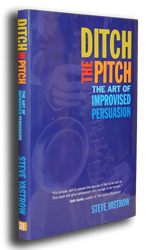
What do oral argument, marketing pitches, and improvisational theater have in common? This blog previously reviewed Steve Yastrow’s informative and entertaining book, Ditch the Pitch: The Art of Improvised Persuasion, and addressed how some of Yastrow’s recommended approaches could apply in the oral-argument setting.

444166694_bd13e2fa7f_b
Philip Larson/Flickr

Some of these applications may be unexpected — but one particular tactic is something skilled oral advocates have been doing from time immemorial: the “callback,” or referring to something someone said earlier.

“Calling back,” or referring to a judge’s earlier question or comment is a classic tactic for oral argument, although lawyers don’t tend to use the term“callback” in this context. Whatever you call it, Yastrow’s explanations for why it works so well in business translate fairly well to the oral-argument context as well. (And apart from oral argument, the approaches in Ditch the Pitch certainly deserve consideration by lawyers developing their marketing pitches conversations.)

Callbacks demonstrate listening. And listening generates rewards, Yastrow writes, namely the rewards of your audience’s attention and interest.

Callbacks also help the audience understand the conversation. They make it more coherent: “[A] callback ties material together, making it easier to understand and engage with that material,” Yastrow writes. When the information is easier to understand, it feels more cohesive and resonant. It’s more believable.

Most subtly, callbacks involve the audience. In improvisational theater, callbacks help make the audience feel that they are “in on the joke.” They are “with” the cast and not part of the audience. Similarly, using a callback in oral argument involves the judge in the argument as more than a passive listener. When done right, mentioning a judge’s earlier comment or question can subtly suggest that the judge has already begin to take a few steps down the road toward accepting a certain position.

Yastrow’s advice for executing a callback strategy is helpful for oral advocates (and legal marketers) as well. The three basic steps, he writes, are discovering the opportunity for a callback, remembering it, and integrating it into the conversation.

Discovering the opportunity for a callback means being alert. Notice things that are important to the audience. Try to make a mental (or actual) list of “Things That Matter” to the audience. Advocates can prime themselves to be alert by their usual preparation steps such as studying precedent and the particular judges’ prior rulings. During the argument, advocates would certainly want to make a note of the dominant topics, i.e. Things That Matter to the judges.

Remembering the opportunity can be difficult because of the need to be engaged in the conversation itself. This is exceptionally true in oral argument, where time seems to distort itself and nerves interfere with simple tasks like taking a drink of water. (Anyone remember Tom Cruise struggling to take a sip in A Few Good Men?)

Yastrow recommends attaching visual images to the comments to help with recall. For example in a trade secrets case, if the judge asks whether other employees had access to the alleged trade secret, an advocate might visualize a large company meeting with all employees sitting in an auditorium, and the trade secret sitting on a platform on stage. This visual technique may sound a bit kooky, and it is explained fully in a very kooky and wonderful book, Moonwalking with Einstein by Joshua Foer. As Yastrow shows, it works in serious business situations. And it will work in oral argument as well. (Lawyers and law students, have you tried this?)

Lastly, the callback must be integrated into the conversation. There’s a ham-handed way to do this and an effective way. “Play it cool,” Yastrow advises; don’t say, “Hey, look at me, aren’t I clever, I just came up with a callback!” For advocates, one risk is over-playing their hand. Presenting the callback as a “gotcha” to the judge is probably worse than doing no callback at all.

To be effective, the callback must naturally fit in with the conversation itself. And that requires an overall mindset of alertness to the audience’s interests and needs, as well as a willingness to take the risk of improvising.

Bad listening is stronger than good

What’s more productive: targeting problems or building on strengths? Robert Sutton wrote in the Harvard Business Review Blog that “Bad Is Stronger Than Good.” This essentially means that eliminating the bad in the workplace – performance obstacles, bullying behavior, and even toxic people – is more effective than recognizing positive accomplishments and helping employees build on their strengths. Sutton’s post recounts the work of psychologists such as Roy Baumeister: “a huge pile of peer-reviewed studies” show that “negative information, experiences, and people have far deeper impact than positive ones.”

2234047558_020b8447ce_z
Courtesy Jes/Flickr

Under this reasoning, eliminating bad listening habits should be more of a priority than celebrating the most enlightened listening practices. Damage done to team and client relations by bad listening is more significant than the benefits of recognizing and promoting listening excellence.

Thus perhaps this blog should use more scare tactics: 10 Ways to Fail as a Listener, and Therefore as a Lawyer?  5 Listening Mistakes No Decent Lawyer Should Make?

Although these titles are a bit dramatic, they do lead to an important and somewhat fun question: What actually *are* the worst listening practices?

Here are my opening nominations for the three worst. Please feel free to use the comments for sharing your own thoughts on lawyers’ worst listening practices.

1. Looking at one’s smartphone while supposedly listening.

I recently heard two complementary stories about how smartphones affect listening. In the first story, an interviewee checked his phone during the interview. The interviewer couldn’t help but wonder: “What’s so important that you need to look at your phone during my interview with you?”

In the second story, a law firm won a client’s business partly because none of the 20 firm lawyers in the room looked at a smartphone during their lengthy presentation to the client. The client expressed astonishment at the focused attention and lack of distraction in the room during that presentation.

2. Appearing to listen, then sending a confirmatory e-mail that is misleadingly incomplete or biased

Effective listening is a great way of building trust. That trust is broken when an ostensibly good listener follows up with a disappointingly incomplete recounting of the conversation. Or worse, a biased and self-serving recounting.

3. Listening with intent to start speaking at the first opportunity

In a scene from Pulp Fiction, Uma Thurman’s character asks John Travolta: “Do you listen or just wait to talk?” He says, “I wait to talk, but I’m trying to listen.” Several people have brought this scene to my attention since I started Listen Like a Lawyer. It is so memorable because it rings so true with people’s experience of frustrating conversations.

Negativity can be so . . . well, negative. Yet the idea that “bad is stronger than good” suggests that the most productive way for people and organizations to be better at listening is to stop being so bad at listening. 

Listen Like a Lawyer is grateful to Matt Homann for tweeting a link to Sutton’s post. Thanks to Matt for passing along another thought-provoking article with implications for listening.


Rules for listening

Every law student learns about default rules in contract law. A recent post from Matt Homann at the [non]billable hour shows how default rules can affect communication as well.

Here’s the scenario: A team (lawyer-to-lawyer or lawyer-to-client) meets to discuss a matter. After the meeting, “everyone seems to reach consensus on what to do next.” But later, it becomes painfully apparent that “some didn’t agree at all.”

Homann suggests the problem may be the way the team leader interprets silence.  If the leader assumes from silence that the client understands and agrees with everything just discussed, that leader may be in the midst of a real communication breakdown. Silence may and often does mean something very different: resigned acceptance, covert resistance, simmering resentment — or just lack of understanding.

The problem is that a default rule of interpreting silence as acceptance/agreement is often inaccurate. In law-and-economics terms, applying this rule leads to suboptimal outcomes. (Economics experts – please don’t get technical here. This is a loose metaphor.)

So instead of assuming that silence means agreement, Homann suggests the opposite. At the end of a meeting, ask everyone if they agree. In the absence of explicit verbal affirmation, assume they do not agree. Homann draws from Patrick Lencioni’s book The Advantage to suggest this method for both internal meetings and client meetings. The safest and best interpretation of silence is, as Homann writes, that silence means “no.”

What I particularly like about Homann’s post is that it shows a specific listening breakdown and a technique for addressing that breakdown. Listening is not a monolithic, intuitive talent that one is either good or bad at, forever. By studying listening successes and failures, we can derive and apply specific methods to improve.

For lawyers working in teams, what methods do you use to listen effectively in meetings? What about working with clients — how do you handle a client that doesn’t say much in a meeting?

Embracing interruptions

One of the rewarding aspects of starting this blog has been the opportunity to challenge preconceived notions about listening — both my own and others. This recent post from the Harvard Business Review, “Turn Your Next Interruption into an Opportunity,” is a great example of such a challenge.

The preconceived notion is that interruptions interfere with real work. The author, Douglas Conant, takes a more positive spin on interruptions: “Every ‘interruption’ offers an opportunity to lead impactfully, to set expectations, bring clarity to an issue, or infuse a problem with energy and insight.”

But he doesn’t stop there. More radically, “these thousands of little interruptions aren’t keeping you from the work, they are the work.” Conant encourages leaders to affirmatively seek out interruptions and to engage with both the issues they raise as well as the relationship dynamics they reveal.

Lawyers: can you embrace this positive spin on interruptions? How do you cope with interruptions?


Oral argument as an improvised conversation

Oral argument — is it really a “conversation”? How can it be an authentic conversation when the power dynamics are so skewed toward the judges and when the attorney is ethically bound to advocate for the client? A recent incident with Judge Richard Posner is just one example of the inherent challenges of oral argument. Advocates may err on the side of scripted arguments and default answer structures as defense mechanisms to survive in this environment. Conversely, great advocates argue with flexibility, maintaining their basic persuasive agenda but effectively listening and responding to the judges’ questions.

I was thinking of the challenges of oral argument when I came across about a new book, Ditch the Pitch: The Art of Improvised Persuasion by Steve Yastrow (SelectBooks 2014).

ditch-the-pitch-cover-150

Yastrow seeks to replace the scripted, one-size-fits all business “pitch” with the art of “improvised persuasion.” This book is most directly relevant to lawyers interested in marketing, and I highly recommend it for that reason. But for this post, the focus is on making oral argument more responsive and conversational using Yastrow’s improvisational techniques. The rest of the post substitutes [advocates] for salespeople, and [judges] for customers.

The basic truth is harsh and hard to accept. Yastrow begins by attacking the belief that anyone — customer, judge, anyone at all — is actually interested in someone else’s scripted pitch/argument.

“[H]ere’s the unadorned truth: Your [judge] doesn’t really care what you have to say about yourself or what you are trying to [argue.] Your story is not all that interesting to him. He cares much more about his own story.” 

This underlying lack of interest (in what the advocate has to say) informs everything else Yastrow recommends:

“The first thing you have to do if you want [judges] to listen to you, is to earn the right to be heard. Contrary to the most fundamental beliefs about [advocacy], you do not earn the right to be heard just be delivering the right message to the right [judge] at the right time. You earn the right to be heard once you have engaged your [judge] in a dialogue that is meaningful to him.”

Conversations that are meaningful to the other person (the customer or judge) arise out of a “diagnostic” mindset. This means finding out what the other conversation partner wants, needs, and is concerned about. A diagnostic conversation stands in opposition to a prescriptive conversation where you just tell the other person what he or she needs. (This would be oral arguments consisting entirely of scripted arguments and scripted answers to questions.)

How does one create a diagnostic conversation? An advocate cannot turn the table on a panel of judges and say, “Your honors, I’d like to start by learning more about your needs in handling the challenges of deciding this case. What are your sticking points with my client’s position?” But advocates *can* use oral argument as the opportunity to learn how the judges are thinking about the case.

In this sense, many techniques from the book seem applicable:

  • “Think input before output.” Perceive and comprehend the input conveyed through the judges’ questions and even at times their facial expressions and body language.
  • “Say less to notice more.” Speak slowly enough that judges have a chance to think and ask questions as they arise. Make points thoroughly but concisely.
  • “Turn down your analytic brain.” This doesn’t mean abandoning legal analysis. It means trying to turn down the overly critical self-judging that comes from worrying about how things are going as they happen. If an advocate is berating him- or herself for bungling a question, the advocate is not open to the new cues being offered and how to keep the focus on the judges’ needs.
  • “Listen for the game.” Oral argument isn’t a game, but this language, drawn from theater improvisation, means finding the common ground of the improvised conversation: “What are we really doing? What are we really talking about? What’s going on here?” If an advocate is emphasizing the substantive legal question but the judges are asking technical questions about procedure or the effect on future cases, then there is no common ground — and no shared game to play.
  • “Ensure your [judge] keeps saying yes.” In Yastrow’s words, “If your [judge] says ‘no’ to something you say or disagrees with a statement you make, you will immediately feel the conversation stall.” Indeed. To try to minimize these stalled moments, focus on areas of “mutual affirmation and agreement.” It seems that mutual agreement may come many sources: taking reasonable positions that the court might actually adopt; using binding precedent in skillful way; invoking shared understandings such as canons of construction; and possibly invoking shared imagery that is meaningful to the court.

And one final interesting approach: “Keep 95 percent of the conversation about the [judge].” When selling, Yastrow continually monitors his own performance in the conversation and asks, “Are we still talking about them?” Phrased in terms of oral argument, “[the judge] wants to hear about himself. If you notice that the conversation is about you, change it! Focus the conversation on your [judge].

There are some other interesting points from the book to be explored in later posts, but let me end this post on the 95 percent point. How can advocates actually advocate for their clients while also keeping 95 percent of the focus on the judges? I have a few ideas, such as highlighting what the opinion will mean for the court as precedent going forward. What do you think? For oral advocates, have you explicitly tried to keep the focus on the court, and if so — how?

And more generally: does the analogy of a sales pitch correspond to oral argument? How can advocates listen and improvise more effectively at oral argument?


Listening to your 1L voice

Listen Like a Lawyer has been on hiatus during a busy time for first-year legal writing students and professors. As the students wrote and finalized their first appellate briefs, I located my own old 1L appellate brief. Even without the 1996 date, the blue paper and Courier font are like a voice from the past.

photo-5

Maybe this “voice” should really be “voices”: I can hear the words of my professor in sentences that I never would have written on my own. For example: “The district court’s ruling can be comfortably affirmed under the first or third parts of the test.” What 1L comes up with the words “comfortably affirmed”? Also any use of the Code of Federal Regulations was purely a product of what she told the class to do. I had no idea what I was doing.

And that leads to another voice: the voice of doubt. When in doubt, many people return to their comfort zone. For me, the comfort zone was description–basically, just summarizing the facts and holdings of cases. Several sequences of paragraphs consist of nothing more than “In one case, xyz happened. . . . In another case, abc happened . . . .” This brief was guilty of the incredibly common 1L mistake of the “book report,” as described by Kristen Tiscione in her article on classical rhetoric, Paradigm Lost: Recapturing Classical Rhetoric to Validate Legal Reasoning. Yes, those paragraphs should have had stronger topic sentences developing an actual legal standard. In “listening” to it now, I can hear the voice of a 1L who was just not sure what to say.

Although there is much to criticize and pity in the brief, there are also moments of confidence. Good writing often corresponds with appealing rhythm and pace–features that one can hear when reading sentences out loud. In describing the client, who had been fired due to tobacco addiction and possibly his age as well, the brief juxtaposed his seniority against what the CEO wanted: “[The plaintiff’s] age and his advanced career actually hinder him; companies want ‘new blood that will stay forever.’ (R. 18).” The brief even reached for a figure of speech: “HIs tobacco addiction resulted in the Defendant’s firing him and the doors of the biotechnology market simultaneously shutting in his face throughout New England.” There is no doubt I stated these words — verbatim — at my 1L oral argument.

Legal writing scholars debate the existence of “voice” in legal writing. As Chris Rideout has written, legal writing has a “professional voice” but not so much a “personal voice.”  Legal writing professors walk the fine line of trying to teach the professional voice while not crushing the personal.

Perhaps the voice of legal writing occupies a middle ground, as Rideout suggests: the voice comes from a “discoursal self” that performs a discourse tradition in its own way in that context, at that moment. The appellate brief, for example, embodies a certain tradition, yet the brief-writer has the opportunity to contribute to and even change the tradition in performing it.

And my old brief was certainly a performance. The words reflect the very personal effort of a fledging grownup, trying on and testing out the professional voice of a lawyer. My actual voice as a 1L probably sounded a lot like it does now, because the human voice remains relatively stable from age 20 to 60. But my “voice” as a writer and a lawyer has developed so much since that 1L brief, with one of the most obvious improvements being stronger topic sentences. They could hardly have been worse.

And now from the past to the future. Law students: Without falling victim to hoarding, maybe you should print out a hard copy of your 1L brief. Who knows whether your memory sticks and cloud servers will still be easily accessible 20 years from now? And consider saving your actual voice as well. What about doing a video time capsule to yourself? Tell your future self what you’re doing. Talk about the law generally, or describe your most recent writing project or your favorite class. Show the way you think. Use an app such as SpeakingPhoto to narrate what you were thinking when a particularly photo (yes, even a selfie!) was taken. Your future self will likely appreciate the chance to hear your voice when you were just a “baby lawyer.”

And experienced lawyers: maybe find a way to “listen” to the young lawyer and law student you used to be. Dig up some old work or find an old tape from a trial-advocacy class. Naive? Cynical? Confident? Scared? Yes, yes, yes, and yes. Sometimes it’s enlightening to listen to your own voice.

The author dedicates this post to Stephanie Feldman-Aleong, a former colleague at Emory Law School and professor at Nova Southeastern, who passed away in 2008. Stephanie inspired me in many ways such as by sharing her own 1L work with students.

Thanks to Beth Wilensky of the University of Michigan Law School for comments on an earlier draft of this post.