Speed of speech < speed of thought

You could certainly accuse this blog of idealism about listening. In contrast to e-mail, for example, just go and talk to the person. Through listening to their words and observing their body language, you can pick up so much more subtle and complete information: How do they feel about the subject? What are their expectations and how can you adjust your own work in light of those expectations? How important is this to them, anyway?

The downside of all that additional information you get from listening is . . . all that additional information you get from listening. People speak at about 140-180 words per minute, but on average, a listener can comprehend about 400 words per minute. Different sources offer slightly different numbers, but a common thread runs across all version of this statistic: the listener thinks faster than the speaker thinks.

That “thought-speech differential” or “listening gap” means the brain has extra capacity and WILL process information using that extra capacity. For example, the listener can process lots of non-verbal cues. Great listeners will observe such cues and use them to guide the conversation to fit their communication goals.

But the difference in how fast people talk and how fast they listen also creates the opportunity for the brain’s cognitive biases to operate and shape how the listener’s perception. I have previously written about some of the cognitive biases that may arise in particular when listening is involved. See Listen Like a Lawyer blog posts here and here and here covering cognitive biases such as the well-known confirmation bias.

To use Daniel Kahneman’s framework, the difference between the speed of thought and speed of speech is a space where “System 1” can roam. System 1 is the automatic, always-on system and also the one with all the cognitive biases (in lay terms, mental shortcuts). The more thoughtful “System 2” is where you find the careful “thinking slow” of his great book’s title, Thinking, Fast and Slow.

Whatever the task, the most effective communicators are able to use the speech/thought differential for custom listening, not listening fueled by standard cognitive biases based on the Kahneman formula “WYSIATI”—What You See Is All There Is. Effective listeners are able to suss out what is not happening, and what they need to ask.  Effective lawyers in particular will use their excess cognitive capacity to both attend to non-verbal cues and how the speaker presents, while also ignoring the cues and presentation to focus on the information and what else they need to know. As with all other lawyering skills, the most effective lawyer-listeners perform the task in a way that is both standardized to what they need to know and do as well as customized to the particular situation including strictly relevant facts and all the other seemingly irrelevant but highly important background and emotional factors affecting the communication experience.


Note: The original version of this post cited to sources no longer available, an article by Rita Hedley on Medium, and Ken Grady’s project for Seyfarth Shaw at Seytlines. Ken now teaches at Michigan State and writes on Medium here.


Being “judgeable” is a good thing, mostly

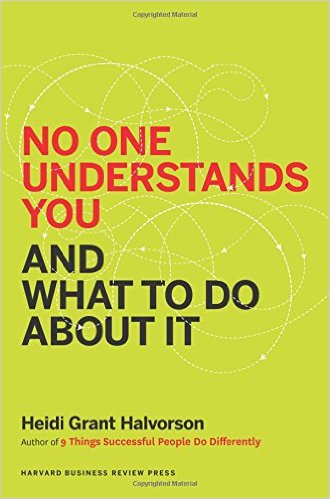
Listen Like a Lawyer previously reviewed Heidi Grant Halvorson’s No One Understands You and What to Do About It. The review (and much of the book) focused on understanding how you are perceived, to have a more accurate effect on others. Accurate in this sense means you are perceived the way you intend to be perceived. It’s a pragmatic concern about how to interact with the world so as to be effective. The portions of the book about trust, power, and ego should be highly relevant to any lawyer working in a group.

What I didn’t talk about enough in the original review, and want to talk about now, is a deeper and more personal aspect of the book: the concept of being “judgeable.” Different people are stronger and weaker at being judgeable. What it means is expressing yourself so that others can perceive you more accurately:

It is definitely better to be judgeable—to have others read you easily and accurately. Research consistently shows that people who are more judgeable are psychologically better adjusted—they are happier; are more satisfied with their personal and professional lives; have more lasting, positive relationships; and have a greater sense of purpose. They feel able to live more authentically and are more confident in their self-knowledge. This makes a lot of sense.  . . . Life is simply easier and more rewarding when people “get you” and provide you with the opportunities and support that are a good fit for you.

Halvorson mentions a connection between being judgeable and living authentically. Within the context of a book all about thinking about how others perceive you, I found that a bit counter-intuitive at first. Before reading No One Understands You, I might have naively described authenticity like this: Proclaim you are living authentically and then stop caring about what other people think; you’re now living authentically and people need to accept you as you are. If they don’t understand you the way you like to express yourself, that’s their problem. You shouldn’t do anything about it because to do so would be compromising your authenticity.

(It should be obvious I hadn’t read very much on authenticity up to this point.) 

In fact, the book implies that living authentically means caring more about what other people think. Thinking about how trust, power, and ego may affect the way others are interacting allows a person to adjust to those distortions. By understanding the perception of others and trying to shape their perception toward what is really intended, a person can become more judgeable. This in turn helps them find the right social and professional fit for their skills and personality, which bears an obvious connection to living and working authentically.

In the professional world, we all know there are times when professionals—including but not limited to lawyers—need to make themselves less judgeable. Masking one’s motives in a negotiation, for example, could be an important skill. Projecting confidence when you are feeling dread seems like a good tool for any trial lawyer.

But negotiating and trying cases call for different skills than effectively managing a team. No One Understands You  is a business book, and Halvorson’s main audience is business leaders. For leaders, coming across to others as they intend helps with both communication and motivation. Thus lawyers interested in leadership and retention would do well to check out No One Understands You. 

So would lawyers who are interested in authenticity on a more individual basis. I had never heard the word “Judgeable” used in this context, and to be honest, the spelling with that “e” in the middle of “judgeable” still makes me cringe a little bit. (Too many years of highlighting “summary judgement” in commenting on legal writing.)

The concept of being judgeable, however, makes a lot of sense, both personally and professionally.

Listening analytics?

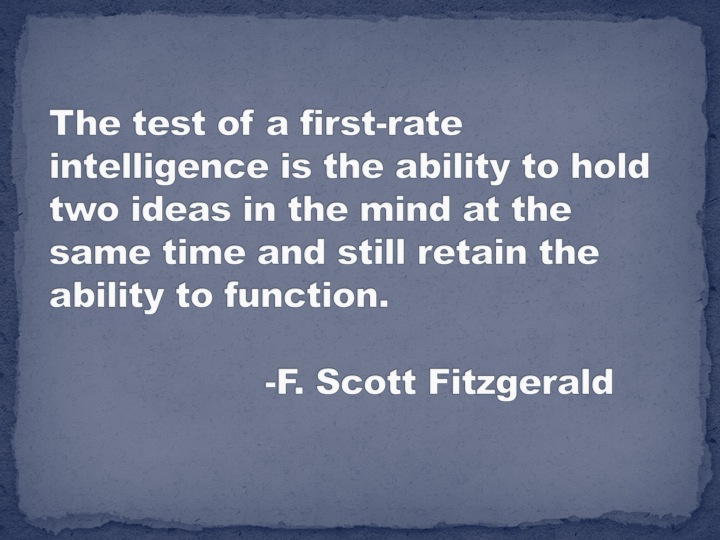
One of my favorite sayings is from F. Scott Fitzgerald:

Slide1

Kenneth Grady’s Seytlines blog is an exercise in what Fitzgerald meant. In Grady’s essays on innovation in the legal industry—what it needs and where it is stagnating—human skills including “soft skills” have never been more valuable. Yet humans must use processes and systems and technology to avoid losing the competition to deliver value. Individual lawyers in all of their humanity have never been less expendable—or more.

Grady’s recent post Talking About Lawyer Performance illustrates the tension:

Providing legal services today involves much more than listening to a client’s problem and giving an opinion or delivering a document. It is a complex task in a fast moving environment that involves a much deeper and more nuanced understanding the environment in which the client operates. This isn’t an equation solely for large law firms and corporate legal departments, it is true throughout all levels of legal services delivery. Individuals’ lives are much more complicated today than 10, 20 or 30 years ago, so advising them isn’t as easy today as it was then.

This complexity manifests in the idea that legal-services delivery should be examined and broken into more distinct parts. This idea is pervasive throughout the legal-innovation conversation, and I’d like to think more about how it affects listening.

There may be a tradeoff in client satisfaction unless technological innovations are built with empathy and surgically precise understanding of how to approximate human interaction, and when actual real-time conversations and face time are crucial. On the other hand there will be a gain in client satisfaction if perceived unnecessary conversations where the client keenly feels the billing clock ticking are reduced or even eliminated. As I said, I’d like to think more about the delivery questions—and mostly I would just like to learn from those such as Grady and Patrick Lamb and Jeff Carr and others, the gurus in this area.

Beyond the questions of legal services delivery are deeper questions about what an individual lawyer does. (See Grady’s post on Defining the Unique Role of the Lawyer.) The analytical and problem-solving contributions are inextricably wrapped in the soft skills used to deliver them. As Grady has written elsewhere, “During the next decade, the skills that make up personality will play an increasingly important role.”

But do not believe that means the lawyer is unique beyond measure. Even the most human of human skills can benefit from systems analysis because even the most human of interactions can be measured:

Alex “Sandy” Pentland, who directs MIT’s Human Dynamics Laboratory and the MIT Media Lab Entrepreneurship Program, is one of the leaders in the people analytics field. His team developed sociometric devices—smartphones using special software—that teams of employees would wear during the day. The devices measured proximity to other employees, who was talking, engagement levels, and other data points. They did not capture what was being said. But, from this data Pentland’s team could determine which group dynamics led to more creativity or productivity. By altering the work situation, such as aligning work breaks rather than staggering them, Pentland’s team drove performance improvement along many metrics.

This was the part of the Lawyer Analytics post that really stood out. This blog has talked at various times about the problem of measuring listening. If you can’t measure it, you probably can’t assess it in a meaningful way. Perhaps these “sociometric devices” are the beginning of a solution to the problem.

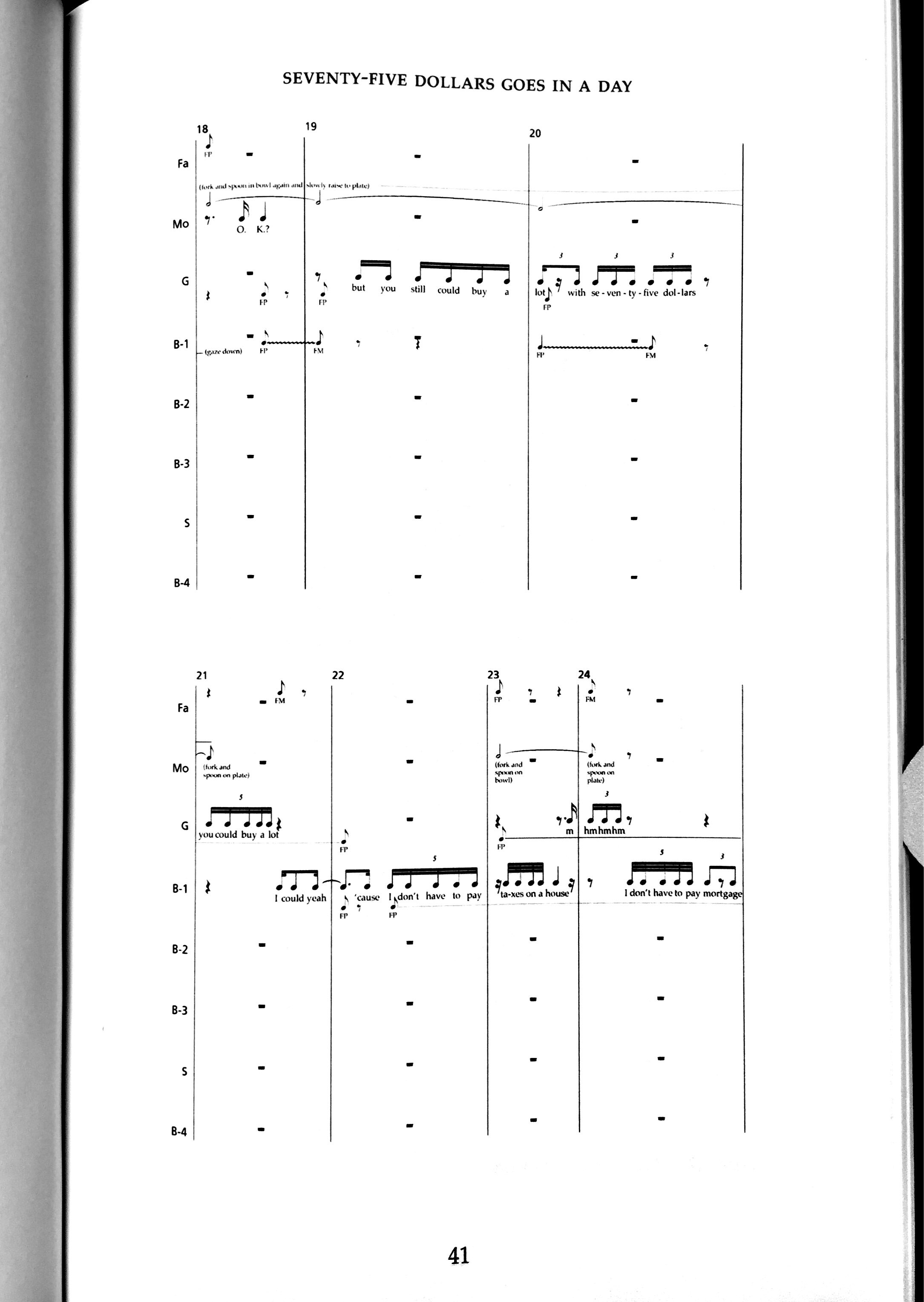
When I first got started blogging here, I read a difficult but rewarding academic book, Talk and Social Theory: Ecologies of Speaking and Listening in Everyday Life, in which a scholar, Frederick Erickson, analyzed detailed transcripts of several conversations recorded in 1974: a blue-collar family at dinner, a college counselor and a student who was eligible for the Vietnam draft, a combined kindergarten-first grade class, and a medical resident and intern diagnosing a difficult case. He parsed every last detail of these conversations and even showed how they could be rendered with musical notation:

image

This book is where I learned the concept of the “conversation turn,” which essentially means taking over or handing back the conversational flow to your conversation partner. (See prior post on the “turn sharks” in law school.)

How do a bunch of random conversations in 1974 relate to legal skills today? Some things don’t change: Being a good listener means mastering conversation turns to keep the conversation going without taking over.  Just refer to Pam Woldow’s lengthy discussion of “manterruptions,” and the gender imbalance in who does the interrupting versus gets interrupted, to understand the relevance of conversation turns today. (Part I of Woldow’s series is here.)

The conversation studies in Erickson’s book were fascinating but clearly expensive to create and difficult to replicate.  With newer and more affordable technology like the sociometric device described in Lawyer Analytics, people won’t need to be invited to a scholarly study to get this kind of data. (To see the logical and alarming extension of these possibilities, read this article on “searchable speech.”)

The possibilities of these devices inevitably bring to mind FitBits. Ken Grady’s boss Stephen Poor has already covered that ground for lawyering generally in “FitBits, Data and Lawyers.” On quantifying communication specifically, it seems pretty likely that we will soon have relatively affordable “FitBits” for listening.

No offense . . .

Today 3 Geeks and a Law Blog offers an interesting post by Casey Flaherty: “No Offense, But Aren’t You Embarrassed to Open Your Mouth?” Flaherty is known for creating the Service Delivery Review (formerly known as the Legal Tech Audit) and generally promoting efficient lawyering through technology in a variety of ways including via his company, Procertas.

Flaherty travels the legal-tech circuit, and on that circuit he recently received a potentially offensive question:

No offense, but how did a mid-level lawyer at a mid-tier company get so much pub for saying something that everyone already knows.

Flaherty’s response (both internal and external) should be interesting to readers of this blog on a couple of levels.

“No Offense, But . . .”

This phrase is not good. In a comment on the 3 Geeks post, former general counsel Jeffrey Carr (newly on board at Valorem Law Group) points out, “lawyers are particularly prone to use these kinds of ‘amnesty phrases’—phrases that give the speaker ‘permission’ to say something that appears responsive but in actuality can be non-responsive, offensive, groundless, insensitive, or simply unsupported.” A few others he lists are these:

  • with all due respect
  • I don’t disagree with that
  • It would not be inappropriate
  • It’s a business decision

I would add this gem:

  • I’m not trying to . . . . but . . . .

Somewhere on the Internet I read a great interpretation of this phrase: delete the “not” and replace “but” with “therefore”:

  • I am trying to . . . ; therefore . . .

(If a reader could help me find the origin of this great interpretation, I would be very grateful. I have tried many times to track down the source because it’s so clever.)

Slide1The main point here is that phrases such as “No offense, but . . . ” are generally not consistent with a constructive conversation. Careful observation of nonverbal cues after a “no offense” statement will probably reveal hostility and reduced eagerness to continue with good-faith conversation. (Let me rephrase: they won’t want to talk to you anymore, or at a minimum they will be annoyed.)

So those who want to work on their listening would do well to eliminate these phrases from their own working vocabulary. Honestly I would think that’s fairly obvious, but see the discussion of the Dunning-Kruger effect that follows.

“No offense, but you’re saying something that everyone already knows.”

Flaherty writes that when he received this question, he actually was not offended. In that sense he may be a particularly gifted conversationalist, or just a very peaceful person.

He writes he was not offended because he has often wondered the same thing. Is what he is preaching really common knowledge? He then delves into the nature of ignorance and knowledge, as general concepts and specifically in his area of legal process and technology usage.

The first point of interest is “meta-ignorance” or delusions of inadequacy—that is, the Dunning-Kruger effect: the most ignorant do not know what they don’t know. I think he’s saying that since there are enough lawyers out there ignorant of their own ignorance about process and technology improvements, technology innovators in law have to keep going and spread the word.

His second point is that saying something and actually demonstrating it by doing are two different things.

And third, information is only common knowledge if everyone in a group not only knows that information but also knows that the rest of the group knows that same information. (Check out the links in his post for more interesting backdrop on each of these points.)

What I liked about his post for Listen Like a Lawyer is that I’ve gotten similar comments:

No offense, but it’s obvious that listening is valuable and under-appreciated. You’re saying something that everyone already knows.

So Flaherty’s response is helpful to me as well. Modeling Casey: I shan’t take offense when people suggest listening is obvious. I have that same question!

Regarding the problem of meta-ignorance, just as legal process improvements may not be appreciated by those who labor in a state of low-tech, inefficient ignorance, listening too may be a victim of the Dunning-Kruger effect.

Here I couldn’t help but think of legal writing by comparison. Listening in the legal profession receives a fraction of the attention legal writing gets from articles, blog posts, tweets, and comments by judges and Supreme Court Justices about what attorneys need to do better. And even with all that coverage, Dunning-Kruger remains a real problem for poor legal writers, as my friend Scott Killingsworth has pointed out, leading to this discussion by Bryan Garner. If it’s possible to exist in a state of meta-ignorance about one’s legal writing, how much more so is that a problem for the relatively less-appreciated skill of listening?

Also listening skills are much more subtle and hard to recognize and assess, whereas bad writing can seem so glaring. The red squiggly line on Microsoft Word’s grammar checker is at least one tool that the meta-ignorant have going for them to try to overcome that state. There is no grammar checker for listening.

Another point of interest is the nature of knowing something and doing something about it. We all know listening is important and valuable. But how many lawyers really do something about their own listening or training others in effective listening? It’s worth continuing to talk about listening to try to bridge that divide between saying and doing. Personally I try to walk the walk by being a good listener. It can be quite difficult. Sometimes I will write about that here, and through sustained effort over time, maybe this blog can offer some lawyers the tools they need at the right moment to become stronger listeners or encourage others to do the same.

And lastly, to track Flaherty’s analysis, what exactly is “common knowledge” about listening in the legal field?

I don’t think the legal community’s common knowledge—that we all recognize as common knowledge—is all that fleshed out or deeply shared. Law professors such as Neil Hamilton have worked to enhance that body of knowledge. Despite such efforts, I worry that the actual common knowledge in the field may boil down to two words: active listening. That isn’t enough.

I want to do more on this blog to help expand that base of common knowledge, or create a conversation about what it might be. I’m still reading and learning a lot, so this is very much a work in progress. No offense.

Thanks to Casey Flaherty of 3 Geeks and a Law Blog for an interesting post prompting these thoughts. 
Listening—and speaking—in a time of grief

Carolyn Elefant, solo practitioner and blogger at My Shingle, is a valuable source of wisdom and advice, as well as some spicy and entertaining sarcasm.

But earlier this year she shared a beautiful post of grief and remembrance after the death of her husband.

Today she follows up with a related post, When Faced With Loss. Say Anything. This post should be read by any law student or lawyer whose colleague or client may die or face the death of a loved one—which is to say it should be read by all law students and lawyers. Especially those who care about kindness.

I recently fielded a question from a law student whose supervisor’s mother had just passed away. She was not sure whether to send an e-mail, write a personal note, or say anything at all. For business colleagues, as Carolyn points out, just acknowledging their situation and their grief is so much better than avoidance. Even if you say or do the wrong thing, it’s better than not trying.

Back to school means “what’s your learning style?”

The idea that each learner has an ideal learning style—that is, a style such as visual or aural or kinesthetic, in which they learn most effectively—remains unproven. Yet it appears to be wildly popular and naturally appealing to both teachers and students. The new school year seems like a hot zone for this idea to proliferate anew.

Before delving into the research on learning styles, let’s preempt some backlash. Of course different students have different strengths and weaknesses, and of course different students have different preferences and habits for studying and learning. That’s not the problem.

What remains unproven is that a given person learns “best” in a particular learning style that is different from the way another person (with a different learning style) learns the same materialHere’s UVa education professor Daniel Willingham summarizing his critique of learning styles as a theory. Here’s another article by two psychology professors summing up the studies finding no support for learning styles, including one that tested medical students.  A frequently cited 2008 study by four education professors concluded  “there is no adequate evidence base to justify incorporating learning-styles assessments into general educational practice.” 

Learning styles are so appealing and so omnipresent from preschool to graduate school that it can be hard to accept they are some sort of “myth.” A helpful illustration comes from neuroscientist Christian Jarnett in Wired Magazine:

[A]lthough each of us is unique, usually the most effective way for us to learn is based not on our individual preferences but on the nature of the material we’re being taught – just try learning French grammar pictorially, or learning geometry purely verbally.

Similarly, studying sculpture is not done best by reading long texts describing said sculpture, as pointed out this helpful and balanced piece from the Vanderbilt Center for Teaching.

Christian Jarnett goes on to argue that adhering to learning styles as a teaching method is not just a benign misconception but actively harmful. It encourages teachers and learners to direct their teaching toward existing areas of strength, given that “style” may function as a proxy for existing ability and preference. Dan Willingham would also say that mixing teaching styles in the interest of meeting different learning styles in a group may also be harmful, or at least not as beneficial as believed, if doing so works to the detriment of teaching the particular subject matter in the most appropriate way.

This is where listening comes in. When people are surveyed to try to determine their dominant learning style (or preference), listening—i.e. auditory learning—does not tend to rank as a top choice. Legal educator M.H. Sam Jacobson suggested a ranking for law students as learners: most law students report being verbal learners (learning by reading), followed by the next-most populous group of visual learners, followed by oral learners (learning by talking) and only then by auditory learners who learn by listening.

And because auditory learning is relatively unpopular, teaching to preferred learning styles could effectively hurt students’ listening skills even more. Under this theory, if a law student feels most comfortable as a visual or verbal learner, should that student thus learn to represent clients by looking at photographs of clients and reading scripts of interviews with clients? Clinics and externships offer incredible opportunities to interview clients, to take notes, to negotiate, to go to court—to do a lot of things that don’t neatly fit into the most popular categories.

It seems unlikely that an idea about learning styles would dissuade someone from clinic work. What I’m more concerned about is the way learning styles might subtly affect law students’ habits and beliefs: A law student might gain the notion he or she learns particularly well by reading and visuals, more so than by listening, and thus steer her way of thinking and studying towards words and images and away from talking and listening. Or struggle with taking notes in class or interviewing a client, and conclude that part of the reason is a learning style other than auditory.

Law students need to develop all modalities to be effective practitioners. . . . [R]egardless of whether one self-identifies as a visual, auditory, kinesthetic, or tactile learner, lawyers regularly use each of those modalities in practice. They process information by reading and synthesizing legal authority and documents obtained during discovery, for example, and act on oral directives from clients, judges, and colleagues.

This is from an excellent, in-depth, and critical yet constructive exploration of learning styles in legal education, Aïda Alaka’s article Learning Styles: What Difference Do the Differences Make?, 5 Charleston L. Rev. 133 (2011). Alaka carefully explores other frameworks for learning styles besides the “visual-aural-kinesthetic” model which is the main focus of this post. She ultimately concludes with the pragmatic notion that teaching material in a variety of ways beyond (1) assigning cases and (2) employing the Socratic method is certainly a good thing. (Hear, hear!)

She also suggests that while listening should not be neglected, reading will remain the most critical skill:

[R]ecent empirical studies suggest that developing law students’ critical reading skills and literacy are paramount to successful law school performance. Regardless of desire or preference, law students should understand that learning through reading is, and is likely to remain, the principle method by which they will absorb new information in law school and beyond.

In reading for this post, I came across a completely different type model formulated by educator Ken Bain in his book What the Best College Students Do:

  • Surface learners “do as little as possible to get by”
  • Strategic learners “aim for top grades rather than true understanding”
  • Deep learners “leave college with a real, rich education”

Just on its face, this framework bears parallels to listening. Surface listeners may just take in the key points and miss information as well as subtle cues. Strategic listeners may deploy active listening and other techniques, but miss opportunities to follow up and dig because they seize conversational cues to begin talking again. Deep listeners make the most of precious face time spent with conversation partners, leaving the conversation with a “real, rich” sense of learning information and building relationships through their communication skills including listening.

I look forward to reading more about this framework and exploring how learners who may fit into each of these categories can enrich the way they learn, and especially the way they listen.

__

Blogger’s note: People I greatly respect have written about and at times touted the benefits of teaching to individual learning styles. In fact I myself gave a 2006 presentation about using visual tools to teach legal writing, which I based partly on the idea of visual learners as a significant component of the law-student population. My post here does not in any way change my admiration for the scholars and educators who have studied learning theories including as learning styles in the quest to improve their teaching and their students’ learning.

Lucky listening object?

This summer I had the pleasure of reading Between You & Me: Confessions of a Comma Queen, by a longtime copy editor at the New Yorker, Mary Norris. This book is a pleasure, something you can tell just by the epigram:

IMG_3693

Later on, Norris expounds at length upon the editor’s pencil—not in a Platonic sense, but in the sense of the actual pencils and pencil sharpeners she uses for her tasks. Her favorite is the Blackwing, a premium and pedigreed pencil that promises “half the pressure, twice the speed.” (The smooth writing experience will appeal to certain pen fanatics as well.)

IMG_4590

On Norris’s recommendation, I ordered a box of Blackwings, specifically the Palomino Blackwing 602 model. They really are pretty awesome, from the silky flow onto the paper to what Norris describes as the chiclet-shaped eraser. Her loving and detailed description of trial and error before finding the Blackwings also imbued them with a special sense of purpose. As a legal writing professor, I began to think about whether law students would benefit from having some sort of totemic editor’s tool. This does seem appropriate, since lawyers should be editors as much as writers.

And as with many of may daily activities (see Orangetheory post from last week), I wondered whether this idea of a special writer’s tool could apply to the complementary skill of listening. What could lawyers and legal professionals use as an expert tool of the trade, giving their listening a special sense of purpose? The ideal tool would be subjectively powerful for the individual using it and carry some historical or contextual significance as well to help the individual perform the task in the aspirational spirit of the profession. (The Blackwing website promotes a myth like this through the pencil’s history: discontinued in the 1990s and then brought back in the 2010 after some were paying up to $40 per pencil for remaining stock.)

But listening is a receptive communication channel, in contrast to writing and speaking. What does the idea of a special tool even mean for receiving information rather than making it?

The first thing that came to mind is the art of taking notes. It’s not listening exactly, but it’s an artifact of listening. When I asked academic-support expert Moji Olaniyan how she works with students on their listening, she said the first thing she looks at is their notes, and they way they take notes. (More specifically, Moji Olaniyan is Dean Olaniyan, the Academic Dean for Academic Enhancement at the University of Wisconsin.)

One revered method for taking notes is the Cornell method, described by Lisa Needham in an updated Lawyerist post just this week. The note-taking method itself does not demand any particular purchase since any paper can be used with a few lines drawn to create a left margin and summary at the bottom. However, the Levenger notebooks are one way to spend on this method if desired. For practicing lawyers, of course note-taking does not go away after law school, although it changes form. Lisa’s post offered some interesting glimpses into what note-taking looks like in law practice.

Note-taking can also go multimedia such as with a Livescribe pen that records while you write. This pen may not make listening feel sacred and special the same way the Blackwing works for Mary Norris. Rather I suspect it would make one feel a tiny bit like an engineer (or spy?), which could be good in a different way—assuming it’s legal and culturally acceptable to record audio wherever you may use it.

But note-taking is just a proxy for listening, and only in situations where note-taking is socially acceptable.

What about the listening act itself—the experience of taking in the information, and the speaker’s perception of being listened to? In social situations, people may grasp a glass of wine or a Coke, a reminder in the hand of social cues to follow. Grasping a warm cup (including but not limited to a cup of coffee) may help with social interactions, scientific research has suggested.

On the other hand, have you ever been in a conversation where it seems to be going pretty well and then you see the other person’s eyes dart sideways, as if looking down at a phone—even if they’re not actually doing so? They may be drawn to another “talismanic,” “fetishistic” and “fanatical” object: the “amulet” of the smartphone.

Law-school roundup (fall-semester edition)

FullSizeRenderAs 2Ls and 3Ls return to the classroom and new law students start their journey, this is a good time to recap some of Listen Like a Lawyer’s posts especially for law students. These are in order below from before law school to 1L and beyond. You can also see posts in reverse chronological order by searching the blog category “law school.”

Please share ideas for additional posts related to listening in law school. And good luck to law students (and law professors) starting a new school year now.

Law-school prep for listening skills

Listening 101 for law students 

The note-taking method that worked for me (link to guest post on The Girls’ Guide to Law School)

An app for legal reading and legal writing

Listening checkup for 1Ls (halfway through first semester)

What are the core professional qualities of lawyers? 

Guest post on externships

Oral argument

“Listening” to the legal job market 

Interview skills and listening

Callback interviewing

Observing the courtroom

Last but not least: Graduation reflection

And one more:  What it sounded like at the bar exam

Listening until it hurts

Recently I tried a workout at Orangetheory. This is a relatively new exercise franchise offering intense one-hour workouts with running, rowing, lifting, and uncountable numbers of crunches. Everyone wears a heart monitor, and throughout the workout you can check out the monitor to see just how hard you and your heart are working—as well as everybody else in the class.

I was nervous to try a new workout, but every time I glanced up there, my score was green. Green is good, right? It’s aerobic, and aerobic is good, right?

Actually no.

5447958713_050cab91aa_b

To score points in the Orangetheory workout, you have to go beyond green. You have to get into the “orange zone” (thus the franchise name, I suppose) or even the red zone. That means not walking, not jogging, not running at a steady clip. That means sprinting, and panting, and gasping for breath.

You get lots of points for orange and red. Not so much for green.

At the end of the workout, the guy next to me had scored 24 points and I got 6. He crushed me even though he appeared to be near exhaustion the entire time. He crushed me because he appeared to be near exhaustion the entire time.

As I pondered this failure, I wondered whether the lesson might to listening as well.

It seems likely that many of us are sailing comfortably along with our listening and other communication skills. Of course we’re putting out effort. We make eye contact. We use active-listening techniques to paraphrase back important nuggets of the conversation and move it forward. We take notes unobtrusively and follow up with e-mail confirmations.

We’re in the green zone of listening.

What would it look like to move into the orange or even red zone?

Listening is a receptive communication channel (like reading, and in contrast to writing and speaking). To design an Orangetheory program for listening, we would need to raise the intensity level quite a bit. It’s not about trying a little harder on one or two points all the time. It’s taking a short amount of time to listen, radically.

But how would we know that someone was working in the high-intensity range of this receptive skill?

Maybe by measuring the proportion of time spent talking to listening. There is a natural give and take in conversations, but if you’re talking and listening comfortably—for you, subjectively—you may be malingering in the green zone. (See Mark Goulston on “How to Know If You Talk Too Much.”)

Some have suggested an 80-20 rule of focusing on the other person. Steve Yastrow, who writes about improvisation techniques for marketing, says to keep the focus 95 percent about the other person. That is red zone material. That’s hard.

Maybe the mindfulness of the listener to what the speaker is saying. There’s no “brain monitor” for focus—at least no affordable one—but theoretically if the listener’s mind is filled with what to say next and what to eat for dinner, that may not even be in the green zone of listening. It could be the dreaded blue zone, which is literally the zone of pointlessness in Orangetheory because you score no points.

Red-zone listening takes in information in a powerful and efficient way. At the front end of the listening process, focus and memory are as crucial as body strength and VO² max are to powerful workouts.

Maybe one key metric would be whether—and to what extent—the listener feels he or she is actually being listened to.

One reality of exercise and mental processes is that they work only to exhaustion. Attention is a muscle that can be depleted. The body and mind together can be depleted. (Read anything by Daniel Kahneman’s work, or anything about his work. In a study of parole decisions, judges made harsher decisions when they were hungry and tired after hearing several cases.)

But the concept behind any program like Orangetheory is to build capacity by stressing the body. The stress has to be appropriate, but what is appropriate has changed. (See this article from the New York Times on a 12- minute workout that helped veteran runners shave time off their 5Ks simply by a few 10-second spurts of going all out.)

Georgia attorney and magistrate judge Phill Bettis told me about a church mission to West Virginia where he met and talked with a retired coal miner. Phil and I were discussing emotional intelligence and empathy, and how they relate to listening. This was a vivid memory for Phil because he wasn’t sure at first how to find common ground with someone whose life experience had been so very different from his. Phil’s experience might be viewed as one type of “red-zone listening.”

So is listening to someone in grief, or a life crisis. An attorney recently wrote on the Texas Bar Blog about his experience with depression, and how other attorneys may serve as a “patient friend.” No one seeks a conversation like this out in order to hone their own skills, of course. (Actually some people run from them, although those will admit doing so are rare in their honesty.)

Being in such a conversation creates a moment to leave the green zone (the comfort zone) behind. Really listening at such a moment—which regardless of your legal training and expertise may actually be the only way to help—makes all the other efforts pay off, and far beyond what can be quantified in zones a scoreboard.

Here is a related post imagining “Tabata” training for listening.

Photo credit: Courtesy E’Lisa Campbell/Flickr/CC BY-SA 2.0

Why it’s so hard to be understood

Among Listen Like a Lawyer’s summer reading is Heidi Grant Halvorson’s No One Understands You and What To Do About It (Harvard Business Review Press 2015). Halvorson is a professor at Columbia Business School; here she is interviewed by CBS News about the book.

51nTzV8T70L._SX328_BO1,204,203,200_The book’s focus is on understanding how others perceive you, so that you may better manage how you are perceived. It’s not focused on the legal industry, but it discusses psychological dynamics that certainly apply in law offices as well as any organization. For lawyers, law students, and legal professionals, I would say this book is most useful for the following goals:

  • exploring the dynamics of interviewing process
  • delving beyond the surface in what is happening at work, particularly in work teams and with organizational clients
  • improving how one is perceived by a supervisor or work team
  • lightly exploring broader “psychology of leadership” concepts in the business world

Across situations, cognitive biases on all sides create distortions and disconnects in how someone thinks they are perceived and a perceiver’s actual impression. For the person communicating a message, the “transparency illusion” creates the overly optimistic expectation that others do in fact understand our intention. This illusion comes about in part from overconfidence about how clearly we communicate:

Your emotions are less obvious than you realize, and your face is less expressive too. Studies show that while very strong, basic emotionssurprise, fear, disgust, and angerare fairly easy to read, the more subtle emotions we experience on a daily basis are not.

On the receiving end, the well-known confirmation bias leads people to interpret information as confirming what they already think. These types of biases are semi-automatic and hard to combat, although more effortful, careful thinking in the “correction phase” can correct for distortions. (This is what Daniel Kahneman calls System 2.)

After laying this groundwork, Halvorson spends most of the book talking about the “lenses” that affect first impressions, before any intentional “corrections” can take place. The three key lenses are:

  • the trust lens

Trust is based on two factors—warmth and competencethat may sometimes be at odds with each other. More on that in a moment.

  • the power lens

To get the attention of a powerful person, it’s all about showing your “instrumentality.” As Halvorson writes, “It’s not about being niceit’s about being useful.”

  • the ego lens

The ego plays games with perception so that the perceiver comes out on top. Understanding ego dynamics can help a person avoid being seen as an ego threat. The least manipulative-sounding of these is focusing on how the speaker and perceiver are members of the same group (such as alums of the same school or members of the same profession).

These lenses are at work in difficult situations that lawyers and legal professionals face every day. A few that come to mind: clients who resist signing settlements that are strongly in their favor; supervising lawyers who want to control conversations with clients; legal professionals who gain a reputation—either for good or poor work—that seems difficult if not impossible to alter.

All of these lenses could help with the goal of listening, in that knowing about them can help a listener understand better what the other person is saying and why. Developing trust by cultivating warmth was where listening came into play explicitly. Some warmth tactics seem obvious: make eye contact, smile, and focus. But Halvorson cites studies that “people generally have no idea when they are not doing these things.” One practical theme of the book is just to ask friends and family about how you come across: do you make eye contact? How do they perceive you?

A potential difficulty for lawyers is the conflict—or at least perceived conflict—between what it takes to show warmth versus competence:

When people are trying to appear warm, they are agreeable, engage in flattery, make kind gestures, and encourage others to talk (i.e. they are good listeners). But when they want to appear competent, they do the opposite–speaking rather than listening, focusing the conversation on their own accomplishments and abilities, and challenging the opinions of others as a demonstration of their own expertise. In fact, both consciously and unconsciously, people tend to use this knowledge and play down their competence (i.e., play dumb) to appear warm, and vice versa.


Halvorson notes this conflict is a particular conundrum for “nontraditional women” who may experience particularly virulent sexism for perceived failure to adhere to stereotypes about women. This is an example where she nods to the deep and troubling excesses of cognitive biases, but this book is not the place to look for introspection or sensitive exploration of stereotypes and what to do about them.

Rather, it’s a pragmatic toolkit for the person who wants others to “get” them. For trying to resolve the warmth/competence conflict, Halvorson suggests the “moral” aspects of warmth do not conflict with competence. These aspects include being “courageous, fair, principled, responsible, honest, and loyal.” She notes that in a brief interview, it is a lot easier to show your sense of humor than that you are principled. But overall, perceived—and actual—trust is built by “being someone the perceiver can always count on to do the right thing.”

Halvorson also has chapters for difficult interactions such as those with “vigilant risk-mitigators” and “aloof, avoidant perceivers.” She closes with a relatively short treatment  seeing others more clearly (e.g., “take more time” and “consider evidence for and against” a hypothesis) and even seeing yourself more clearly. A common thread throughout the book is to ask friends, family and (if you dare) colleagues how you come across. If people consistently perceive you in ways you don’t intend, then reading, re-reading, and working on the ideas in this book may be in order.