Law-school prep for listening skills?

‘Tis the season of advice for 0Ls, meaning those about to enter law school this fall. While reading Scott Turow’s One L and banking some “me” time are both great, 0Ls might want to think about their listening.

I once heard a law professor say that starting law school is like learning Chinese by being dropped from an airplane into a community where only Chinese is spoken. Law-school prep classes, boot camps, and online programs have sprung up to help students make the transition. Perhaps a law-school prep course is a little bit like reading a grammar guide and a few key survival-oriented sentences before the big drop.

Courtesy Flickr/Steven Depolo/CC by 2.0
Courtesy Flickr/Steven Depolo/CC by SA 2.0

But there are ways to prep for law school without paying a fee, such as “by visiting your local Barnes and Noble.” Plain English for Lawyers by Richard Wydick and Getting to Maybe by Richard Fischl and Jeremy Paul are often recommended. These books are great, and as a legal-writing professor when I’m not blogging, I especially recommend Plain English for Lawyers. I would also add Barry Friedman and John Goldberg’s Open Book as a new and popular contender in the law-exam-prep market.

But the skills these books ultimately focus on—writing legal documents and exam questions—are partially the artifacts of earlier skills in reading and listening. What about targeted prep for these skills?

For reading, future law students may want to take a look at Ruth Ann McKinney’s Reading Like a Lawyer: Time-Saving Strategies for Reading Law Like an Expert. I also like Wilson Huhn’s The Five Types of Legal Argument. It’s not about reading per se but about the major building blocks of legal opinions and legal reasoning generally.

For listening, I’m not aware of a specific book focusing on listening for pre-law students. (Hmmm….)

If there were such a book, what would it cover? Here’s a thought experiment on what pre-law students could do the summer before law school to enhance their listening:

  • Acclimate to the pace of a law school class.

Incoming law students could search for a few lectures on YouTube and sample what they really sound like and how they move. Socratic interchanges and professorial pauses may be new experiences. Class can move slowly or very, very fast.

Some students may want to work on smartphone etiquette and attentiveness so as to avoid distractions during class even when it seems to move slowly. This in turn is good practice for avoiding smartphone distractions during meetings and interviews with clients and others as a practicing lawyer. Even if a student loses no actual information by looking at a smartphone during class, that student may be sacrificing the speaker’s good impression.

  • Start to develop a note-taking method.

It is difficult to decide how to take notes in class before actually attending many—or any—real classes. But having a note-taking strategy in place before the first class should allow students to get more out of the first few classes and to adjust more quickly with experience. Lisa Needham published a post in the Lawyerist about the famous Cornell note-taking method, which she described as a way of “hacking chaos.” On a more specific note, I guest-blogged about one strategy,  #professorsays, at The Girl’s Guide to Law School.

  • Integrate reading and listening on a particular case.

This is somewhat idealistic, but the idea is as follows: the reading raises questions and makes the student curious to find out whether and how the professor answers those questions. Then the student listens effectively in class because of having context (from the reading’s facts) and being curious (from the student’s questions). And then the student’s engagement with the material in class means the student will have even better questions to formulate when doing the next set of readings in preparation for the next class.

One way to practice this integration of material without doing a prep class would be to use the power of YouTube: find a YouTube video discussing a particular case, then read the case before fully viewing the video. Or read a Supreme Court case and then listen to the oral argument audio on oyez.org. Listen for the concepts in the questions and answers that you remember in the opinion itself. I would suggest the audio arguments in Campbell v. Acuff-Rose Music, Inc. as an entertaining and educational opportunity. (Here’s the Supreme Court’s written opinion.)

  • Prepare yourself to ask questions—good questions—when you are confused.

While listening and reading can be a virtuous cycle, most law students also have the experience of feeling really lost and confused at one point or another. Throughout the semester, and not just in the final push of studying for exams, students should monitor their own listening and thinking to recognize confusion setting in. Starting a conversation with the professor by asking good questions is one way to address a creeping sense of confusion. If asking a question after class is too crowded or just uncomfortable, go to the professor’s office hours or make an appointment.

Asking “good questions” is something great future lawyers learn as soon as possible. It’s not just “Help. I’m confused.” That’s fine for a trusted study group but not so helpful for interacting with a professor. To make a better impression as well as start a more helpful conversation, ask questions the explain what you know and don’t know. For example: “I think I’m confused. Here’s what I believe I know. Here’s what I think I heard you say. Where I’m not seeing the connection is why . . . ”

A law school prep class may give the opportunity to ask this kind of question. Outside of a prep class like this, listening to a law-school lecture on YouTube and then formulating some hypothetical questions. Or the same idea could be accomplished with a different communication medium. A student could read some difficult material and then imagine questions for a professor about what the student understands and where that understanding trails off into confusion and questions.

What else? Listening to people.

Effective classroom listening is valuable and necessary for law-school success, but not actually sufficient for good lawyering. What about the kind of listening lawyers really do? Lawyers talk to people (some friendly, some not friendly) in real conversations, in order to learn the facts, glean motivations, find out what else needs to be known, and discern how to make recommendations and arguments. This list is not meant to be exhaustive. The point is the intellectual listening integrating large blocks of topical detail in the 1L year is very different from the kind of listening lawyers actually do. A student might find it difficult to follow three classes on what constitutes various types of offers, but that same student might find herself highly motivated to interview a client about an alleged agreement starting with a so-called offer.

So here’s a proposal for some unorthodox advice on law school preparation, with a particular focus on listening. In the summer before law school, volunteer to take an oral history for an archive project. Interview an older relative about some aspect of his or her life. Tutor a kid one-on-one. Invite a potential mentor to lunch and get that person talking about life and law school and law practice.

It’s not exactly sipping piña coladas and having “me” time by the beach. Some of those suggestions may actually involve writing! But spending time in conversations like this will build listening skills. And it may even build up resilience and motivation—qualities that will definitely be needed later, to get over the hump of the 1L year.

Teaching Success > Analyzing Failure

Why blog about listening? It drew me in because it’s different than legal writing—which I honestly love, and love to teach, but sometimes tire of, with its skirmishes in broader linguistic debates about two spaces after a period, commas outside quotation marks, and the indefinite singular pronoun, as well as the temptation to go negative.

Courtesy Flickr/Martin Fisch/CC BY-SA 2.0

Listening is among the softest of the soft skills, so soft it’s hard to perceive and even harder to measure. It’s not talked about as much as writing or speaking—or even the other “receptive” communication channel, reading—but I believe it has a huge impact on every aspect of law students’ and lawyers’ effectiveness, both real and perceived. If a law student gets every relevant fact from an externship client including important gaps in the client’s knowledge and then produces excellent notes for the supervising attorney, but the client does not feel heard, is that a successful interaction? How can law students and lawyers enhance their listening skills?

I hoped to mainly focus the blog on constructive ideas, as opposed to the “what not to do” method so prevalent in some conversations about legal writing. Yet soon as I launched the blog, the most common reaction was to parade out the listening failures:

“Your blog is called Listen Like a Lawyer? Oh, so you mean poorly and with preconceived ideas?”

Thus the temptation. It can be fun to write about bad examples of anything, whether listening or writing or any other skill. I had a little too much fun writing a Halloween post about “scary” listening here. And here’s a more serious post focusing on terrible listening. The attraction—and impact—of talking about failure is based on a larger disturbing reality:

[N]egative information, experiences, and people have far deeper impacts than positive ones.

This is from an article in the Harvard Business Review explaining Roy Baumeister’s paper “Bad Is Stronger than Good.”

Prevention is better than failure

The temptation to talk about any skill in terms of failure came immediately to mind when I read Ken Grady’s latest post at the Seyfarth Shaw Lean Consulting blog SeytLines, “On Teaching Lawyers to Succeed Rather than Fail.” His post focuses on critiquing the case method of law school, in which almost every fact pattern by definition represents a failure of the parties and lawyers to find a mutually beneficial solution and settle the case.

His critique is not unreasonable: why is that a good way to teach lawyers to solve problems? Actually Grady is less interested even in solving problems than in anticipating and preventing them. And he doesn’t think the case method is very good at this at all:

“[T]aken to an extreme and when used as the primary method of teaching students, [the case method] becomes a vicious circle keeping us trapped in a cycle of failure.”

Re-thinking the model to teach law students how to proactively work with clients to prevent legal problems turns out to be very difficult. Prevention is a lot harder to see than failure:

“Much of the best lawyering ever done was not recorded in case books or articles. It went unrecorded because that work prevented failure from happening. The lawyers who provided those services kept their clients out of trouble, kept costs down, and avoided burdens on society.”

Role-playing real situations is one way to get at preventative lawyering, as in the following example from Grady:

“A general counsel is faced with a new business model. She investigates the obvious legal risks of the model and does not find anything at odds with existing law. As far as she can tell the proposed business model is perfectly legal. But still, something does not seem right to her. She pushes further into the model. As she studies it, she realizes how it may conflict with evolving concepts in the law and societal trends. Today the model is perfectly legal, but in three to five years, it most likely will be problematic. Our general counsel could do nothing and leave any problem to the future. She could follow the maxim of make money today and let tomorrow bring whatever it may. Or, she could look for something to mitigate the risk.”

Problem-solving and leadership

Grady’s post “On Teaching Lawyers to Succeed Rather than Fail” reminds me a lot of Emory Law Professor Dorothy Brown’s recent article Law School Without Borders (PDF). In the article, she outlines an alternative approach to teaching law. She gives a case study problem solving and problem prevention for a hypothetical client who happens to be a “nationally known Southern-style celebrity chef” sued for race and sex discrimination. In the article, Brown walks through the possibilities for achieving success through proactive, interdisciplinary, collaborative lawyering. More broadly, she suggests what law schools can and should do to broaden their focus:

“A law school that incorporates more than just teaching students how to think like lawyers, but how to also solve problems and take a leadership role will graduate students better equipped to add value to their firms and clients on the first day. Emotional intelligence should not be underestimated. By emotional intelligence, I mean empathy, exercising good judgment, maturity, wisdom, common sense, and last, but not least, the ability to have difficult conversations successfully.”

Hear, Hear! to the idea of teaching leadership, emotional intelligence, and difficult conversations. The “law school without borders” Professor Brown describes is consistent with Ken Grady’s interest in teaching problem prevention through anticipatory lawyering. Their ideas both fit within and challenge the ongoing conversation about experiential learning in legal education, such as here.

Better listening by analyzing listening successes

This is a huge topic, but what we can do here is to bring the focus back to listening. From time to time, we can turn away from “10 Ways to Be Awful at Listening.” We can instead talk about “10 Ways Great Listening Helped Lawyers Serve Their Clients By Understanding and Avoiding Potential Disputes.” Here are some questions:

  • How have you seen lawyers use listening to successfully prevent and solve problems?
  • What did they do, specifically, that showed their listening?
  • How can proactive, preventative, powerful listening be a tool for lawyering success?
  • What are some ways to teach that kind of listening?

Listening and legal marketing

This blog is a place where not only lawyers but all legal professionals can come together around the topic of listening. Listening helps to bind us together in productive work—or hold us apart, when we listen poorly. Legal marketing professionals have a huge contribution to make here, as they really know deep in their bones the importance of listening to the client (and the potential client) in a variety of ways. I didn’t attend last week’s annual conference of the Legal Marketing Association, but the meeting produced an excessive and interesting number of live tweets, so I decided to point out some themes of interest here on the blog.

The keynote was by Daniel Pink, and he kicked it off by invoking Alec Baldwin’s ABC moment—”Always Be Closing”—from Glengarry Glen Ross to set the stage. (I thought about linking that clip here but it is quite NSFW.)

Dan Pink suggests a new set of ABC’s for a world where the seller no longer has superior information to the buyer. Instead, the key principles to successful sales, or marketing, or whatever term makes you comfortable when it comes to finding potential clients and convincing them to use your services—which this blog fundamentally assumes to be activities of interest to most lawyers and legal professionals—are attunement, buoyancy, and clarity. If attendees got one thing from Pink’s keynote, it would be these three principles:

Each of these principles has something to do with listening, I think, with attunement at the top of the list.

A. Attunement and listening mutually reinforce each other

Attunement means being able to understand the client’s point of view. Being open to the other person’s perspective is crucial:

But it’s not the same thing as emotional intelligence:

To stress the point, what the other side is thinking is at least as crucial and probably more so than what they are feeling:

Tweets from other sessions, not the keynote, touched on attunement in different ways such as handling the pitch meeting and maintaining the relationship:

Attunement remains crucial throughout the relationship, when things are going well . . .

. . . and especially when the relationship may be going south:

One tweet pointed out the importance of attunement for legal marketers in their role as facilitators of business delivered by others:

This was an intriguing point with several interpretations. Maybe it’s necessary to understand “the service” and the providers of that service, and the strengths and weaknesses of both. As a witness in one of my first IP cases said, “My job is to make sure the sales team only sells what the engineering team can actually deliver.” Or maybe it’s necessary in the sense of how the legal marketer adds value to a law firm: legal marketers who are superior at attunement to client needs add irreplaceable value to the law firm’s team of professionals.

And this point about attunement in a three-point relationship (legal client/legal marketer/lawyer) may be expanded to the cover lawyers. Being attuned to the knowledge and expertise of the legal marketers who specialize in understanding clients and potential clients can help lawyers better understand their clients as well.

B. Buoyancy means dealing with rejection

The value of buoyancy apparently came wrapped in some generalities about lawyers’ perhaps non-buoyant personalities:

But relationships can help:

The tweets don’t say this, but isn’t it clear that listening is a great tool for anybody to build relationships with mentors and sponsors?

I’ll have to read Pink’s book To Sell Is Human to get a fuller picture of what he says on buoyancy. He also wrote the book (literally) on motivation, which leads me to expect words of wisdom on self-talk, or internal dialogue. What do lawyers and legal professionals hear when they listen to their own self-talk? To be buoyant, we need healthy ways of handling self-talk. And if our self-talk is overwhelmingly negative, we probably can’t listen effectively to others for problem-solving and relationship-building.

C. Clarity is about finding problems and curating information to help solve them

The clarity principle seems to focus on finding problems and sharing information in productive ways. Pink spoke about helping clients find problems:

The part about not being a problem solver is interesting. “Solving” problems too quickly can itself cause problems, such as not fully understanding the actual problem and not forging the relationship necessary to address it. And jumping in to answer a question, rather than fully hearing someone out, is a hallmark of bad listening.

So finding problems is part of clarity, and the most advanced way to do this is to find the problems that are hard to perceive:

The theme of information saturation plays a continuing role throughout these new ABC’s. For example, clarity is a huge part of content strategy, basically selecting and sharing what clients and potential clients really need to know:

And that brings us full circle to the role of the legal marketing professional. Revealing more about who the clients are and what they need helps everyone:

“Personas” and “key client types” may be a bit jargon-y, but lawyers and legal marketing professionals can work together to understand each other’s language and the ideas behind that language. Listening to one another in this way helps with the broader common goal of listening to the client. Listening helps with all of the new ABC’s of selling, which in turn lead to getting business, forming relationships, and ultimately serving clients in effective ways.

Pink’s keynote at LMA drew extensive on his book To Sell Is Human. For those interested in seeing him present the ideas, here’s a webinar hosted at the Harvard Business Review. And Nancy Myrland has collected all of the blog posts from the LMA15 meeting here.

Listening is part of emotional intelligence

Daniel Goleman is the father of the emotional-intelligence movement. He recently shared a checklist of “EQ” competencies with the New York Times. EQ has four overarching categories:

1. self-awareness

2. self-management

3. empathy

4. relationship skills

Not surprisingly, listening was included as a skill related to empathy:
You pay full attention to the other person and take time to understand what they are saying, without talking over them or hijacking the agenda.
In the context of ever-present smartphones, this is much harder than it used to be. The presence of a phone decreases the actual empathy the person feels, according to several psychology experiments: “[B]ecause of the many social, instrumental, and entertainment options phones afford us, they often divert our attention from our current environment, whether we are speeding down a highway or sitting through a meeting,” reported the Scientific American. “[C]ell phones may serve as a reminder of the wider network to which we could connect, inhibiting our ability to connect with the people right next to us.”
There are a lot of directions I would like to take this post—for example reflections by practicing lawyers on what EI means to them in their work. Also the pragmatic benefits of emotional intelligence such as better negotiation.  But thinking about the instrumental benefits of emotional intelligence leads me to think of Machiavellianism and the “dark side of emotional intelligence.” Without getting too side-tracked into those areas at least at this time, I’ll stop. Listening is part of empathy, and empathy is part of emotional intelligence.
Note this post has been corrected to reflect “EQ” as the commonly used acronym for Emotional Intelligence, rather than “EI.”

A tale of two sales

A 40-something lawyer attempting a triathlon is apparently so common as to be a cliché, but I’d rather be a healthy, fit cliché than wither away uniquely.

Courtesy Flickr/CC by-SA 2.0

Two recent experiences shopping for triathlon gear prompted this post about listening and sales. Listening is a crucial part of one-on-one marketing, and a few aspects of my experience may help lawyers as well.

Store #1

I happened to visit this store while picking up a race number for a small running event. It’s a place I’ve always driven by and been interested to visit, but never actually gone into until now. While I was picking up the number, the store owner stood by. He took the first step by asking if I wanted to look at some shoes. I actually am very interested in the new super-cushioned shoes I’ve been reading about, which this store does carry. But I didn’t say that just yet. I gave a noncommital but friendly “maybe, when my current shoes wear out.” I then told him the model of my current shoes.

The response was immediate and vociferous, “Oh, we’ve got to get you out of those.” He then critiqued their design and suggested they are actually weakening my feet. He asked me if I saw a television news report with an orthopedist’s endorsement of a certain brand featured in this store.

The store owner didn’t find out that my existing brand of shoes has helped me recover my running career. He didn’t find out that I have a long history of orthopedic issues. He didn’t find out what I like in a pair or shoes, or that I was actually highly interested in a different brand of shoes that he actually does carry in the store. It appeared he had a featured brand he was selling to every runner that came in the store. I got the strong impression his initial conversation with almost any potential customer would lead to the same solution no matter what the potential customer said.

Store #2

This was a bicycle store, so potentially a much more expensive purchase. A salesperson approached me as I browsed and asked how he could help. He said he had only been working there for a few weeks and brought in a more senior sales person. She asked a series of questions. First and foremost: “What is your goal?”

After I told her, she asked some follow-up questions about my commitment to triathlons. She said she would recommend a very different bike for someone attempting a triathlon once as a bucket-list item as compared to someone who was going to ride more frequently and compete throughout the summer and beyond. It was understood I wouldn’t be walking out right then and there with a bike, but she offered to e-mail me some “eye candy” and specs on the bike she suggested. Her follow-up e-mail began with “It was a blast talking with you about bikes today” and continued with detailed information about the bike.

Lessons for lawyers

What do sales tactics in specialty sports stores have to do with marketing legal services? I saw a few potentially relevant points:

Marketing to someone you just met

I had never seen the shoe guy or the bike lady before in my life. To be fair to the shoe guy, I went into the store for a different reason (to pick up a race number), whereas the bike lady knew there’s no reason for me to be in that store other than interest in bicycles.

Either way, establishing rapport seems like a fundamental sales tactic. Others have suggested an 80-20 rule: get the other person talking 80 percent of the time. In his excellent and fun book Ditch the Pitch, marketing expert Steve Yastrow recommends a higher burden: keep the conversation on the customer 95 percent of the time.

The shoe guy didn’t ask me a question other than “while you’re here, do you want to look at some new shoes?” Once he got a quasi-positive answer, he was off and running with his pitch about the benefits of the shoes and the recommendation of an orthopedic specialist in a news report.

In that sense, he fell into a trap lawyers may face as well: the desire to show what you know. It does seem intuitive that one can sell by impressing them with your subject matter expertise. This seems especially true for discerning buyers with competitive goals and a willingness to innnovate for better results. And it is especially true when you have developed an expertise in a new and exciting approach or idea or product. But he gave the impression of being wound up like a child’s toy to release his spiel.

The bike lady asked a series of questions and didn’t talk about bikes at all until she learned more about me and my goals. After building a rapport with these questions—the equivalent of intake questions for lawyers?—she moved toward a solution that addressed the questions. At that point she selected and described a solution, i.e., a particular recommended bike. She pointed to its features and compared and contrasted it with other solutions, i.e., other bikes higher and lower in the spectrum of features and price.

Marketing to someone who has already made purchases in that same market

The shoe guy heard what brand and model of shoe I wear and immediately said, “We’ve got to get you out of those.” The message and the phrasing set a bad tone in a couple of ways.

First of all, there was no “we” at that point, since I had been in the store all of five minutes. Second, I am actually really quite happy with my shoes. It almost made me feel bad about the shoes I’m wearing. Instead I resolved the dissonance by shifting into a feeling of dislike toward the sales person.

Despite the good experiences with my existing shoes, I actually would experiment with another pair of shoes that are similar to these because I have read about great results other runners have gotten from the new super-cushioned shoes. But I’m just not going to go in a totally different direction, given the good experience I’ve had to this point. And that guy would never know this because of how he approached the entire conversation.

So, if a lawyer is talking to a potential client who has a history with a different lawyer or firm, it would seem rather arrogant to lead with “We’ve got to get you away from that [lawyer or firm]!”

Rather, the lawyer could find out more about what the potential client needs in terms of business services. What does the potential client want from a lawyer? There’s no need to trash the status quo if you can—subtly—offer an improvement on it.

Marketing what you believe to be the superior product or service in the field

The bike lady selected a model to show me and talked about its great features including how light it is, its hidden cables, its smooth gears. She pointed out how the pedals can be customized to preferred feel and functionality. She offered to let me ride it in the neighborhood. She then talked about models one step down and one step up from that model. And she mentioned that adjustments to the bike are free in the store for the life of the bike—potentially 10 years or more.

In this way a lawyer can present a client or potential client with options: the one that seems the most effective to the lawyer, even if it’s not the cheapest approach, as well as the higher-end and lower-end ways to deal with the issue, including their advantages and disadvantages.

Creating a longer-term relationship with the customer/client

Some kinds of businesses are better able to form a relationship than others. A bike needs adjustments and can benefit from various add-ons any time during its useful life. The bike lady made sure to mention the free adjustments for life that come along with any bike purchase.

Still, even a one-off sale can form a relationship. For running shoes, the chance to try on the shoes in the store could be a powerful incentive to buy because now you’ve spent the sales person’s valuable time working with you. Or the store could provide ongoing support with smaller items like running gloves, water bottles, special compression socks, and so on.

It may be disturbing to discuss similarities between marketing legal services and selling special socks. But if those socks are a reasonably inexpensive way to prevent years of injury and expensive physical therapy, then they are pretty awesome. And similarly with legal services, an ounce of prevention may be worth a pound of cure, creating a grateful client. Walking out of the running store with a $40 pair of compression socks and a positive experience would have made me more likely to stay interested in buying shoes and other gear there over the long term.

Standing by the product/service while also providing flexibility

The bike lady acknowledged that the bikes she is selling are a fairly major purchase. But, she said, if you buy it and get it home and within 30 days decide you just don’t like cycling and aren’t going to use it, bring it back. We’ll give you a refund. Or, she said, if you get it home and within 30 days decide you actually love cycling and want to get an even better bike, we’ll let you trade up into something nicer.

Legal services may offer similar flexibility given the many decision points along the way in handling a legal matter. For example, a client may be able to work with counsel to test out a particular strategy and then adjust upward or downward. By explaining some of the time frames and decision points for adopting a different strategy, the lawyer can help the client understand she is not locking herself in to one decision forever.

Conclusion

Listening seems to be a key part of all of the above. The person who took time to listen to my goals and to tease out some of my experiences with biking made a far better impression than the person who reacted to my status quo by criticizing it and trying to force his favorite off-the-shelf solution.

Of course lawyering is different than selling shoes and bikes. But the universal principles of persuasion are at work for all kinds of customers and clients in all kinds of selling environments.

A myth about listening and learning

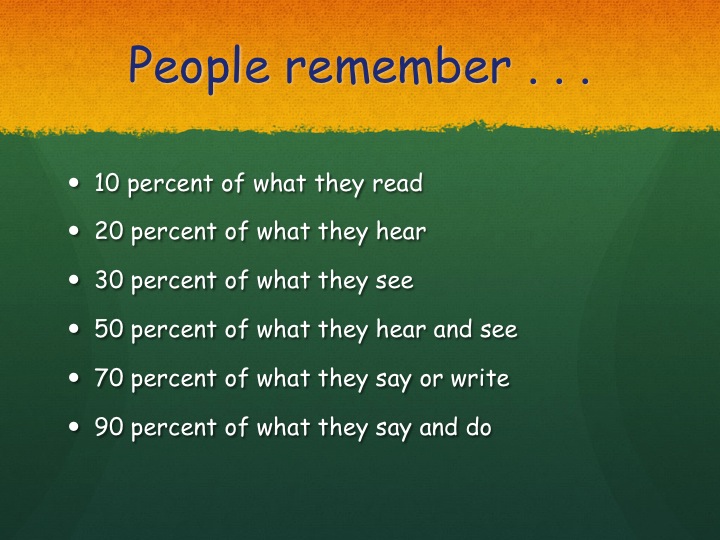
Listening is a loser, at least according to the widely circulated Pyramid of Learning:

Slide1

I’ve been hearing about the Pyramid of Learning — also known Dale’s Cone of Learning — since I was a child. Yet it has a problem. Specifically, a lot of credible people believe it to be “zombie learning theory that refuses to die.”

Digging through the evidence to find out exactly what is true turns out to be difficult, partly because there are just so many sources that repeat these numbers. One of the best I have seen is by Candice Benjes-Small and Alyssa Archer on the Association of College & Research Libraries blog (these are the folks that called the learning pyramid a “zombie learning theory”). They gather sources and trace how this idea started as a conceptual model about conveying information at various levels of abstraction. There were no numbers making any retention claim. At some point, most likely during World War II, the graphic of the pyramid emerged with numbers attached to it representing retention percentages.

The graphic of the pyramid and numbers makes it feel irresistible. Matching the strength of their appeal with a strident attack, Will Thalheimer has described the pyramid as “dangerous” and a “fraud” on his blog Will at Work Learning. A fairly comprehensive timeline of debunking sources can be found at the Institute for Learning Professionals. The American Society of Engineers published a conference paper with a detailed, balanced refutation including graphical representations of where these numbers appear to come from.

In her textbook Designing Information Literacy Instruction: The Teaching Tripod Approach (2014), Joan Kaplowitz commits the debunking to print:

As appealing as that notion [of the learning pyramid] might be, an exploration of the literature shows there is no solid, research-based data to support it. 1

Kaplowitz goes on to suggest the numbers themselves contain the seeds of their own destruction:

Even the numbers themselves should make us raise an eyebrow and question the so-called data. The percentages are just too perfectly distributed with each number being a multiple of 10 and the spacing of categories somewhat even to have arisen from any real-world experimentation.

That’s a lot of debunking, but is it enough? The appeal of the learning pyramid creates a pedagogical Scylla and Charybdis: If you tout these numbers, many teaching faculty will discount your credibility. But if you doubt the numbers, you may lose your connection with other faculty who embrace them. Benjes-Small and Archer advise “treading carefully.”

What does this mean for lawyers and law professors?

We are experts in being precise with words as well as being skeptical about claims. So we can avoid broad assertions of the pyramid’s scientific truth.

We can be careful in how we present information, testing it on audiences when possible and relying on our own experience as a guide. For example, showing a text-heavy Power Point while simultaneously reading the words is terrible. it doesn’t reinforce the information; it creates competing streams of information and, in a broad sense, is just plain annoying.

We can rely on more recent and more specific research into information retention. Not surprisingly, studies support the use of images: “Humans can remember pictures with 90% accuracy in recognition test over several days, even when the images are presented for only a short time during learning.” This is from Doug Linder and Nancy Levit’s The Good Lawyer: Seeking Quality in the Practice of Law, citing a study that is about 1000 percent more scientific than the cone of learning (as well as 1000 percent more difficult to read and understand). The science confirms the art of lawyering, as recounted by Linder and Levit:

Images are so effective to effective communication that David Ball contends a “trial attorney without images is like an art book without pictures.”

The fundamental truth behind Dale’s original concept is that information can be presented in many forms ranging from the concrete to the abstract. Whether teaching a class, making a presentation to clients, or arguing to a jury, we can “mix it up.” That’s not scientific, and there are fancier ways to say it, like Benjes-Small and Archer’s recommendation: “Think multimodal.” However it is phrased, this broad recommendation is more reliable than a neat set of mythical percentages.


  1. Kaplowitz cites Char Booth, Effective Teaching, Effective Learning (2011); James P. Lalley and Robert H. Miller, “The Learning Pyramid: Does It Point Teachers in the Right Direction?” published in volume 128 of Education (pages 64-79) in 2007; and Michael Molenda, “On the Origin of the Retention Chart” in volume 44 of Educational Technology in 2004.

Steal their listening

Keith Lee’s book The Marble and the Sculptor: From Law School to Law Practice (ABA 2013) is a bracing, honest, challenging compendium of advice for new lawyers. I would strongly recommend it to upper-level law students and new lawyers. (See also his blog, Associate’s Mind, as well as his columns in Above the Law.) One chapter in Keith’s book that caught my eye is “On the Importance of Stealing.”

In addressing new lawyers, Keith advises the following:

“[S]tealing is an essential skill for you to develop.”

Not for larceny, of course, he says, but “within the framework of learning and growth.” The objects of this stealing are varied: “other lawyers, CLEs, books, anything really.” New lawyers should “steal their pattern of success.”

This is great advice. But it’s easier in some areas than others. We can look at a great legal brief and break down how each section and each sentence works. We can watch a great advocate and recognize skillful pauses and variations in tone. We can admire a senior lawyer who knows literally every statute and case in a given area of expertise and can assemble and reassemble them instantly in response to any factual question.

What about listening?

Listening is hard to observe and very hard to measure. Speaking and writing are productive – i.e. observable – communication skills. Listening is one of the two receptive communication skills, along with reading. “Listening is a hypothetical construct, something you know exists but you can’t physically see. You can see only the behavioral indicators supporting its existence.” This is from Debra L. Worthington and Margaret Fitch-Hauser’s textbook on listening.

So how do you steal from a hypothetical construct?

The behavioral indicators are a place to start.

This is a complex process: you’re observing affirmative actions such as making eye contact, using appropriate body language, asking questions, and providing “discourse markers” such as “um-hm” that encourage conversation. But you’re also observing what the listener doesn’t do: noticeably look away, check a smartphone, interrupt. Noticing what isn’t there is very, very difficult. As Nobel Prize-winning psychologist Daniel Daniel Kahneman tells us, “WYSIATI”: What you see is all there is.

The ease of perceiving what is there may partly explain why active listening is such a popular listening concept. It has a set of specific repeatable, measurable behaviors that go with it, such as repeating what the speaker has said. If you watch a skilled active listener, you can steal the method. But note how this is not really stealing the person’s listening skills. It’s stealing the productive act of speaking in a certain way, by repeating what the listener just heard.

The most important components of listening are hidden: being aware of and receiving the information, placing it into context with one’s previous knowledge, evaluating and (perhaps) remembering the information, and responding. These elements of listening are drawn again from Worthington and Fitch-Hauser’s MATERRS model of listening.

It’s hard to steal someone’s level of awareness. Again here, specific affirmative behaviors may be the only practical proxy. Making eye contact is a sign of awareness, for example. The educational-reform model KIPP teaches children a set of specific classroom behaviors that include “sit up,” “track the speaker,” and “nod your head.”  Body language can shape not only communication behaviors but actual brain chemistry, as Amy Cuddy famously described in her TED Talk and other work on “power posing.” 

The “s” in the MATERRS listening model stands for “stay connected and motivated.” To be a good listener, you have to want to listen.

But how can a person “steal” someone’s else’s motivation? Maybe the answer is an instrumental one: you can observe what their good listening does for them. Specifically, you can observe how you feel when you interact with a skilled listener.

In The Marble and the Sculptor, Keith Lee emphasizes communication — actually over-communication — with clients. This means keeping the client informed, of course. It also means taking time to get to know the client: “Take time out to learn the stock price, industry, day-to-day culture, players and overall goals of your client. Visit their offices and plants. Do it free of charge.”

This is one of Keith’s many kernels of advice to consider stealing. (Actually he got it from and attributes it to Dan Hull of What About Clients.) Before going on an outing to spend the afternoon at the client’s site, it’s a good idea to prepare. Study up on the client, of course. But also, consider inviting a great lawyer to lunch — someone whose client development and communication skills you know to be first rate.

And then steal their listening.

***

Note: I was grateful to meet Keith in person as he spoke to the legal blogging class I am co-teaching at Emory Law School. His advice on lawyering and legal blogging is first-rate (obviously!) and was received with great enthusiasm by the students. After seeing him interact with students, I can say Keith is not only a great speaker but also an excellent listener.

Core professional qualities of lawyers

About a thousand law professors are gathering now at the Annual Meeting of the American Association of Law Schools. The first session I attended this morning was Incorporating Teaching Professional Identity into the Legal Education Curriculum, with speakers from Mercer Law School and the University of North Dakota School of Law. Both schools offer innovative courses in building a professional identity as a lawyer.

The new program on professional identity at North Dakota emphasizes twelve core professional qualities, which I quote here from their handout:

  • Adaptability/Deals with Unpredictability
  • Confronts Mistakes
  • Courage
  • Diligence/Reliability
  • Empathy/Compassion
  • Generosity/Public-Mindedness
  • Honesty
  • Humility/Respectfulness/Courtesy
  • Integrity Under Pressure
  • Loyalty
  • Patience/Perseverance/Resilience
  • Professional Objectivity/Sympathetic Detachment

I really love this list and wanted to focus the rest of this post on how listening relates to these core qualities. Interestingly, the list does not include anything about “communicates effectively.” I think the point is to talk about the essential character of the lawyer, which is separate and broader than the lawyer’s discrete skills like communicating effectively. The lawyer’s core qualities are broader and more significant than any one skill; they drive the lawyer’s individual actions and deployment of skills in many ways.

Here are my quick thoughts on highlights of the list in relation to listening.

Adaptability and Dealing with Unpredictability

To be able to adapt, the lawyer has to listen. This is easier at the beginning of a project, when the lawyer is beginning to create the narrative of the case or the strategic approach. It’s harder when the client and/or lawyer already have a narrative or strategy in mind. The best lawyers can hear explicit or implicit dissonance with their chosen narrative, and then assess the risk to that narrative.

Listening also helps with unpredictability, I think in the sense of asking questions and listening to the answer. Open-ended questions may tease out that unpredictability and let a lawyer prepare for it. Closed questions that lead the conversation in a certain way may mask unpredictable facts or preferences, setting up nasty surprises later.

Courage

Lawyers have to deal with very difficult facts sometimes. The setting may be a courtroom where a witness recounts painful testimony or a law office where a client shares an uncomfortable truth or a mediation room where harsh words are exchanged or an icy test of wills becomes apparent. The lawyer has to have courage to face these situations and listen with professional body language and a problem-solving demeanor, even if that lawyer’s personal preference would be to go anywhere else in the world.

Diligence

To do a thorough job, the lawyer has to set up sufficient time for fact-investigation including, possibly, interviews. And the lawyer should use judgment to decide how to go about collecting facts, whether by e-mail or phone or face-to-face meetings.

Empathy/Compassion

Listening like a vacuum cleaner sucking up information is not, by itself, effective listening. The listener may be primarily interested in fact investigation and analysis, but listening with empathy will almost always be more professional (as a value) as well as more effective (as a skill).

Generosity

Giving time to listen is a form of generosity. Giving undivided attention during that time is more difficult and therefore more generous.

Humility/Respectfulness/Courtesy

Effective listening is all of these things. We’ve all witnessed situations with a bad listener who interrupts to ensure everyone gets the benefit of his or her “wisdom.” Interrupting is a little more complicated than that, though, because some forms of interruption show engagement with the conversation. Effective listening, like professional identity more broadly as discussed in this session, is complex and holistic and cannot be wholly addressed by a set of steps or distinct, invariable behavior rules.

Patience

At times, listening is hard. That’s partly because people speak more slowly than our brains want to process information. (A whole separate blog post or posts will cover this idea later. It’s a huge component of why really effective listening can be so hard.) Effective listeners may need to show explicit signs of patience, such as body language and encouraging responses. Effective listeners may also need to struggle with their own intrinsic impatience due to the differential between how fast they hear the information and how fast they are capable of processing information.

Perseverance

Many people have mentioned to me that the best listeners are able to hear what’s not said. That’s partly an intellectual skill. But perseverance helps–asking questions in different ways, listening with discernment to how a person says something, and defining the gap. That’s just one specific point where perseverance and listening intersect. Being able to withstand a 4-hour conference call is another form of perseverance.

Professional Objectivity and Sympathetic Detachment

Effective listening means limiting the influence of one’s preferences and biases. It means being empathetic while not becoming so wrapped up in the narrative that one’s objectivity is compromised. The lawyer’s role is a complex and difficult one, and the seeming paradox of “sympathetic detachment” is just one illustration of the fine line lawyers must walk.

Please feel free to use the comments for sharing more thoughts on listening and how it relates to the core qualities of lawyering.


Thanks again to Professors Patti Alleva and Michael McGinniss of the University of North Dakota and Professors Tim Floyd and Patrick Longan, and Dean Daisy Hurst Floyd of Mercer. I probably won’t be able to blog in this depth again during the conference but will try to at least tweet further thoughts of interest on listening. Listen Like a Lawyer’s Twitter feed can be seen here on the blog on the right-hand panel.

Artisanal listening

McSweeney’s post last week, “I Am An Artisanal Attorney,” caused a ripple of laughter and sharing among lawyers on social media. If you have ever eaten small-batch honey from a meadery or had your mustache trimmed at a groomery or considered purchasing an ascot from an ascottery—or if you just need a laugh—stop and read it.

Courtesy Larry Hoffman/Flickr

Author and very special attorney John Frank Weaver promises not just to write legal documents, but to hand-craft his own paper from local flax and write the text in ancient script using a feather quill and squid ink:

Don’t be lulled into a complacent life filled with more cheap, manufactured goods than you’ll ever need and lawsuits that don’t reflect your uniqueness. Insist on a life well-lived with food, experiences, and litigation that reflect people and skills, not factories and automation.

After I finished laughing, which took a good long time, I wanted to make a semi-serious point. Weaver’s comic post taps into anxiety about new realities and related fears such as “Here Come the Robot Lawyers.”  In contrast, an artisan is “a person or company that makes a high-quality or distinctive product in small quantities, usually by hand or using traditional methods.” How much of the legal market is and should be artisanal — or “bespoke” — and how much should be standardized or automated is a huge, ongoing, and critically important debate stoked by Richard Susskind and many others. (Here’s one article from the ABA’s Legal Rebels on Susskind’s Tomorrow’s Lawyers tapping into this debate.)

Even for those of us who, at heart, want to practice on the bespoke end of the spectrum, we might agree that lawyers don’t need to squeeze their ink out of local squids. They don’t need calling cards printed on Himalayan pressed paper. But it is a requirement of the profession to provide clients with legal services that are customized to the facts of the case. It is an ideal of the profession to tailor these services to the personality and needs of the client as well. And “thinking like an artisan” can be an excellent marketing practice for lawyers because clients may screen their lawyers based on objective criteria and then choose their lawyers based upon more artisanal criteria such as values and fit.

Drawing on what it means to be an artisan, one of the lawyer’s most “traditional methods” is quality face time with people. This relationship building is intertwined with the broader tradition of lawyer as trusted advisor. And one of the traditional techniques of the trusted advisor is listening. Listening is most often and most effectively done in small quantities, such as one-on-one meetings. It takes time and attention to focus on a client and make that client feel special. It takes skill to deploy active as well as passive listening and every other form of listening as needed in the moment. Being really listened to and understood makes a client person feel, well, special—kind of like some people feel when they sip cold-pressed juice infused with artisanal ice and nibble on a side of hand-crafted toast.

Yes, I’m listening to Serial. Aren’t you?

The podcast Serial has, in the past few months, become the most popular podcast ever. As a dedicated bibliophile and not much of an audiobook fan, I’ve been surprised to become so engrossed. Serial reinvestigates the murder of Hae Min Lee, a high-school student from Baltimore who was killed in 1999. Her ex-boyfriend, Adnan Syed, was convicted and remains in prison. Serial raises a lot of questions about criminal justice, the legal system, and lawyering—and it manages to raise them in an interesting, suspenseful way. Listening is intertwined with these issues in a variety of ways, from our own experience as listeners to the vexed role of listening in the investigation and beyond.

Lawyer as listener

Lawyers are used to be the “tellers” in storytellers. As we listen to Serial, we experience a story as the audience. Producer Sarah Koenig controls the pace of the narrative both “week by week” and moment by moment. What immediately struck me—in a good way—was her use of pauses. She speaks quickly but in comprehensible segments, leaving space for understanding. She also uses the voices of others so well. Of course, one would expect nothing less from any affiliate of This American Life. Yet Serial brings a fresh appreciation for the interplay of voices and pauses delivered up for the listener’s ear. Just as one concrete benefit to spending your time with Serial: if you have a CLE presentation to prepare, it might inspire you to use a short video segment, or to experiment a little more with pauses and conversational suspense the way Koenig does.

It’s also interesting that each episode of Serial differs in length. Koenig doesn’t try to space out the narrative to fill a set length of time; she breaks off one coherent piece of the story, fleshes it out, and stops. An episode may be 28 minutes long, or it may be 53. The flexibility of the podcast format is extra courteous to the listeners: we can listen whenever and wherever we want, and we know that an episode is just exactly as long as the producer thinks it should be, no more. The fact it’s free doesn’t hurt either. (In episode 9 she asks for listener contributions, and to date enough has been gathered to support a second season.)

One more note on the listening experience, and this is a little more critical: Serial is in part a work of entertainment, and as such, it has own music. At first, the signature jaunty opening piano left me confused. The music also includes some looming, menacing moments, as well as plaintive notes associates with Hae, the victim. But when we later think of Serial and its phenomenal podcast success, I think we’re going to think of the jaunty piano. As Slate asked, “What the heck is Serial: A mystery? A comedy? A touching memorial?” I can understand why her family may be in pain to have her murder brought back into the public’s view—and the public’s ear—in this way.

Listening in the criminal-justice system

Then there is Serial‘s substantive coverage of how listening happens in the legal system. The listening comes in the form of information gathering, but also information-confirming, and the line between them is not always clear.

We hear several segments of taped interviews with a key witness—indeed, the state’s star witness—talking to Detectives Ritz and MacGillivary. One detective would ask a question that leads the witness to answer and perhaps ramble, at which point the other would follow up with pointed clarification, as Koenig points out. Perhaps it’s surprising that we hear any tactics at all in these interviews. Before taping, the witness and detectives spent three hours “ironing out” this witness’s statement, which was the standard practice back in 1999 and has since been discredited. As producer Sarah Koenig points out this untaped “pre-interview” is “where the mischief can happen, the contamination.” She’s quoting Jim Trainum, a former homicide detective and now consultant to police forces, innocence projects, and others (such as famous podcasts) on issues of interrogation techniques and false confessions. Serial hired Trainum as a consultant for the series.

In prosecution of Syed, the star witness had the virtue of providing valuable information the detectives hadn’t been able to get anywhere else. That witness also provided closure, “a satisfying investigative circle, a murder case on a silver platter,” Koenig points out. When detectives hear possibly conflicting details, they don’t push. The reason they don’t push are both explicit and much more subtle. In terms of obvious strategy, as Trainum states, “You don’t want to do something if it’s going to go against your theory of the case.” No confession is perfect; there will always be some inconsistencies. Those inconsistencies are handled very, very carefully because police don’t want to create “bad evidence.” Producer Koenig literally sputters when Trainum tells her the purpose of the interrogation is not so much to get to the truth as it is to make the case.

Compounding the conscious intent to make the case is the subconscious effect of verification bias. (Listen Like a Lawyer has previously posted on various cognitive biases including confirmation/verification bias.)

To illustrate verification bias, Trainum recreates the mental dialogue of a detective taking a statement, when that detective hears something that doesn’t quite fit: ”I want to believe you because you’re my witness and I think this is what happened and all that, so the fact that you’re giving me something that’s inconsistent and doesn’t fit my theory of the case, what does verification bias cause you [sic] to do? Ignore it and push it aside.”

By the time the detectives interview defendant Syed, as chronicled in episode 9, they have moved from information-gathering to what looks like information-confirming: they open his interview with a “theme.” One of the detectives introduced himself to Syed by suggesting that the detective himself had an ex-wife and could understand how “this” could happen. Serial doesn’t suggest that listening must always be open-ended and can never arrive at a central narrative. That would be naive. But Koenig is certainly suggesting the narrative that convicted Syed is problematic. In essence, Serial is listening to Syed’s story as of today, as it has developed post-conviction, in a way that the court system may or may not do. His petition for post-conviction relief is pending.

Serial has finished its ninth episode and has a handful more to go. For lawyers who have not yet picked up on it, I do recommend it. For those who are already listening to Serial, please share your thoughts. How has the listening experience affected you? What do you think it shows about listening within the legal system?