Listening to your 1L voice

Listen Like a Lawyer has been on hiatus during a busy time for first-year legal writing students and professors. As the students wrote and finalized their first appellate briefs, I located my own old 1L appellate brief. Even without the 1996 date, the blue paper and Courier font are like a voice from the past.

photo-5

Maybe this “voice” should really be “voices”: I can hear the words of my professor in sentences that I never would have written on my own. For example: “The district court’s ruling can be comfortably affirmed under the first or third parts of the test.” What 1L comes up with the words “comfortably affirmed”? Also any use of the Code of Federal Regulations was purely a product of what she told the class to do. I had no idea what I was doing.

And that leads to another voice: the voice of doubt. When in doubt, many people return to their comfort zone. For me, the comfort zone was description–basically, just summarizing the facts and holdings of cases. Several sequences of paragraphs consist of nothing more than “In one case, xyz happened. . . . In another case, abc happened . . . .” This brief was guilty of the incredibly common 1L mistake of the “book report,” as described by Kristen Tiscione in her article on classical rhetoric, Paradigm Lost: Recapturing Classical Rhetoric to Validate Legal Reasoning. Yes, those paragraphs should have had stronger topic sentences developing an actual legal standard. In “listening” to it now, I can hear the voice of a 1L who was just not sure what to say.

Although there is much to criticize and pity in the brief, there are also moments of confidence. Good writing often corresponds with appealing rhythm and pace–features that one can hear when reading sentences out loud. In describing the client, who had been fired due to tobacco addiction and possibly his age as well, the brief juxtaposed his seniority against what the CEO wanted: “[The plaintiff’s] age and his advanced career actually hinder him; companies want ‘new blood that will stay forever.’ (R. 18).” The brief even reached for a figure of speech: “HIs tobacco addiction resulted in the Defendant’s firing him and the doors of the biotechnology market simultaneously shutting in his face throughout New England.” There is no doubt I stated these words — verbatim — at my 1L oral argument.

Legal writing scholars debate the existence of “voice” in legal writing. As Chris Rideout has written, legal writing has a “professional voice” but not so much a “personal voice.”  Legal writing professors walk the fine line of trying to teach the professional voice while not crushing the personal.

Perhaps the voice of legal writing occupies a middle ground, as Rideout suggests: the voice comes from a “discoursal self” that performs a discourse tradition in its own way in that context, at that moment. The appellate brief, for example, embodies a certain tradition, yet the brief-writer has the opportunity to contribute to and even change the tradition in performing it.

And my old brief was certainly a performance. The words reflect the very personal effort of a fledging grownup, trying on and testing out the professional voice of a lawyer. My actual voice as a 1L probably sounded a lot like it does now, because the human voice remains relatively stable from age 20 to 60. But my “voice” as a writer and a lawyer has developed so much since that 1L brief, with one of the most obvious improvements being stronger topic sentences. They could hardly have been worse.

And now from the past to the future. Law students: Without falling victim to hoarding, maybe you should print out a hard copy of your 1L brief. Who knows whether your memory sticks and cloud servers will still be easily accessible 20 years from now? And consider saving your actual voice as well. What about doing a video time capsule to yourself? Tell your future self what you’re doing. Talk about the law generally, or describe your most recent writing project or your favorite class. Show the way you think. Use an app such as SpeakingPhoto to narrate what you were thinking when a particularly photo (yes, even a selfie!) was taken. Your future self will likely appreciate the chance to hear your voice when you were just a “baby lawyer.”

And experienced lawyers: maybe find a way to “listen” to the young lawyer and law student you used to be. Dig up some old work or find an old tape from a trial-advocacy class. Naive? Cynical? Confident? Scared? Yes, yes, yes, and yes. Sometimes it’s enlightening to listen to your own voice.

The author dedicates this post to Stephanie Feldman-Aleong, a former colleague at Emory Law School and professor at Nova Southeastern, who passed away in 2008. Stephanie inspired me in many ways such as by sharing her own 1L work with students.

Thanks to Beth Wilensky of the University of Michigan Law School for comments on an earlier draft of this post.


Listening: a romantic thing to do

On this Valentine’s Day, if you are celebrating with a significant other, consider effective listening as a gift more valuable than chocolates or jewelry. (And that really means something, at least coming from the author of Listen Like a Lawyer.)

A few specifics that might make this day more romantic. These are inspired by some of the tweets and retweets from Listen Like a Lawyer:

  • Keep your focus on your partner.

  • Instead of saying “but” and then clarifying, say “yes and . . .” to keep the conversation going.

  • When discussing a problem, don’t try to solve it too soon.
  • Come into a room with the attitude of “Ah, there you are!”

  • No conversational “tee-ups” like “I’m just saying . . . .” Please.

  • No “screen face” when you look up from a device.

  • If all else fails, try gasping in agreement. Seriously.

Listening in law school: second-semester update

First-semester 1Ls face a daunting challenge: they are learning the law as taught in the language of the law—which they don’t know yet. This challenge is to some extent uncomfortable and unavoidable, but there are steps 1Ls can take and resources they can consult to ease the transition. As one of many examples, here is a helpful chapter from UMKC Professor Barbara Glesner-Fines’s law-school success book, with a section on active listening in the classroom. Listen Like a Lawyer previously outlined the idea of a first-semester listening check-up.

Second semester is different. Well, actually one thing is the same: it’s still a rather poor choice to surf the internet during class. A fundamental step in effective listening for law school novices as well as experts is to pay attention, as law school success coach Lee Burgess has discussed.

But the classroom experience really is different for second-semester 1Ls. Becoming more comfortable with legal language means that a law student should have a larger capacity to learn legal concepts and, ideally, should be increasingly efficient at doing so. One way to help assess your effectiveness at learning is to do another mid-semester listening check-up.

A second-semester 1L doing a listening self-assessment is now much better able to evaluate difficult but important questions such as the following:

  • When should my listening be informational – almost like a reporter taking notes?
  • When should my listening focus on the concepts?
  • What verbal and nonverbal cues is the professor offering that help signal his or her attitude toward the content?
  • When are these nonverbal cues complex, such as when a professor role-plays disdain for a particular holding and then switches to praising its effectiveness?
  • What can I do after class to better process and remember the information I just heard?
  • During class discussion, how do I change my listening when the professor asks questions and students respond?
  • When on call, what can I do to reduce stress and focus on listening to the question and connecting it to my class preparation?
  • What point do I think the professor is trying to make in spending time on a statute, case, or other legal source or idea?
  • Does the professor explicitly identify any particularly complex or important issues, or trending questions in the field?
  • What does the professor leave unsaid, such as by exploring several steps to a line of reasoning but then stopping to let the students draw their own conclusions?
  • What seems to be undisputed doctrine and what is more a matter of interpretation and disagreement?

Study groups may be a more valuable resource during second semester because the group members have a better collective idea of what they are doing. Study-group members might try a one-class listening experiment in which one member would try to record everything said in class, another member would paraphrase, and a third would record just the gist of important concepts. Comparing these notes could be quite informative about the structure of the big ideas and the details used to support those ideas.

Talking with a professor, if the professor is willing to discuss listening as a topic, could also be helpful. Some professors may engage with listening method itself, as in “I don’t think you should try to write down every word but rather should listen for understanding and write down key concepts and key moments during the lecture and discussion.”

Other professors may respond better to discussion of specific doctrines. A student could review her class notes and engage with the professor on whether the student’s takeaway is consistent with the professor’s main points about a specific substantive area of law. After meeting with a professor, the student can then reflect on what that discussion revealed about his listening.

As a final note, law students should be working with academic support deans, teaching assistants, and other academic resources. Listening effectively is a key part of learning effectively.

A brilliant, flawed listener

Listen Like a Lawyer spent last week sheltering in place during the Atlanta snow debacle. It was a good week to make crock-pot chili and spend some time re-reading a good book—Wolf Hall by Hilary Mantel.

Wolf Hall is a brilliant novelization of the Henry VIII saga. It has been chosen as the first book for the Wall Street Journal Book Club (Twitter hashtag #WSJBookClub). It will be discussed this weekend at the Crime in Law and Literature conference at the University of Chicago Law School.

Flickr/Lisby
Flickr/Lisby

The main character is not Henry VIII or Thomas More or Anne Boleyn, but Thomas Cromwell. Cromwell was a commoner of uncommon distinction: a mercenary, a wool merchant, a lawyer, a politician, and Master Secretary to the king. This powerful and adept “nobody” earns the fear, if not the respect, of the English nobility at this “disordered” historical moment involving Henry VIII’s quest to father a male heir.

In reading and re-reading Wolf Hall, I was struck by Cromwell’s listening. The different ways he listens, and how he fails and succeeds by his listening, have much to teach lawyers.

Listening to his client’s spoken and unspoken instructions

As portrayed in Wolf Hall, Cromwell listens to what the king says as well as what he really means. Cromwell well understands that the king wishes to view himself as perfect although his desires and actions are certainly not. Thus there is a mismatch in what he says and what he wants to have done. “Sometimes it is a solace to me,” Henry says to Cromwell, “not to have to talk and talk. You were born to understand me, perhaps.”

Listening to his client’s mood

When Henry “rages,” Cromwell responds not with words but with quiet: “He sits quietly, watching Henry, trying by stillness to defuse the situation; to wrap the king in a blanketing silence, so that he, Henry, can listen to himself. It is a great thing, to be able to divert the wrath of the Lion of England.”

Listening to what cannot be written

At one point Cromwell is sent by the king to check on the former queen, Katherine, and their daughter, Mary. For Cromwell—by then the Master Secretary of the kingdom—this seems like a waste of time. Yet as he perceives the situation at Katherine’s lodgings, he understands why the king sent him in person: “The things that are happening cannot be put in a letter.”

The new queen, Anne Boleyn, seeks to make the old queen’s life miserable through her instructions to Katherine’s servants. The king does not want to contradict her openly yet does not want to bring misery to Katherine and Mary either. Only by in-person presence and careful listening to the servants’ statements of their orders can Cromwell comprehend the situation accurately and help the king avoid direct harm to Katherine while also appeasing Anne Boleyn.

Listening to everyone, not just the powerful

Cromwell speaks many languages and is a master “code-switcher,” able to converse with anyone of any station. He is always collecting bits of information about the common people’s mood toward the king. In one scene, Cromwell takes off his fine ring and helps the cook to chop meat as he learns what the people are saying about Katherine of Aragon and Anne Boleyn.

At times Cromwell listens to what he was not meant to hear, such as what people really think of him. He passes by a doorway and hears a sycophantic musician discussing not only his own desire to see Cromwell’s execution but also the musician’s belief Anne Boleyn was not a virgin when she married Henry VIII. This information helps Cromwell first assist the king in marrying Anne Boleyn and later to prosecute her.

A failure of listening

Despite Cromwell’s many strengths as a listener, he fails at one crucial moment. For years early in his career, Cromwell served Cardinal Wolsey, who became his mentor. Wolsey is a powerful man, handling much of the kingdom’s business including arranging marriages among nobles. In an early scene in Wolf Hall, Wolsey meets with Anne Boleyn’s father, brother to the powerful Duke of Norfolk. Cromwell stands in the corner.

The cardinal and Monseigneur Boleyn discuss Anne Boleyn’s unsanctioned decision to enter a marriage contract with a young nobleman. Cromwell says nothing as Wolsey insults the entire Boleyn family as lowborn, and attacks Anne Boleyn in particular, calling her “spoiled goods.” This is not, as it turns out, a good career move for him.  Later, in privacy, Cromwell shares with the cardinal the rumors from London about the king’s growing alignment with the Boleyn family. He has already begun an affair with Mary Boleyn (popularly depicted in The Other Boleyn Girl). Cromwell’s action–or really, his inaction–during this crucial meeting has helped to set in motion the cardinal’s downfall. “Why did you not speak up?” the cardinal asks. “How could I have introduced the topic?” Cromwell replies.

The Boleyns later take revenge; the cardinal loses everything and dies alone. Cromwell manages not to go down as well, instead transitioning to the king’s service, where he helps the king refute Anne Boleyn’s supposed marriage contract. Cromwell then masterminds the legal and political strategy to separate England from the Catholic Church.

Wolf Hall is a worthwhile read for lawyers, especially those with an interest in literature, history, or politics. If you have read it, please share thoughts in the comments here. The second book in the series, Bring Up the Bodies, narrates Cromwell’s actions during Anne Boleyn’s reign and fall. (In an early scene in Bring Up the Bodies, one of the queen’s courtiers tries to share gossip about her with Cromwell, who is distracted and inattentive. “You are usually such a good listener,” she says.) Hilary Mantel’s third and final installment in the series, The Mirror and the Light, is forthcoming in 2015.

Lawyers and hearing loss: two profiles

Hearing loss is a challenge for anyone whose job requires communication. Last week, Listen Like a Lawyer reviewed Katherine Bouton’s excellent book Shouting Won’t Help: Why I–and 50 Million Other Americans–Can’t Hear You. This week features interviews with two lawyers who experienced quite different trajectories of hearing loss but shared a similar open, constructive mindset.

Image%5b1%5dPatti Richards is a tax attorney practicing independently in Atlanta. She lost some hearing in her right ear after contracting measles at age 5. She had experimental surgery as a child and went on to teach high school, attend law school, and practice law for ten years until 1999.

At that point, when she was 50, her hearing had become severely degraded. Her left ear did not hear at all, and the hearing in her right ear was weakening. Richards had surgery on the right ear to reconstruct the deteriorating bone structure. The damage turned out to be too extensive. “Since then,” Richards said, “it has been a process of constant reinvention.”

Richards began the process of fitting a hearing aid. Her experience was typical in that several readjustments were necessary: “The first time I left the audiologist’s office, the elevator bell dinged on my floor—then it dinged two more times.” She has since gotten good adjustments on a Phonak hearing aid. She does not need a special cell phone that cuts feedback; she holds a regular cell phone so as to reduce feedback in the hearing aid, or she uses speakerphone.

The nature of her hearing loss does not lend itself to cochlear implants. Her remaining hearing is compromised by allergy symptoms, so she takes an aggressive course of allergy shots.

Richards is a tax attorney. For listening to clients, she uses the auditory input with help from the hearing aid, as well as other inputs: “You can listen other ways by reading what they say, their gestures and body language.” But she noted that with a tax practice, what her clients need most of all is help understanding tax jargon and tax consequences. Thus her practice leans more heavily on her speaking and writing skills in explaining how tax law works.

“I’ve been fortunate my whole life,” she said. She recalled the sacrifice her parents made for her have the experimental surgery as a child; thinking about that sacrifice made it easier for her to accept the hearing loss and move on. “For a long time, I didn’t have to tell people about it, but now I do,” she said. “But I won’t let it drag me down and stop me.”

Dave Thomas has a “tremendously personal” practice as an executive-compensation attorney with Wilson Sonsini in Silicon Valley. At age 40, he suffered substantial hearing loss in his right ear after a sinus infection.image001-2

Thomas worked with doctors for three months to determine whether the hearing loss was permanent. A hearing test, CT scan and MRI revealed that the problems with his hearing weren’t structural. The doctors said there was a chance the hearing would return, but Thomas faced a choice: “You can have diminished hearing and hope it comes back, or you can treat it.”

The choice wasn’t difficult for Thomas. He had seen his own father struggle with hearing loss, caused by service as an artillery officer, in his older years. “It took forever to convince him to get hearing aids,” Thomas said, and when his father did begin using hearing aids, “it was like night and day watching him be be able to engage in conversation again and engage in life again.”

After the battery of tests, Thomson got a hearing aid, which—as is the case for many if not all hearing-aid users—has required some adjustments. Thomas had lost the middle auditory tones, which led to difficulty tracking conversation in groups and hearing what direction speech is coming from. The hearing aid provides valuable amplification of these tones, but too much amplification sometimes means Thomas can hear ceiling fans. He has worked hard with his audiologist to amplify the tones where he has trouble while avoiding the distraction of amplifying other tones.

Other strategies including positioning himself to put his “good side” toward the room. If it’s a boardroom negotiation, that means sitting on the corner of the table. When he speaks on panels, he asks to sit on the far right of the panel. Thomas describes himself as a “right ear person” until the hearing loss; now he uses a headset in his left ear for phone conferences. Many people struggling with hearing loss describe wearing their hear longer to cover the hearing aids, but Thomas said he had already started wearing relatively longer hair before the hearing loss. Regardless of hairstyle, he said, the hearing aid is small enough to not be noticeable unless you’re looking for it.

Thomas has some advice to other lawyers who think they may have hearing loss. “My advice is that number one, they figure it out. Go see an audiologist or ENT and have a hearing test. As lawyers, we don’t ever give our clients advice without making sure know the facts, but with personal health we’re often willing to make assumptions and avoid fact gathering.”

He also praised the technology and various cost options for handling hearing loss. Hearing aids can be pricey, but Costco is one option for reducing the cost and gaining flexibility with adjustments and returns, he said.

Thomas could do well as a coach if he decides to transition out of his executive-compensation practice. “If you need a hearing aid, own it. Deal with it,” he said. “The hearing aid lets me sit back in board meetings and go back to listening and thinking instead of worrying about hearing.”

Lawyers and hearing loss

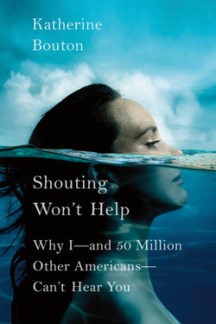
Hearing is necessary for effective listening. Thus, hearing loss is a critical issue for professions that require listening, such as lawyering. In her frank and informative book, Shouting Won’t Help: Why I–and 50 Million Other Americans–Can’t Hear You, former newspaper editor Katherine Bouton describes her struggle with hearing loss while trying to do a job comparable in many ways to lawyering.

ImageAs her hearing was declining—always in conjunction with personal stress such as her father’s death—Bouton was faced with boisterous editorial meetings and intense individual conversations. She tried to hide her deteriorating hearing for many years but ultimately began to accept help via hearing aids and other technology. Bouton tells her story in such an honest way; I can’t recommend this book enough. For further praise of the book, see Seth Horowitz’s New York Times review.

Hearing loss is far more common than many would expect. An estimated 48 million Americans experience some degree of hearing loss (about 17 percent of the population). “Nearly one in five people, across all age groups, has trouble understanding speech, and many cannot hear certain sounds at all,” Bouton writes, citing Johns Hopkins researcher Dr. Frank Lin. With approximately 1 million American lawyers in practice, the same math suggests that more than 170,000 lawyers are facing some degree of hearing loss.

Yet hearing loss is “an invisible disability”: “There’s no white cane to signal a problem, no crutches, . . . no bandages or braces,” Bouton writes. The lack of outward signals can mask various efforts to compensate. “Most hearing-impaired people quickly learn to nod or smile or respond in a noncommittal way, taking their signal from the speaker and the people around them.” These forms of compensation are imperfect at best, as Bouton acknowledges: “I lose the train of the discussion and ask a question that was just answered. I think we’re talking about one thing when we’re talking about something completely different.” And over time, the accumulation of awkwardness can lead to isolation and withdrawal. Bouton describes how she maintains her social lifelines, yet she also decided long ago not to participate in group conversations except with her closest friends.

Shouting Won’t Help is both a personal narrative and a treatise on hearing impairment. Bouton traces her own diminished hearing and environmental aggravators—primarily, noise. She acknowledges her fear of the conditions associated with hearing loss such as depression, heart disease, insomnia, and dementia. As to dementia, the correlation maybe a side effect of social isolation or cognitive overload, or there may be a common pathology—which, to Bouton and anyone facing hearing loss, is “deeply distressing.”

Bouton’s work is a particularly helpful read for lawyers because her work as a senior editor at the New York Times had a lot in common with lawyering. She struggled in phone conversations, editorial meetings where people talked over one another, and group lunches in noisy restaurants. She missed a lot in large public events such as the Broadway plays she was assigned to cover. “I communicated with my writers as much as possible either face-to-face, where I could read their lips, or by e-mail. I e-mailed people who were ten feet away. But there were a couple of writers who wanted to talk—by phone. Often these calls would go on for a half hour or forty minutes, with me catching just as much as I needed to murmur occasionally ‘That sounds good,’ ‘Oh, I’m so sorry,’ or ‘Well, just get it to me as soon as you can.'”

As Bouton came to terms with her impairment and need for hearing aids, she began talking to some trusted former colleagues. They had noticed behaviors that could describe lawyers’ attempt to compensate as well. As one friend and colleague remarked, “’I did notice that you often held back at meetings, and didn’t necessarily engage in conversational back-and-forth after you’d given your own assessment of a piece. . . . I recognized a certain reticence in your approach to the job. I could see from your reading of our knottier science stories that your analytical gifts were considerable, and yet I sensed a reluctance to use them fully in face-to-face interactions. I attributed this reticence to temperament, or to a discomfort with the management of the magazine, or to . . . a waning of interest in the workaday routines of journalism after years in the trenches.’”

As her hearing loss became more severe, Bouton was forced to accept the loss and seek help. Her book describes many methods for addressing hearing loss, from hearing aids and cochlear implants to phone amplifiers, caption technology, and special alarm clocks that mimic the sun at dawn. Technology called hearing loops can help with otherwise incomprehensible noise in public spaces such as museums and ticket loops. Bouton worked intensively with doctors and audiologists, using virtually every technology available. Yet she also experienced rough transition with some of her hearing aids and a missed opportunity to fully adjust to the cochlear implant.

Despite aversion to being a “joiner,” she also joined the Hearing Loss Association and attended meetings, where she met new people and kept up with new technology. Although her adjustments were time-consuming and results imperfect at time, Bouton concludes the book with gratitude—both for the many advances making now a “good time to be deaf” and, on an individual level, for the “freedom of coming clean” and not having to “fake it” anymore.

Next week Listen Like a Lawyer will feature interviews with lawyers who have faced and adjusted to hearing impairment in their life and work. Please share your thoughts below or contact me at jromig@emory.edu if you would like to share your experience with hearing loss.

Listening in the midst of turn sharks

Conferences are a unique listening opportunity, especially for those of us who regularly stand on the speaking side of the podium. Sitting in the audience at a conference presentation lets us experience and reflect on our own listening: are we perhaps just as distracted as those we complain about when we have the podium? If we tune out for just a moment, how hard is it to reintegrate into the speaker’s flow of ideas?

Flickr/Magnus Brath
Flickr/Magnus Brath

Being in the audience also gives us the social experience of listening. Listening and learning are not merely acts of individual will; our perception and comprehension are affected by the acts of those around us trying to do the same thing. There are some interesting social aspects of social listening I have learned about since starting this blog—for example, “turn sharks.”

I first read about turn sharks in Frederick Erickson’s book Talk and Social Theory. The phrase describes aggressive behavior during conversational turns—basically, interrupting someone else’s turn to speak and taking over. When there is a potential opportunity to speak, turn sharks circle the conversation opportunistically. They look for weaknesses in the speaker or pauses that would allow them to break in. If the turn shark thinks he or she can make the point better or has a related point that simply must be heard in tandem with what is being said, the shark raises a hand, uses nonverbal cues to enter the conversation, and sometimes just starts talking.

Turn sharks can be just a very strong version of what speakers want and what listeners in the audience need—that is, other actively engaged members of the audience. And a turn shark may be so aggressive because he or she really does have the most relevant or efficient thing to say. The speaker may wish to use such comments to advance the conversation.

But sometimes the turn shark begins to dominate, or to direct a conversation away from the speaker’s goals. To manage the dynamic, a speaker can try several strategies:

  • Demonstrate comfort with pauses and silence.
  • Listen receptively to each audience member’s comment, reinforcing that person’s autonomy as the speaker.
  • “Listen” visually by scanning the entire room to see who has a hand up, rather than opting for volunteer with the most aggressive body language.
  • Actively engage others in the audience by explicitly giving them a turn to speak.
  • Use a method such as a “talking stick” to reinforce who has the floor.
  • Protect audience members who have been targeted by a turn shark, returning the conversational focus back to them.

For single-session meetings such as at conferences, where the audience mixes and reconstitutes for each individual session, turn sharks may be as nomadic and unpredictable as real sharks. For ongoing social situations where the same audience comes together over time—such as, for example, in a class—conversation leaders may need to institute more structured conversational customs to let the sharks have their say while keeping others out of their jaws.

Here are a few questions for listeners and for speakers reflecting on the group dynamics when they involve the audience:

  • If you have been a member of an audience that included a turn shark, how did you react? How did the turn of conversation affect your listening?
  • If you yourself have been a turn shark, what was your motivation? How did you insert yourself into the conversation, and what was the impact on the group?
  • If you have led a single-session meeting that included one or more turn sharks, how did you handle the conversational flow?
  • If you have lead a multi-session group that included one or more turn sharks, how did you handle the conversational flow?

Many thanks to Emory Law Professor Barbara Bennett Woodhouse for feedback on this post.

Listen to learn: Four ways listening can help you get the most out of your externship

Listen Like a Lawyer is grateful to welcome this guest post by Kendall L. Kerew, Co-Director of Georgia State University College of Law’s Externship Program.

Kendall_Kerew

An externship (a field placement for academic credit) can be a great opportunity for law students to learn outside of the classroom alongside practicing lawyers and judges. If you are a law student beginning an externship this semester, you might want to consider the following ways listening skills can help you gain the most from your experience. If you don’t have an externship this semester, think about how you might be able to incorporate listening skills into your approach to a current or future internship or summer job.

1. Listen to maximize opportunities.

When you begin your externship, you may have a sense of what you want to learn from the experience. While it is important to clarify your own learning goals and expectations, it will add to your experience if you ask your supervising attorney or judge about his or her goals and expectations. What does he or she want to teach you? What experiences does he or she think you shouldn’t miss? What kind of assignments should you expect? What observation opportunities will you have? If you listen carefully to how your supervisor answers these questions, you will have a good idea of whether your goals are realistic and achievable.

2. Listen to increase understanding.

All externs have the shared goal of delivering a quality, useful work product. To get one step closer to achieving this goal, be sure you know what your supervisor wants. Listen to all parts of the assignment to make sure you understand what you are being asked to do and why you are being asked to do it. Ask clarifying questions to determine the scope and application of the assignment. Listen to the answers and ask follow-up questions.

Listening to your supervisor is just as important after you finish the assignment. Be sure to actively seek your supervisor’s assessment. Hear the feedback. Be open-minded and receptive to constructive criticism. You can’t improve without knowing where you went wrong or what you could have done better.

3. Listen to what others have to say.

You will interact with many non-lawyers during your externship. Be sure to listen to what they have to say. The administrative assistants, court personnel, and other interns/externs who support your supervising lawyer or judge can provide invaluable information about office procedures, preferences, and expectations. Listening to non-lawyers can provide you with a different and important perspective about the practice of law.

4. Listen to yourself.

Throughout your externship experience, you will be expected to actively reflect on what you are learning, not only about the law, but also about yourself and the formation of your professional identity. Set aside a few minutes each day to focus on yourself and engage in self-reflection. Ask yourself questions that will help you to figure out what kind of lawyer you want to be. What did you like or dislike about a particular assignment or area of law? What professional or unprofessional lawyering practices did you encounter and how did they make you feel? What lessons did you learn from observing the lawyers and judges around you? How do you want to practice law? Assess your likes and dislikes, your strengths and weaknesses, and map out your plan for the future (both immediate and long-term). The work you put into figuring out what kind of lawyer you want to be may prove to be the most important work you do all semester.

Kendall L. Kerew, Co-Director, Georgia State University College of Law Externship Program

The author is grateful to her externship program co-director, Andrea Curcio, for her helpful feedback and unflagging support and to Jennifer Romig for inviting her to write this guest post.

Listen Like a Lawyer’s Year-End Review

IMG_4525January 1, 2014 will begin the sixth month of Listen Like a Lawyer’s existence. In light of this benchmark as well as peer pressure from so many other blogs’ year-end reviews, this seems like a good moment to reflect on the blog’s brief past and to anticipate its future.

I am so grateful for the support received from many sources: colleagues at Emory Law School, where I teach legal writing, research, and advocacy; and many friends and acquaintances, both lawyers and non-lawyers, who have shared valuable contacts and relevant ideas about listening. Some lawyers have been particularly generous with their time, writing guest posts and giving interviews. Some of this content has already been published, and other content is yet to be published. For all who have allowed themselves to be associated with such a new endeavor, thank you!

For encouragement on the importance of listening skills for lawyers, I am especially grateful for the exchange of ideas with Professor Tami Lefko, Director of Legal Writing at Vanderbilt Law School. Professor Lefko and I look forward to our joint presentation on listening skills at the 2014 Legal Writing Institute Biennial Conference this summer.

The actual writing of the blog has involved elements of my experience as a lawyer, professor, and journalist. But blogging is a writing genre of its own. I am grateful to lawyer and blogger Dan Schwartz at the Connecticut Employment Law Blog, Professor Tim Terrell at Emory Law School, and lawyer Bard Brockman at Bryan Cave LLP for gently encouraging me to write shorter, more focused posts. I am working on it!

Just as there has been a learning curve for writing posts, there has also been a learning curve for sharing and distributing the blog. I am grateful to all who have retweeted, liked, and commented on Listen Like a Lawyer’s content. The blog has drawn interest from several communication experts, and I look forward to exploring and sharing their ideas on the blog in the year to come.

Looking to 2014, Listen Like a Lawyer will continue to offer weekly posts and curated tweets. The mix of content will continue to attempt to balance the interests of both law students and practicing lawyers. Of interest to both audiences, the blog will feature more interviews with experienced lawyers and legal professionals.

Please share your thoughts on what you’d like to see on Listen Like a Lawyer. Thank you! And Happy New Year to all. In the New Year, may we listen intently, compassionately, efficiently, strategically, and effectively. Please add your own adverbs in the comments below.

When All You Hear Is “No”

Active listening is an essential strategy for negotiating with difficult people, as discussed in this valuable post from At Counsel Table,

Alex Craigie's avatarAt Counsel Table

gtreHave you ever found yourself negotiating with a brick wall? Maybe not a wall, but an opponent, coworker, spouse or five-year old so entrenched in her position that it seems to take a herculean effort to procure even the slightest movement?

I’ve previously quoted from the slim but powerful text about negotiation strategy, Getting To Yes. One of the authors of that landmark, William Ury, subsequently wrote Getting Past No: Negotiating With Difficult People. I don’t know about you, but anyone who doesn’t go along with my program is clearly difficult.

Ury developed a five-step strategy for making progress with these . . . er . . . difficult people. The first step is to take your own emotions out of the equation; this will help prevent you from reacting without thinking, which can immediately stall or even end productive negotiations. Ury calls this Going to the…

View original post 1,116 more words