A Day of Listening      

Thursday, September 15, 2016, will mark the International Day of Listening, an event envisioned and promoted by the International Listening Association. This Day of Listening has its own website with some excellent listening resources and ideas.

screen-shot-2016-09-08-at-11-49-20-am

For lawyers, law students, law professors, and legal professionals, I will highlight a few ideas for what to do on the International Day of Listening. Or any day, really. The big idea is that listening is helpful on any given day.

Invite someone to a conversation.

The website provides a template form for inviting someone to a conversation. The template looks a little bit like a subpoena or affidavit, so lawyers wishing to make a personal connection with someone may want to avoid or modify the actual form and focus on the concept. The form envisions providing a topic for the conversation; this isn’t randomly generated small talk but a purposeful conversation. Even more important, the person initiating the conversation makes a commitment: “I promise to give my undivided attention and to do the best job of listening I can.” This is a one-way promise offering something valuable without expecting or demanding something in return.

Invite a group to a conversation.

The website also provides a template form for initiating a group conversation also centered on a stated topic. Here the group makes a pledge to one another: “We will all pledge to give our best efforts to listen well to one another.”

The phrase “best efforts” stuck out at me as an interesting term for lawyers. Ken Adams has analyzed the history and meaning of this phrase in contracts. Interpreting “best efforts,” various courts have imposed a good faith standard, something more than a good faith standard, a reasonableness standard, and a diligence standard. Because the idea of “best efforts” can be vague in a legal sense, it helps to compare efforts against a benchmark, Adams points out. Benchmarks can include explicit promises made during negotiations, industry standards, the same party’s practices in similar situations, and how the parties would act toward one another if they were united in the same enterprise.

Fortuitously, the website for the International Day of Listening does offer a nice benchmark-type resource. They don’t call it a benchmark or a bookmark but actually a “ListenMark.” It’s available both here and here in the Professional Activities section of the website. I think the intent is for people to use the “ListenMark” as a bookmark or other tangible reminder. Although the name is kind of corny, the content is excellent. From putting electronic devices away and giving undivided attention to giving nonverbal signals and being familiar with others’ expectations about how to show respect, it’s a solid overview of good listening practices. It could be a good review to glance over just before key meetings.

The Professional Activities section of the website is structured around lideas for professional activities to try on September 15:

·          Tech-Free Meetings
·          What Happens When You Tune Out
·          Free Listening
·          Listening to Opposing Viewpoints
·          Listening to a Life Story
·          Listening Café
·          Discussing Issues
·          Listening to TED
·          “When am I listening or being listened to”
·          Successful Listening Strategies
·          First Hit the Pause Button

One of my favorites on this list is “Listening to a Life Story.” Carole Grau submitted this idea, and it’s a good way to learn more about a longtime coworker—perhaps someone you see every day but don’t know that much about. The core of the activity is this:

Have the listener identify a significant company employee or a long­time employee/member that they (the interviewer) can interview about that person’s (the interviewee’s) life story and their experience within the organization. What have been significant events in the company/organization or in the person’s life while they have been employed or a member?

Bar associations encourage activities such as “take opposing counsel to lunch.” What about dedicating some listening time to a longtime contributor within your own firm or organization? The longtime courthouse runner at my old law firm recently passed away; he was a consummate legal professional with so many great litigation stories. He would have been an incredible interview along the lines Grau suggests.

The outline for listening to a life story gives more details on conducting such a conversation and listening effectively. It recommends resources such as an app offered by  StoryCorps, which itself promotes a National Day of Listening the day after Thanksgiving every year. (In a world of so much talking past one another, we really can’t have enough listening days.)

These are just a few of the ideas and resources available on the website supporting the International Day of Listening. The purpose of this post is to encourage lawyers, law students, law professors, and all legal professionals to recognize and practice listening on September 15, 2016, and other days too.

Do men and women listen differently?

A friend asked whether Listen Like a Lawyer has ever blogged on this:

Do men and women listen differently?

That’s an interesting—and fraught—question.

Some websites and popular books on communication skills propound appallingly simplistic statements with no research support. And the research on gender and listening that does exist has been described as “scarce and inconsistent.” (This is Laura Janusik surveying the literature up to 2007.) Still, the research is based not on speculation or stereotypes, but on a variety of actual studies with real participants (often college students, more on that later). And the results of this research serve to challenge overly simplistic beliefs about sex and gender.

FYI, the articles cited in this blog post are listed at the end. The information in this post focuses on listening generally or in professional settings, not in personal relationships. This is a very long post but it’s intentionally combined into one post so that the “nature” and “nurture” points can be taken together in context rather than in isolation. And the post tries to maintain the terminology of sex for biological differences and gender for psychological/self-identified/cultural roles.

Here is a simple takeaway if you don’t want to go through the rest, from a 2003 article by Virginia Tech professors Stephanie Sargeant and James Weaver:

Despite the popular reception of gender asymmetry in the way we talk with, listen to, and interact with one another, considerable research suggests that sex differences may actually play only a minimal role. Canary and Hause efficiently summarize the literature when they conclude, after considering hundreds of studies represented in meta-analyses, “sex differences in social interaction are small and inconsistent; that is, about 1% of the variance is accounted for and these effects are moderated by other variables.”

(Intrusive citations have been omitted from this quote.)

If that’s all you need to hear, now’s a good time to stop reading. The rest of the post goes into some various more specific gender-related findings on hearing and listening.

Hearing

The first step in listening is hearing. And this is where the strongest sex-related difference actually has been found. Audiology research in 2008 reported men are 5.5-times more likely to suffer hearing loss than women. After controlling for factors such as noise exposure, smoking, and cardiovascular condition, the study still found men had a higher rate of bilateral and high-frequency hearing loss (i.e both ears and higher sounds). An earlier study found “hearing sensitivity declines more than twice as fast in men as in women at most ages and frequencies.” That study also that hearing decline generally begins for men at age 30, whereas the age varies for women, and age-related hearing loss occurs regardless of low-noise or high-noise work environment.

Regardless of sex or gender, Listen Like a Lawyer previously blogged about lawyers and hearing loss here and here, and recommends to readers to have their hearing tested and get a hearing aid if recommended.

Listening

Beyond hearing, generally accepted definitions of listening involve some form of mental processing and responding. The International Listening Association has adopted a definition of listening that centers on process:

the process of receiving, constructing meaning from, and responding to spoken and/or nonverbal messages.

Detailed research findings on whether the broader listening process differs by gender are summed up by Kittie Watson and Larry Barker in their 2000 book for popular audiences, Listen Up:

Although the literature on cognitive processing suggests there are innate gender differences, most behavioral scientists believe gender differences in listening are more influenced by our cultural socialization than by a biological predisposition.

It seems there are two parts to unpacking that:

  1. possible innate gender differences in cognitive processing, and
  2. the behavioral view based on cultural socialization.

The innate differences have to do with brain activity while listening:

Brain research studying hemispheric processing discovered that when men listen they process language using the left hemisphere while women process language through both the right and left hemispheres.

If true, this study suggests implications for how men and women listen:

Since emotions are processed primarily in the right hemisphere, and language in the left, men may not be able to connect words to feelings as easily or effectively as women may.

Watson and Barker go on to summarize further research that because of this left-brain processing, men may be less distracted as listeners because they essentially receive only one message rather than multiple messages. This contradicts some popular psychology claiming men are more distracted listeners—reinforcing the point that overbroad answers to this question are too simplistic. In terms of brain processing and listening, another study cited in Watson and Barker found that men tend to remember the “gist” of the conversation, whereas women tend to recall precise words and phrases.

But the left-brain/right-brain finding is itself subject to dispute. These sex-based processing differences were found in an Indiana University study in 2001 by Phillips et al. But a larger study from two years earlier did not reach the same findings:

[A] larger scale MRI study (50 men, 50 women) concluded that men and women actually do not have substantive differences in lateralization of brain activity or brain activation patterns during a listening task.

This is from Andrew Wolvin’s overview of research in Listening and Human Communication in the 21st Century (2010), citing a 1999 study by Frost et al. (On a  related side note, the reliability of pretty much all fMRI research has recently been questioned.)

Listening comprehension

It’s also unclear whether any such processing differences make a difference in actual listening comprehension. Auburn professor Margaret Fitch-Hauser and colleagues did a study of actual listening comprehension—they called it “Listening Fidelity”—where participants were exposed to spoken words and then were tested on their listening comprehension. This study found no difference in listening comprehension among men and women (college students in this case). They also found listening comprehension did not significantly relate to the participant’s self-described listening style. In other words, listeners with a more “people-oriented” preferred style did not perform significantly differently from those whose preferred listening style leans towards information or tasks (more on this in a moment).

The listening process overlaps with working memory, as remembering the message (or not) relates to the listener’s response. A 2016 study of concentration and listening (as well as reading) comprehension reiterated past studies finding no gender differences in working memory. That study by Wolfgramm and colleagues, surveying a group of sixth graders in Switzerland, reached somewhat complex findings on gender. The overall finding was that concentration is a significant factor in listening comprehension, although not so much in reading comprehension. Along the way, the study reached findings that contradicted a perceived gender gap (favoring girls) in reading and listening:

Boys . . . outperformed girls in one of the listening comprehension tests. However, girls scored higher when tested for their ability to concentrate and for working memory but not when tested for vocabulary. This indicates that boys seem to have more problems with bottom-up processing than girls do. Nevertheless, problems with bottom-up processes do not affect boys’ performance in listening and reading. It would seem that boys compensate for their underperformance in concentration and working memory: We presume academic self-concept to be a possible factor accounting for that compensation.

Listening, self-concept, and social status

And this raises the strongly conflating issues of nurture and culture. “Academic self-concept” refers to confidence or anxiety at the task. In the Wolfgramm study, boys had a higher academic self-concept than the girls, and their self-concept compensated for whatever processing differences might exist. This is just one example of how socialization by gender could play a significant role in the question of sex, gender, and listening.

One paper reviewing various studies on gender and stereotypes pointed out that experimental participants listened more carefully when they occupied “low status” roles and were assigned to listen to “high status” individuals. The paper, by Michael Purdy and Nancy Newman, pointed out the connection between status and gender:

There are compelling reasons, according to LaFrance and Henley (1994), why women are usually better at “performing” the nonverbal affective display of listening than men. They link this motivation to men’s “greater social power relative to women in everyday social interactions.”

Listening preferences

As children grow into adult learners, they develop listening preferences which also correlate with gender. Dr. Kittie Watson created a questionnaire that has been used extensively, with survey questions revealing one of the following four listening styles:

  • The people-oriented listening style has an external focus on other people.
  • The action-oriented listening style prefers an organized approach focusing on the facts and results.
  • The time-oriented listening style prefers short and to-the-point statements that do not interfere with other scheduled activities.
  • The content-oriented listening style focuses on facts, evidence, and support, and less on who is speaking.

A 2007 study by William Villaume and Graham Bodie found a “rather small relationship” between gender and listening styles. They set out to study the connection between personality (including gender perceptions as one factor) and listening styles by administering a series of questionnaires to college students. Students completed the Listening Styles Profile as well as a questionnaire on their gender role exploring “gender role self-perception” resulting in a “masculinity” or “femininity” score. They also completed a battery of other surveys regarding personality traits, communication style, communication competence, apprehensiveness at communicating and receiving communication, verbal aggressiveness, argumentativeness, and “interaction involvement” such as attentiveness, perceptiveness, and responsiveness.

Villaume and Bodie did find that having an action, time, or content orientation was slightly affiliated with self-reported masculinity score. But people who strongly identified with “feminine” or “masculine” traits both scored higher in terms of people-oriented listening styles. In other words, “people-oriented listening is associated with both high femininity and high masculinity.”

And overall, the gender effect was small, explaining about 5 percent of their study results in light of the other personality-driven factors they included. For example the “Big Three personality traits” measure extraversion (sociability); neuroticism (anxiety); and psychoticism (deviation from social norms). Their study found that Big Three personality differences explained about 9 percent of their study results. The much broader list of personality traits did much more of the work in explaining their study results.

Villaume and Bodie ended the paper with some caveats including the inherent limitation of studying college students. Their comments were not about gender but I think it’s very much about the realities of working as a legal professional:

More importantly, the fact that all participants in this study were university students may affect the nature and strength of the canonical functions derived. These students have not held professional-level jobs with real pressures to get work done efficiently and effectively. It is possible that the listening preferences of these students may change with the added pressures and complexity of professional life after university. This study should be replicated with a sample of adults holding jobs in the working world. It is possible that people-oriented listening may no longer be characterized with all the positive associations reported in this study. Content-, action-, and time-orientations in listening may become more positively evaluated.

Listening skills in the workplace

Other research does look at how working professionals listen and communicate in the workplace. A 2013 paper on working professionals surveyed staff and managers in medium and large organizational environments. In this study, Welch and Mickelson used a “Revised Listening Competency Scale” (developed by Andrew Wolvin and Carolyn Coakley) to evaluate their survey participants on the following types of listening:

  • Discriminative listening means listening for auditory cues, attending to verbal and nonverbal signals.
  • Comprehensive listening means paying close attention to the actual message.
  • Therapeutic listening is emotional listening and letting a speaker “vent.”
  • Critical listening evaluates the message to support a decision of accepting or rejecting it.
  • Appreciative listening is listening for enjoyment.

Using these dimensions of listening, Welch and Mickelson studied working professionals focusing on two key variables: (1) level of employment (staff, line or middle manager, or senior manager) and (2) gender.  Were staff and managers different at listening? At the same level of employment, did men and women show differences?

Their findings are fairly complex. Here are a few takeaways:

  • For discriminative listening, the study did not find gender differences among employees at the same level (staff, line and middle managers, and senior managers).
  • For comprehensive listening, there were “very large gender differences” for line and middle managers, with women scoring higher. The study found: “Comprehensive listening is a core skill that differentiates managers from staff, and that also differentiates female managers from male managers.”
  • There was a moderate difference in genders on therapeutic listening, with women scoring higher.
  • There were apparently no significant differences among genders in critical listening at the same level of seniority.

Just an individual’s perception of gender role impacts listening style, Welch and Mickelson pointed out the possibility that male and female managers might relate to their organizational culture differently, explaining some of the differences they found. “Male and female managers might approach their organizational culture with different beliefs about different types of listening,” they hypothesized.

But their more significant findings centered on the listening progression:

[I]ncreased listening competency is associated with more responsibility.

This possibility led them to recommend more study of how listening quality develops over time.

Conclusion

To conclude this tour of the gender research on listening, here is an insight from Melissa Beall’s overview of intercultural listening. She’s quoting an earlier study by Purdy and Newman in 1999, which they presented at the International Listening Association. That study looked at “good and poor listener differences according to gender.” The study reached a finding that resonated:

[T]here were several characteristics that respondents identified as characteristics of good listeners, no matter which gender: eye contact; willingness to listen; shows interest; asks for clarity; gives feedback, and offers advice when wanted.

Thanks to Professors Margaret Fitch-Hauser and Debra Worthington for reading an earlier version of this post.

Sources and links (for non-paywalled sources)

Yuri Agrawal et al., Prevalance of Hearing Loss and Differences by Demographic Characteristics Among US Adults: Data from the National Health and Nutrition Examination Survey 1999-2004, Arch Intern Med. vol. 168 (July 28, 2008).

Larry Barker and Kittie Watson, Listen Up: At Home, At Work, In Relationships: How to Harness the Power of Effective Listening (2000).

Melissa Beall, “Perspectives on Intercultural Listening,” in Andrew Wolvin, ed., Listening and Human Communication in the 21st Century (2010).

Margaret Fitch-Hauser, William G. Powers , Kelley O’Brien & Scott Hanson, Extending the Conceptualization of Listening Fidelity, 21 Int’l Journal of Listening 81 (2007).

Laura Janusik, “Listening Pedagogy: Where Do We Go From Here?” in Andrew Wolvin, ed., Listening and Human Communication in the 21st Century (2010).

Michael Purdy and Nancy Newman, “Listening and Gender: Stereotypes and Explanations,” Paper presented to the International Listening Association (2000).

Stephanie Lee Sargent & James B. Weaver III, Listening Styles: Sex Differences in Perceptions of Self and Others, 17 Int’l Journal of Listening 5 (2003).

William Villaume and Graham Bodie, Discovering the Listener Within Us: The Impact of Trait-Like Personality Variables and Communicator Styles on Preferences for Listening Style, 21 Int’l J. Listening 102 (2007).

A. Welch & William T. Mickelson, A Listening Competence Comparison of Working Professionals, 27 Int’l Journal of Listening 85 (2013).

Christine Wolfgramm, Nicole Suter & Eva Göksel, Examining the Role of Concentration, Vocabulary and Self-concept in Listening and Reading Comprehension, 30 Int’l J. Listening 25 (2016).

Andrew Wolvin, “Listening Engagement: Intersection Theoretical Perspectives,” in Andrew Wolvin, ed., Listening and Human Communication in the 21st Century (2010).


 

Eulogy

Yesterday I attended the memorial service for a beloved family member. An activist in his church and community, he was remembered with love everywhere he shared his talents. The eulogy featured one line I wanted to share:

“He had a booming voice . . . but he was a good listener.”

Rest in peace, Lee.

Tomorrow’s lawyers

What do lawyers need to be good lawyers? A project in Denver is investing a lot of time, energy, and resources into answering that question. It’s the Foundations for Practice study, generated by Educating Tomorrow’s Lawyers, an initiative of the Institute for the Advancement of the American Legal System.

The background on Foundations for Practice is this:

In late 2014, we launched Foundations for Practice (“FFP”), a national, multi-year project designed to:

1. Identify the foundations entry-level lawyers need to launch successful careers in the legal profession;

2. Develop measurable models of legal education that support those foundations; and

3. Align market needs with hiring practices to incentivize positive improvements in legal education.

And since then, they have managed to start and finish a huge survey, reaching 24,000 lawyers nationwide. Their survey covered a breadth of law-related topics:

We asked respondents to rate the necessity of 147 foundations (plus two questions that allowed write-in responses); we asked fourteen questions to identify respondent demographics and practice information; we asked about the value of specialization in law school and in early practice; and we asked the respondents to identify the helpfulness of employment criteria (like law school attended, class rank, clinical experience, externships, and letters of recommendation).

One of their key goals was to survey what skills need to be in place when lawyers start their careers, as contrasted with skills that can and should be learned over time on the job. What’s important for new lawyers? Questions on the survey about what new lawyers need probed respondents’ thoughts in three categories:

  • “Legal skills” are those traditionally understood to be required for the specific discipline of law (such as preparing a case on appeal).
  • “Professional competencies” are skills seen as useful across vocations (such as managing meetings effectively).
  • “Characteristics” are foundations capturing features or qualities (such as sociability).

The overall payoff of the Foundations for Practice study is that respondents ranked these categories in the following order of importance:

1. Character

2. Professional competencies

3. Legal skills

So this is a pretty big finding: statistically, aspects of good character were reported to be the most necessary for new lawyers right out of law school. The study got to this number by finding that 76 percent of character items in their survey (items such as “integrity and trustworthiness, conscientiousness, and common sense”) were ranked by half or more of the respondents as necessary.

The next most important category was professional competencies “such as listening attentively, speaking and writing, and arriving on time.” 46 percent of these competences were identified by half or more respondents as being necessary for new lawyers.

And the final category was legal skills “such as use of dispute resolution techniques to prevent or handle conflicts, drafting policies, preparing a case for trial, and conducting and defending depositions.” For these items, 40 percent were ranked by half or more of respondents as being necessary for new lawyers.

The section of the report titled Foundations for Practice contains an overall summary of the 77 characteristics, competencies, and skills that more than half of the respondents deemed necessary for new lawyers right away. Some of the most highly rated items involve communication:

  • 91.9 percent of respondents said it is important for new lawyers to treat others with courtesy and respect
  • 91.5 percent of respondents said it is important for new lawyers to listen attentively and respectfully
  • 80.4 percent said it is important for new lawyers to regulate emotions and demonstrate self-control
  • 77.7 percent said it is important for new lawyers to demonstrate tact and diplomacy
  • 72.9 percent said it is important for new lawyers to be able to work cooperatively and collaboratively in a team
  • 71.7 percent said it is important for new lawyers to seek and be responsive to feedback
  • 69.2 percent said it is important for new lawyers to demonstrate tolerance, sensitivity, and compassion
  • 60.8 percent said it is important for new lawyers to react calmly and steadily in challenging or critical situations

Happily, the survey reveals a broad attitude that many skills can be learned on the job as lawyers. A new lawyer can learn to draft a document or take a deposition. But the study also suggests the belief by respondents that new lawyers either cannot learn character on the job or shouldn’t need to; they should already have it.

Educating Tomorrow’s Lawyers will hold its 5th Annual Conference next month. I won’t be able to attend but would welcome tweets and guest blog posts focused on communication skills from those who do attend.

Here’s another overview of the study from Keith Lee of Associate’s Mind, who also serves on the study’s advisory group. His post shows how the study’s data can be mined for more specific information.

A simple model of listening

All models are wrong, but some are useful.

-George Box

This statement, which originated in the field of statistics, came to mind when I read a recent business article, “There Are Actually Three Kinds of Listening.” According to the article, the three kinds of listening are:

Physical

Mental

Emotional

Basically this brief article—labeled a 5-minute read—says good listeners use appropriate body language, stay attentive, and empathize.

This framework for listening is memorable, but may be oversimplistic. I cringed when I read this advice for being a strong “mental” listener:

If the person uses lots of “um’s” and “ah’s,” or hedging phrases like “sort of” and “maybe,” it’s a good bet that their ideas aren’t fully baked, or that they’re less committed to them.

After a middle-school teacher expressed this same opinion of “um” to her child, law professor Barbara Gotthelf did some academic research on linguists’ approach to “um.” She found a very different view, prompting her to publish The Lawyer’s Guide to Um:

[U]sing uh and um was not only “perfectly normal,” but also helpful in furthering effective communication.

In fact, she found,”the actual effects of fillers on listeners may be less dire than imagined and may even be beneficial under some circumstances.” I recommend Gotthelf’s article for anyone who has been harshly critiqued for using “uh” or “um”, and for anyone tempted to offer such critique to others.

This is but one critique of the basis for the “physical, mental, and emotional” formula. But using these three concepts as a checklist before a people-intensive meeting could help quite a bit. Statistician George Box also wrote, “overelaboration and overparameterization [are] often the mark of mediocrity.” For listeners interested in enhancing their actual listening behavior (as opposed to studying it later), an “overelaborated” or “overparameterized” model of listening would be useless or worse.

And this simple three-part model seems like it could actually be useful.


Learning styles, revisited

For the past month, I’ve been struggling with an ankle injury. Yesterday at the orthopedist’s office, the medical questionnaire asked about patients’ preferred learning style. The question was something like this:

Screen Shot 2016-08-03 at 8.21.06 AM

My answer was and remains, “ I don’t care how you give me the information as long as you fix my ankle!”

And that connects to a post from last year, “Back to school means ‘what’s your learning style?’” That post points out that learning styles are better thought of as learning preferences by individuals. It cites some research and analysis questioning whether teaching to an individual’s preferred learning style actually enhances their learning outcomes. In other words, it’s not clear that teaching to learning styles helps people actually learn.

The consensus at least among learning-style skeptics is this: learning-style preferences do not mean information actually is more effective when packaged to meet any one person’s preference. A learner may prefer to learn visually, but certain lessons about music must be presented in auditory format. A learner may prefer to learn by acting and moving, but certain math concepts must be presented visually in a formula. For physical therapy, learning by doing makes a lot of sense so you can model the right way to do the exercises. The basic takeaway is this:

The nature of the information is the most significant factor in how that information should be presented to learners.

This is an important point for those who care about good listening skills. With the popularity of texting and email and other screen-based forms of communication, comfort with and preferences for listening and face-to-face conversations would seem to be in jeopardy. Future lawyers should not use their exposure to learning styles to say, “I’m going to text the client this bad news instead of calling her because I prefer to get information in writing and visually.”

As I wrote last year, many people have written really good articles about using learning styles in the law-school classroom. And none of this is to excuse a decision by a professor to always use the Socratic method or any other default method. But it is worthwhile to question what seems to be the very popular belief that people learn information effectively when it is reshaped to fit their preferences.

It’s interview season

For law students working on fall campus-interviewing opportunities, here is a roundup of posts on listening during interviews:

And a few additional posts of interest to candidates facing interviews:


What lawyers say, and what they actually do

How do lawyers transfer their knowledge? Lawyering scholars have been talking about “tacit knowledge” since the early 1990s. A recent ABA publication encouraged law students to use their externships and other practical experiences to interact with lawyers and try to glean some of that tacit knowledge via “extensive personal contact, regular interaction, and trust.” I touched on tacit knowledge in an early-summer blog post encouraging summer associates to talk with experienced lawyers about their work and to closely observe their nonverbal signals during these conversations.

This advice suggested perhaps the slightest hint of the idea that there might be dissonance in what lawyers say they do and what they actually do. An article by one of my law-professor heroes, Richard Neumann, Jr. explores this concept in depth.  The article is Donald Schön, The Reflective Practitioner, and the Comparative Failures of Legal Education, 6 Clinical L. Rev. 401 (2000). It attacks superficial notions of lawyering and legal education at multiple levels.

What is the difference between what lawyers say they do and what they actually do? The real tacit knowledge is in what they actually do—which they may not be willing to describe or even fully aware of.

This insight is from the work of Donald Schön, a now-deceased professor of architecture at MIT. Schon’s ideas and Neumann’s exploration of them aren’t new, but the insights remain relevant and helpful.

Schön sought a deeper understand of tacit knowledge, questioning its foundations:

[T]acit knowledge is not necessarily accurate knowledge. Because it is tacit, it is also unexamined.

And because it is unexamined, it may be worthy of the term “knowledge” only in sarcastic quote marks:

The tacit ‘knowledge’ of an ineffective professional might be nothing more than superstition—and correspondingly dangerous to clients.

Schön questioned professionals’ capacity to understand and describe their own work. What professionals think they do and what they actually do are often entirely different. Here he used two terms to categorize false and real tacit knowledge. (Neumann, while clearly a fan of Schön’s work, didn’t really like his terminology, and here you may feel a particularly strong urge to close this browser window. But consider plowing on.) Schön’s terms distinguish what a professional says about the work from how the professional actually does the work:

  • A “theory of action” is how a person describes the work they do.
  • A “theory-in-use” is what actually governs the person’s actions.

As a result, we can only learn a person’s true “theory-in-use” by observing their behavior. More broadly, this discrepancy “makes it harder to improve how professionals work.” A lawyer might resist making a change out of the mistaken belief about what she is actually doing. “Because our theory of action seems satisfactory to us, we do not see any reason to change.”

And willingness to change isn’t necessarily sufficient to make a real change. “[E]ven if we can be persuaded to change, we might be satisfied” just by changing our theory of action. This is a change in name only if “we continue what we were doing before because our theory-in-use remains unexamined and controls our actions.”

I’ve thought about this concept with legal writing, and writing generally. It’s much easier to change one’s nominal theory of action, especially if that means adopting new writing software or formats or labels about what one is doing. In an article titled Fighting “Tippism,” Stephen Armstrong and Timothy Terrell wrote about how superficial writing “tips” are no substitute for the real work of learning and using the lessons of rhetoric, logic, and cognitive psychology.

In the realm of listening, the problems equally difficult if not more so because listening is so difficult to observe and measure. One may have a theory of action that they are in fact a great listener and an active listener. They are totally on board with the value of listening.

But their theory-in-use could be quite different. How well someone listens can be described in three major categories, according to Melissa Daimler, Head of Learning and Organizational Development at Twitter, writing for the Harvard Business Review Blog:

Internal listening is focused on your own thoughts, worries, and priorities, even as you pretend you’re focusing on the other person.

Focused listening is being able to focus on the other person, but you’re still not connecting fully to them. The phone may be down and you may be nodding in agreement, but you may not be picking up on the small nuances the person is sharing. 

360 listening.  You’re not only listening to what the person is saying, but how they’re saying it — and, even better, what they’re not saying, like when they get energized about certain topics or when they pause and talk around others.

A lawyer may believe he is a 360 listener, when in fact he is an obstinately internal listener. This mismatch of belief means the lawyer does not feel any need to work on listening because how can you improve upon something already pretty terrific?

And if such a lawyer does read a blog post or attend a training on listening, she might pick up a new term of art for listening, such as “I’m a 360 listener,” while remaining rather poor at it.  This obviously connects to the Dunning-Kruger effect of being so bad at something that you don’t even know you’re bad.

Schön and a collaborator apparently tried to address this difficulty through seminars and training that guided participants to confront the differences between their theories of action and theories-in-use. They sought to help professionals recognize two major approaches to going about professional work:

  • Model I exhibits “highly developed rationality and a commitment to goals and winning.”
  • Model II “develops the largest amount of valid and relevant information and generates the largest number of options from which to choose.”

Model I sounds a lot like a stereotypical lawyer personality. That’s not good news. Model I—also known by Robert Condlin’s term “persuasion mode”—has a lot of problems. Persuasion mode is sometimes useful and beneficial, but as a default personality it has some significant pitfalls, as described in Neumann’s article:

[A] person in persuasion mode tends to act on hidden agendas and strategies; “to minimize self-analysis and to reserve it for private moments when it will not weaken instrumental effectiveness”; and to argue in ways that are subtle but “needlessly stylized and hyperbolic.” Persuasion-mode behavior is profitable in situations where the struggle is for control rather than insight, and where the “self-sealing properties of persuasion mode habits” minimize tentativeness and perplexity. “Persuasion-mode habits predispose lawyers to take evaluative stands automatically” so that they “make statements that, on reflection, they know to be false.” “It causes one to impute rather than explore others’ ends, shut off rather than encourage legitimate objection, . . . and accumulate rather than share decision-making authority.

The other possibility is the learning mode, also known as the inquiring mode. Neumann’s essay on Schön explores how the inquiring mode is more consistent with curiosity, open-ended thinking, and exploration of ideas regardless of consequences. A number of benefits accrue to clients and lawyers, with more meaningful and effective collaboration at the top of the list. The collaboration is better in at least two ways: First, the lawyer does not have to maintain a “professional façade” of being the expert. “The ‘expert’ will want “deference and status in the client’s response to [the] professional persona,” while the reflective practitioner will prefer a ‘sense of freedom and of real connection to the client.’”  At the same time, a client may feel more comfortable with a lawyer in persuading mode because the client can sit back and rely on the assumption the lawyer is the expert and will do everything right. A more reflective lawyer can create a more reflective relationship with the client. In these relationships, lawyer and client “join” in making sense of the case. The client gains “a sense of increased involvement and action.”

With the inquiring mode, lawyer-client collaboration is better in at least two ways: First, the lawyer does not have to maintain a “professional façade” of being the expert. “The ‘expert’ will want “deference and status in the client’s response to [the] professional persona,” while the reflective practitioner will prefer a ‘sense of freedom and of real connection to the client.’” At the same time, a client may feel more comfortable with an “expert” lawyer in persuading mode because the client desires the comfort of passive reliance. A more reflective lawyer can in turn create a more reflective relationship with the client in which lawyer and client “join . . . in making sense of the case.” The client gains “a sense of increased involvement and action.”

Neumann’s review of Schön’s work ends on an extended exploration of how difficult it is to teach any of this in a formal curriculum—especially the curricula of medical and law school as distinct from the arts and architecture. Teaching reflection and modeling it in experiential classes are crucial. One way to start is simply by sharing with law students and lawyers Schön’s essential and upsetting insight that the way we intuitively explain what we do may not be very accurate.


More on flow and listening

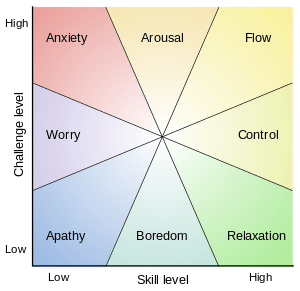
Feeling “flow” means being fully immersed in a challenging task, with a sense of energy and enjoyment. Lawyers might find flow when they have enough skilled experience to know what they’re doing and encounter a new challenge using their skills, as previously mentioned in this post. The founder of flow theory, Mihaly Csikszentmihalyi, created a visual model of flow:

Screen Shot 2016-06-14 at 5.20.20 PM
Credit: Wikipedia (citing Csikszentmihaly, Finding Flow (1997))

As you can see the states inferior to “flow” reflect a mismatch between skill and challenge:

  • Apathy
  • Boredom
  • Worry
  • Anxiety

States with a closer match can be found closer to the upper-right:

  • Control (but the skill slightly outweighs the challenge)
  • Arousal (but the challenge slightly outweighs the skill)

In the far upper right area, where a high skill level meets a high challenge level, you find flow.

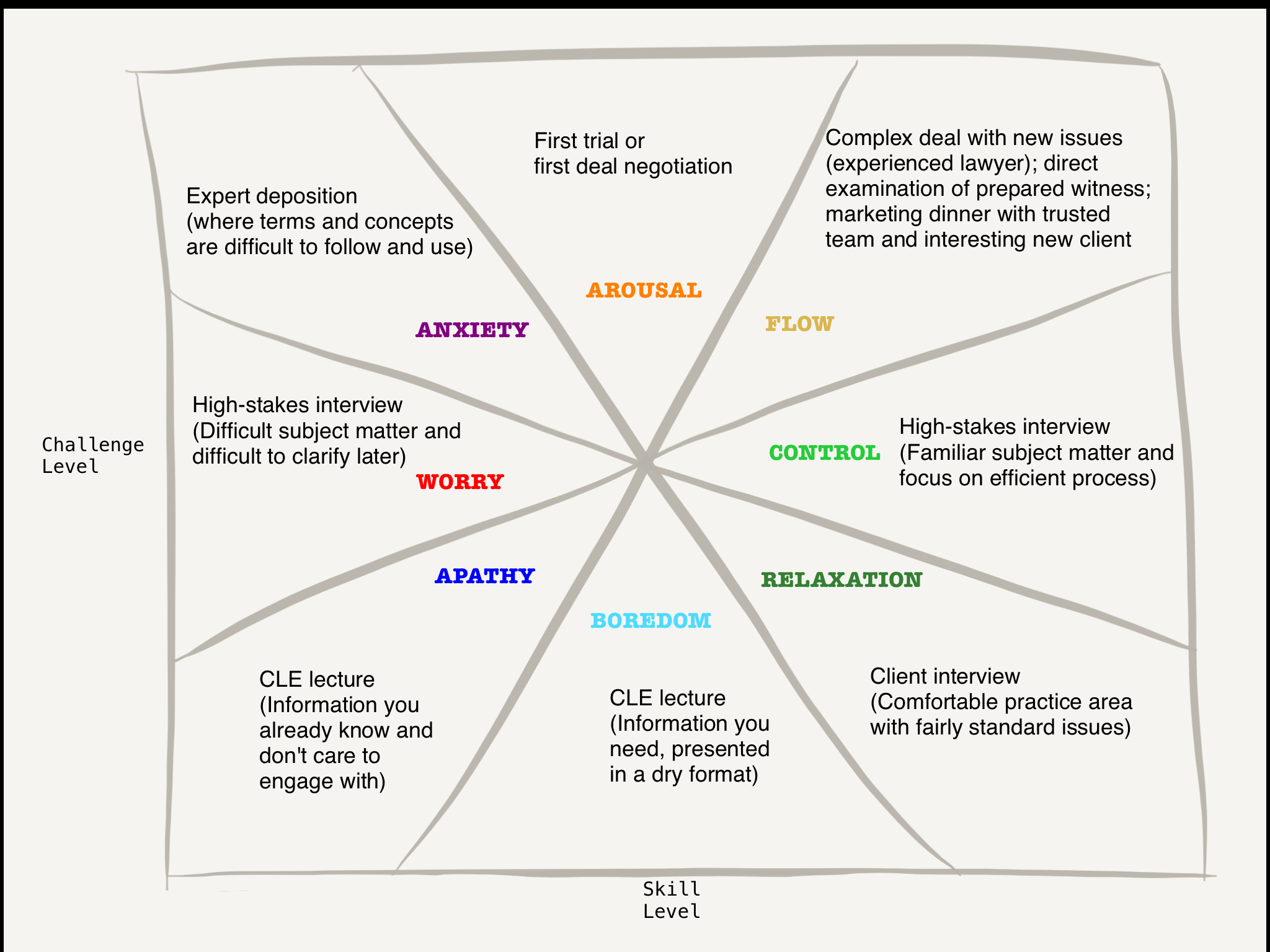
The model below is a variation on Csikszentmihalyi’s general model, tailored for lawyers and legal professionals. The examples here all focus on listening.

image

Please use the comments or social media to suggest other examples and share thoughts on lawyers and flow. What types of listening experiences prompt apathy or boredom? What types of experiences prompt worry or anxiety?  And what experiences may lead to flow?

Q&A with Peg Cheng, the Prelaw Guru

ChengPeg Cheng has worked in prelaw advising for more than twelve years, six and a half with the University of Washington (UW) and another six as the founder of her law school admissions consulting company, Prelaw Guru, which helps aspiring law students prepare their applications. Before that she worked in career counseling as well, bringing her grand total in higher education student services to 18 years.

And she says:

“I’m done.”

Peg is moving into full-time work as a writer. She is in the process of wrapping up Prelaw Guru as of July 2016. Listen Like a Lawyer is grateful to Peg for sharing some of her insights from her years of experience working with aspiring law students.

What has your work in prelaw advising taught you about listening?

What really is an advisor? The advisor has two jobs: One, listen. Two, tell the truth. That’s it.

All the work I’ve done with college students has taught me to be a better listener and a better writer. I couldn’t have done it without the students. Some people think advising is about talking. But if you don’t listen first, your advice is not effective.

How have you used listening with the students you advised and your clients in prelaw consulting?

Clients always tell me they appreciate the opportunity to think about their own stories. That’s what I’ve done: listen to their stories in person, on the phone or Skype, and in their prewriting on the writing prompts I’ve given them.

I was spending so much time with the interviewing and listening that I developed an exercise called “49 Stories.” They are writing prompts to help law-school applicants brainstorm what they might talk about in their personal statements. The process is for the student to set a timer for 3-5 minutes and write as fast as they can. What I’ve noticed is that the internal editor starts to turn off.

The 49 Stories are organized to begin with “softballs”—that is, easier prompts. As the student progresses, deeper prompts are sprinkled in. Completing the exercises allows the person to first sit back and appreciate the ideas they’ve come up with—and also to start to see themes from their life.

So this was a way of saving my own time spent on all those interviews. But the writing itself helps. The more they write, the less they fear the whole process of writing a personal statement. Dyslexic students are an exception. They’re allowed to write less and then tell me more over the phone or Skype.

I read their stuff and tell them what stories I heard. They are in the middle of it and couldn’t see the stories that are valuable to tell. They would spill their guts and then didn’t know what to do after that. So, I would give them permission to write about their lives. They would say “Oh, I can write about that? I never thought of that.”  I help them see how the story is a good representation of them. 99 percent of the time, they say “You’re right, I’ve got to tell that story.” And then they crank it out.

Law school admissions officers are always telling applicants that personal statements need to be personal and about you, even if inspired by another person. Generally there’s going to be one with stronger and more personal elements. It’s almost always the most personal story. Not necessarily the most tragic, but the most personal. It’s about finding the personal in your past and ascribing meaning to it.

Some professors have said personal statements are so trite and formulaic. But I push back against that. If you’re tired of reading something formulaic, that means you’re tired of reading stories. Stories are formulaic! The subject matter changes, but the formula is the same.

The best story to tell almost always has to do with making a change. Stories are about change. And stories are really about human survival.

Law school applicants have the opportunity to meet with admissions officers at law school fairs and forums.  What’s your advice to applicants for managing those conversations?

Students go in thinking, “I’m going to apply these particular schools.” And they are listening to anything that backs up their plan. If they hear something that doesn’t back it up, they’ll stop listening.

When you are really listening, it sparks more questions. Some students are thinking so much about how they present themselves that they ask questions but don’t really listen. And honestly when I was 20 or 21, I was like that too. So let’s clarify some of the reasons this happens: Nerves get in the way. Ego gets in the way.

Students think they will impress the admissions officers by speaking—by what they say. But listening can help them create a better impression. Someone once shared with me some advice I’ll never forget:

Instead of trying to be interesting, try to be interested in.

Whenever I follow this advice, the people I’m talking with and listening to develop a higher opinion of me than if I had tried to impress by talking and being interesting.

Asking questions is a great opportunity to listen and learn. What are some of your favorite questions for law school applicants to ask?

I tell students to ask questions that most people don’t ask. For example, how frequently does the Dean meet with students? How easy is it for students to meet with the Dean? Some admissions people know this right off the bat. Others give vague answers with nothing set up institutionally. Be suspicious of that. The Dean sets the culture and attitude of the law school. Having a regular time to meet with students shows a level of care for the students.

I also ask about faculty culture. I watch how the admission person acts when answering the question. They may not have a great relationship with the faculty. Do they smile instantly? Do they look away and hesitate? For me, how they answer is as important as what they say.

What do you see in prelaw students today?

For me, prelaw students seem to fall into two major camps. They are all achievers—because the people I’ve worked with at Prelaw Guru are by definition achievers in some way—but they generally fall into two groups.

There’s a small group who are good listeners and also very humble and very skilled. They often have something like a 3.9 GPA and a good LSAT score. They aren’t perfect. They are very neurotic and worried about their future. But there’s a relationship between their humbleness, their skill, and their dedication. This is a very small group and they always amaze me. I’m always heartened to find that the most achieving students are also the most humble and the most worried.

The other group is much larger. They’ve struggled too, but I don’t know if they realized how hard law school is going to be. They’re not as worried. They tend to think they will continue doing what they’ve been doing. They may not have been challenged enough in college. They’re not arrogant, but they haven’t experienced enough to know how hard it’s really going to be. They may not have ever failed.

You mentioned a certain profile of some law students as humble but also worried. How do you think law students can cultivate their mental health throughout this process?

One of the biggest problems I see with prelaw students is they depend too much on external markers of success. They get depressed when they don’t receive those external markers, like the grade they wanted to get in a certain class. The focus on external markers leads to anxiety, drinking, and depression.

Those who are more mature realize it’s about internal markers of success. Even if they don’t get the grade they wanted, they can focus on what they learned from the class and the professor. I worked with one law student who was 10 years older than the typical law student. He grew up in a low-income area with a single mom. He said he had been lawyering ever since he was 12 years old, standing on the street corner listening to people, giving them advice, and helping them advocate for themselves. And this is the advice he gave me to pass on:

You have to rage against the machine.

The machine wants you to believe if you get high grades, you’ll be a good lawyer. If you get a big law job, you’ll be a good lawyer.

But you have to realize the machine is not you. You have to find your own version of success.

This student knew he wanted to be a public defender. He would constantly ask for help and get to know everyone both in and out of the law school who could help him toward that goal. And by his third year, he had his job offer in the public defender’s office before graduation and was ready to go.

In terms of listening, how can prelaw students get ready to be better listeners in law school and as practicing attorneys?  

Any type of work experience or internship or volunteer work where they have to listen will help them later. It doesn’t have to be legally oriented. One of my clients did customer service for a pharmaceutical company that helped her develop great listening skills. Many students I’ve met have done  intake work as an intern or volunteer where they have to interview people and then write up those interviews in a report. They benefit from understanding what it means to be of service by listening rather than by speaking. Journalism is also great.

I’m not a fan of lectures where students take a lot of notes then take a test. Sadly, many classes are taught this way. It may be necessary to impart content and a certain way of thinking to students, but I think schools with more hands-on learning in classes will have more successful students.

Students should think about how they learn best. Some can read and absorb what they’ve read. Others need to read and then reiterate out loud what they’ve read. Others learn best by hearing the material spoken out loud. There are lots of different ways of learning and the students who do the best have found ways to support or supplement their learning style.

How have you worked on your own listening skills?

The more I listen and take risks at telling the truth about what I’m hearing, the better results I get. I did a lot of own experimentation with advising during my years at the UW. Also I had several years of personal and business coach training prior to working at the UW that helped me a lot. As I kept experimenting with my students, I realized that’s what people are really looking for—for someone to listen to them and tell them the truth—even if they don’t seem to know that’s what they want initially.

What I have learned is to listen to clients and ask questions that help the client come up with their own solutions. And I tell the truth about what I heard. I try to ask questions that lead the person to the truth, for them. It’s important to understand as well that what’s the truth means different things for different people.

You are working on a career transition yourself.

I’ve always been writing on the side. Last year I wrote a middle-grade novel. I’m working on an adult suspense novel now and I’m also writing a personal finance book for college students.

This month, I’m wrapping up my consulting business and my online personal statement class. My last clients for this admission cycle have all got back to me and let me know their plans, so I feel good about that. It’s been great to help so many people, but I’m one of those people who likes more variety. And I think you should get out of something when you still like what you’re doing. So I will be a full-time writer this whole year, and then see where I’m at next January.

What’s funny is that being a full-time writer has really helped me relate more to my clients and the fears they had about writing their personal statements. They would tell me, “I don’t know if I can do it. But I keep telling myself, this is so important. This is going to decide my future.” I can totally relate to that! This is my year for writing; it’s not a year about procrastinating about writing. That means every single day, I go through the fear and the self-doubt, and just do it.