
Facilitating Dialogue Across Difference

SilversteinMany thanks to Gail Silverstein, Clinical Professor of Law at the UC Hastings College of the
Law, for this guest post about the ABA Section of Dispute Resolution’s recent conference. Gail co-directs and co-teaches an Individual Representation Clinic and a Mediation Clinic at UC Hastings.


The 19th Annual Spring Conference of the ABA Section of Dispute Resolution took place in my hometown of San Francisco, California, on April 19-22, 2017. While participants in the March for Science gathered nationally, conference attendees on Saturday morning learned about facilitating dialogue across difference from the team at the Harvard Negotiation and Mediation Clinical Program at Harvard Law School in a session entitled “Dialogue through Difference: Expanding the Legal Skill Set.”

Harvard’s political-dialogue initiative came out of observing both a national need for dialogues across political differences since the 2012 election and a need at the law-school level as students seemed unable to engage politically in the classroom beyond one standard “liberalish” viewpoint. The three goals of the initiative include:

  1. Educating students to skillfully facilitate and participate in dialogues across difference
  2. Serving the community by providing facilitation services
  3. Creating and sharing pedagogy in this area to build the field

The session described how the initiative is faring thus far and also introduced a new educational video, available soon, entitled “Police-Community Dialogue: A Facilitated Conversation Featuring Commentary with Harvard Law School Professor Robert C. Bordone.” (See trailer for this video here.)

Bookmark Side 2

Session speakers described how the skillset needed for facilitating dialogue across difference contrasts with those of the traditional lawyer. Three of these skills include building connection, unlearning control, and creating comfort with discomfort. Despite the contrasts with the traditional lawyer archetype, all of these named skills relate to listening as both a skill and value that is essential for today’s lawyers.

Building connection

In these dialogues, there is often not a particularized set outcome. Rather, facilitators need to help people connect to one another and their different perspectives and to try to understand where people are coming from in their viewpoints. For Tobias Berkman, who facilitated the police-community dialogue featured in the video, the most important questions used in this sensitive dialogue were ones that engaged the participants personally—for instance “How have these issues impacted you personally?” and “What to do you bring to this?”

Even more important than asking the right questions, listening is the key way we help to build connection with others. The kind of listening that these difficult facilitations require is likely the same type of listening that is helpful to lawyers in early client interviews or during emotionally laden conversation with clients: an open-ended, compassionate listening. I often refer to the work of Peter Elbow on “methodological belief” when I teach my students this type of connection-building listening.  To Elbow, methodological belief is the discipline of listening with the intention to believe what the speaker is saying.  This type of listening, Elbow advances and my experience confirms, allows the listener to feel the power of the other person and his or her ideas, which creates the connection and understanding to which we aspire.

Unlearning control

Second, political-dialogue facilitators need to unlearn that they need to control the process to have a smooth external appearance. Tobias Berkman shared that what looks and feels like a safe place to some participants is actually a “delusion” that privileges a certain kind of engagement. While some appreciate calm and rational conduct, anger and hostility are important for others to express, in order to command respect and power. To maintain a composed exterior on the dialogue does not indicate success for a facilitator as it may be clamping down on important emotions and modalities of expression.

Again, listening is a core component of unlearning control as it is the manner by which we allow the outside world to affect us. In comparison to speaking, which is one of the primary tools by which we impose ourselves on the world, when we listen we allow ourselves to be affected by others. As such, listening is a type of ceding control over ideas, emotions, and narratives to others. All lawyers need to find a good balance between speaking and listening to be effective.

Creating Comfort with Discomfort

Third, political-dialogue facilitators need to build their own comfort with discomfort as they work to move toward the disagreements, instead of shying away from conflict and the multiplicity of emotions. Berkman, along with his co-facilitator Danielle Bart, emphasized that being able to maintain and sustain vulnerability while facilitating can be incredibly powerful and can function as a model for participants. At the same time, it can be demanding for a facilitator to show up authentically as a whole person, particularly in high stakes situations. Rachel Viscomi who teaches Harvard’s “Lawyer as Facilitator” class to law students finds instructive Brené Brown’s vulnerability motto in helping others learning to be genuinely present in these situations:

“Don’t shrink. Don’t puff up. Stand your sacred ground.”

One barrier to effective listening can be our discomfort with our own internal emotions or those that others are expressing to us. Instead of being able to focus on the other person, we become distracted internally or shut down. This lesson of leaning in to the discomfort, which I learned in my mediation training years ago, is a key piece in the internal work necessary to be an effective and skillful listener.

To conclude, in this increasingly polarized world, augmenting lawyers’ skillset to both lead and participate in political dialogue is an incredibly important effort. It harkens to Professor Anthony’s Kronman’s “lawyer-statesman ideal”—that he believed to be failing—where the lawyer possesses qualities such a great practical wisdom, sympathy for others, and a devotion to the public good.

Kudos to the Harvard Negotiation and Mediation Clinic for responding to society’s needs and keeping this ideal alive.

Additional resources:

Anthony Kronman, The Lost Lawyer: Failing Ideals of the Legal Profession (Harvard University Press, 1995).

Peter Elbow, “Methodological Doubting and Believing: Contraries in Inquiry,” in Embracing Contraries: Explorations in Learning and Teaching (Oxford: Oxford University Press, 1986).

Harvard Negotiation & Mediation Clinical Program’s Blog

Access to Harvard Law School’s Police-Community Dialogue Case Study (fee based)

Stuck in the Middle with Everyone

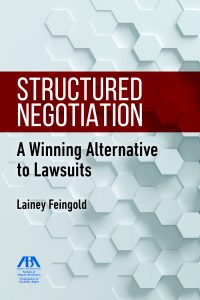
DSC_0866-Version-2-258x300Thanks to Lainey Feingold for this guest post. Lainey is an author and disability civil rights lawyer. Her book, Structured Negotiation, A Winning Alternative to Lawsuits, was published by the Dispute Resolution Section of the American Bar Association in 2016.  She is the 2017 individual recipient of the Section’s John W. Cooley Lawyer as Problem Solver Award.
Later this week I will be presenting at the annual conference of the Dispute Resolution Section of the ABA. The Section published my book last year and I’m excited to be sharing my ideas and meeting and learning from leaders in the field.

Many of those I’ll meet are professional neutrals—private mediators and arbitrators or court-based neutrals.  Many others are academics, teaching the next generation of lawyers how to be collaborative amidst the conflict-based culture of our profession.

I’m not any of those things.

I’m a disability civil rights lawyer who represents blind people seeking access to technology and information.  Before I became a disability rights lawyer over 25 years ago I represented labor unions and women and minorities in civil rights employment cases.  I’ve never been a neutral.  Never been in the middle.

Or have I?

Advocate as Peacemaker

For the past two decades, my clients, co-counsel, and I have negotiated national accessibility agreements with large organizations like Bank of America, Walmart, Major League Baseball, and the City and County of San Francisco.  Enforcing rights guaranteed by the Americans with Disabilities Act and other laws, we reached these agreements without any lawsuits on file, using a dispute resolution process called Structured Negotiation.

Structured Negotiation, the subject of my book, gives parties the tools to talk—and listen—directly to each other.  Third-party help from a mediator can integrate well with the process, but is not required.  In close to 75 cases I’ve negotiated with Structured Negotiation (and without lawsuits), I’ve called upon a mediator just a handful of times.

In all my cases I was, metaphorically, on one side of the table with my clients.  But over time, I discovered the table was round.

9.28-StructuredNegotiations_CV-200x300In writing my book about Structured Negotiation I was introduced to a book that proved crucial to my thinking about the work my clients and I had done for two decades:  Bringing Peace into the Room: How the Personal Qualities of the Mediator Impact the Process of Conflict Resolution edited by Daniel Bowling and David Hoffman.

The book explores the qualities that allow mediators to “bring peace into the room.” Although I’ve never been a neutral “in the middle,” it struck me that lawyers practicing Structured Negotiation also “bring peace into the room.” Reading the essays in Bowling and Hoffman’s book I realized that “bringing peace” and being a strong advocate are not mutually exclusive.

To the contrary, being a peacemaker can serve the advocate’s goals just as it serves the mediator’s.

Understanding that participants in Structured Negotiation are peacemakers gave me new insight on the process my colleagues and I had nurtured since our first cases on accessible banking services in the 1990s.

And a new understanding of the possibility of the middle.

The middle is not a mythic center, but a place of common ground

Perhaps the “middle” is not only a place for a skilled neutral seeking compromise from reluctant advocates.  Instead, maybe the “middle” is the common ground all parties seek in a dispute.  As an advocate, my role is to help the parties get there, never losing sight of my clients’ goals.

Looked at in this new way, the middle is not a precise center point between two opposing views.  When my blind clients needed ATMs that talk so they could use them independently, the middle had Talking ATMs, although my clients may have compromised on the timing of particular features.

It was the same during Structured Negotiation with the nation’s largest pharmacy chains for prescription labels that talk, so blind people can safely take medication. As an advocate in Structured Negotiation, my job was to convince our negotiating partners in the pharmacy industry that the middle has talking labels.

The elements of Structured Negotiation made that convincing possible.  An opening letter that invites participation instead of demanding.  Collaborative meetings instead of one-sided, often bullying depositions.  Relationships that emphasize trust instead of distrust; patience instead of its opposite.

Of course, sometimes there is no middle, no common ground.  Sometimes collaborative peacemaking must step aside for a judge’s order. In the new political reality of Muslim bans, attacks on public schools, and threats to freedoms of every sort, traditional litigation has already proven an indispensable tool.  And it always has been.  But it is not the only tool in the advocate’s toolbox.  Peacemaking in its various forms is in there too.

Fear keeps people from common ground; listening gets them there

In my years of negotiating without lawsuits, I have seen fear as a key obstacle in an advocate’s ability to be a peacemaker. In my cases about website and mobile app accessibility, fear that the law will change, technology won’t work, or the cost will be too high are common.  In other fields the fears will be different but the tools to dissolve those fears are the same.  Talk openly.  Listen carefully. Don’t make the lawyerly mistake of assuming the ‘other side’ is hiding the ball or withholding the truth.  Provide a forum for clients to get to know each other.  Show don’t tell.

I’ve seen firsthand that helping everyone around the table get past fear is not reserved for a neutral positioned between opposing parties.  It is the job of the peacemaking advocate as well.


All this leads me back to this week’s ABA conference this week.  It reminds me to listen carefully to the words of the traditional peacemakers—the private and court-based neutrals—and to the law professors and clinical directors.  I know they will be helpful to my clients and to me as we continue to be the best advocates we can be, seeking a middle that works for everyone. 


Visit Lainey’s website or follow her on Twitter for more information. The title of this piece came from the theme song of her favorite TV show, Grace and Frankie. The song was written by the Stealers Wheel and covered for the show by Grace Potter.


Let the ice cube melt

The other day I had to have my eyes dilated. As they slowly came back into focus, I tested them on this week’s issue of The New Yorker. One of the essays focused on Allison Janney, currently starring on Broadway in “Six Degrees of Separation.” Janney’s character in the play owns a Kandinsky (Wassily Kandinsky, one of the first abstract artists of the early 20th Century), and in the New Yorker essay Janney was viewing a Kandinsky at the Guggenheim as she gave the interview:

On her phone, she pulled up a Kandinsky quote from the play: “It is clear that the choice of object that is one of the elements in the harmony of form must be decided only by a corresponding vibration in the human soul.” She grimaced. “A sentence like that is so hard to understand,” she said. “It’s like an ice cube that hasn’t melted. That’s the way my father used to talk about learning the piano or learning a language. He said, ‘It’ll melt, just give it time.'”

Kandinsky’s actual quote seemed like a legal writing professor’s dream, in terms of editing issues to attack:

  • throat-clearing language (“It is clear that…”)
  • a gaggle of prepositional phrases (“of…of…in…of…by…in…”)
  • passive voice, of course (“must be decided only by…”)

But underneath the verbiage is the artist’s essential concept. How could that wordy sentence be rewritten without changing the concept? I came up with the following:

“The artist must decide on elements in the harmony of form only by seeking a corresponding vibration in the human soul.”

This edit cuts 10 words. Is it better? Even though it reflects standard writing edits, it changed some of the original. Most obviously, obliterating the passive means adding an actor. But maybe Kandinsky wanted to hide “the artist” by using the passive. The most concrete thing in the whole sentence is the last thought—“a corresponding vibration in the human soul.” Using abstract, passive, verbose language leading up to the final culminating moment—“the human soul”—is itself a form of verbal artistry.

This conceptual verbal artistry is at home and welcome in art-theory discourse, not so much in legal writing. The values of plain language and efficient writing have little use for a quote like “It is clear that the choice of objects . . . blah blah blah.”

So after reading Kandinsky’s quote in the essay, I was ready to move on to another portion of the magazine. But luckily, I finished the paragraph, catching Allison Janney’s wonderful turn of phrase quoted from her father:

“It’ll melt, just give it time.”

I think she meant that after effort and thought by the person approaching this sentence, the sequence of words will break down. They will “melt” into meaning in the person’s mind. The sentence itself doesn’t change; after all, that’s what Kandinsky meant for it to say. But the person encountering the sentence can melt it in their own mind so it’s not so rigid and foreboding.

How does this melting occur? As Janney’s father advised her, through time and patience. Not through focused effort directly lasered onto the ice cube. An ice cube melts effortlessly through the passage of time.

This ice-cube metaphor seems to me a wonderful metaphor for learning the law as well. For new law students faced with old cases and new concepts in arcane and twisted language, at times the only logical reaction is to grimace—just as Janney did when she read the Kandinsky quote. And of course you can apply techniques, tips, and tricks (as shown earlier in this post) to break down what you hear and read into something you can actually understand and use.

But really, ultimately the only valid long-term strategy is letting the ice cube melt. It melts slowly and imperceptibly. But then, at some point, something has happened. You can speak the language, and you can play the instrument. The ice cube has melted. You are thinking like a lawyer.


5701354582_350e99527b_o
Lorena Biret/Flickr/CC by-SA 2.0


Postscript on “um”

Yesterday I had the pleasure of moderating a Facebook chat on Rutgers law professor Barbara Gotthelf’s article The Lawyer’s Guide to “Um.” She published it in Legal Communication & Rhetoric: JALWD (for which, full disclosure, I’m a social media editor.) The Facebook chat, available here in LC&R’s ongoing Discussion Group, was a chance to explore and, in some cases, push back on her unexpected thesis:

Lawyers who speak before courts, clients, and other discerning audiences should know how fillers function to communicate information; they should understand that the actual effects of fillers on listeners may be less dire than imagined and may even be beneficial under some circumstances.

More specifically, Gotthelf shows in the paper how listeners comprehend speech better when it contains some discourse markers and “fillers” (also known more favorably as “planners”) such as “um.” Taking a text and reading it out loud perfectly, with no fillers, is less effective for speakers  than inserting some speech cues—including, yes, “um.”  Use of fillers such as “um” can signal delay while processing a thought, but can also preserve one’s “turn” to talk, attract attention, or actually help emphasize a point.

Building off of Gotthelf’s paper, the most heated part of the Facebook Discussion, if you can use “heated” to describe a respectful group of people who appear to care very much about the topic as well as one another, concerned whether to explicitly call students out on using “um.” Professor Gotthelf’s strongly held belief is NOT to point them out early in a student’s preparation cycle:

Many of my students begin the semester with annoying habits. Umms, giggling, hair twirling. It’s early nerves. That stuff melts away on its own as the students gain confidence from practicing and thinking about their arguments.

In that sense, Gotthelf said, “ums” are caused by natural unpreparedness, which can be cured naturally as well, by substantive preparation. Georgia Tech professor Brian Larson uses the opposite approach:

I DO point them out. In fact, we count each other’s (I subject myself to video as well) ums and uhs per minute in presentation videos (undergrad presentation class). We do so to draw attention to something that many audiences find annoying. I also draw attention to the fact that as a very experienced public speaker, I still average 4.5 UPM (ums per minute). Thus, there is no point freaking out about a few ums/uhs. Most of them start the semester at 12-15 ums per minute and are down below 8 by end of semester.

This debate is important because, as Gotthelf writes in the paper, there are two causes for uttering “um”: (1) task complexity and (2) task concern. Basically when a task is more complex and more vocabulary options to describe a single idea, the speaker is more likely to say “um.” And—in a painful but all-too-understandable irony—being self-conscious about speaking makes a speaker say “um” more. Which of course leads others to comment on the speaker’s use of “um” as a problem to fix, leading to even more self-consciousness.

Although there was disagreement about whether to be explicit in addressing “um,” the discussion participants seemed to agree that obsessively fixating on “um” is a mistake. As Gotthelf noted in explaining why people hate “um” so much, it’s partly because “um” is simple:

It’s easy and superficial to focus on things like “um.” It’s much harder to evaluate the content of what someone is saying.

She also noted in the paper that historically—in the classical glory days of spoken rhetoric—no one cared about “um.” Only with playback on radio and TV did “um” become a major perceived problem. And now a distaste for “um” has entered the popular view of what good speaking is:

I think people just accept the conventional wisdom about “um” and don’t dig deeper. So that conventional wisdom gets repeated and repeated and becomes cemented.

Still professors have to prepare students for the world that is, not the world we wish for. Thus some thoughtful approach to helping students avoid excessively distracting “ums” was a common theme—even if that means rigorously never mentioning “um” at all.


Wellness for lawyers…even in Australia

BIO_JDThanks to Jerome Doraisamy for this guest post. Jerome is a 29-year-old lawyer and writer from Sydney, New South Wales. He left legal practice after stints in commercial firms, academia and research, and a major federal government inquiry, to publish his first book, The Wellness Doctrines for Law Students and Young Lawyers. He currently works as a contract consultant for law firms and universities.

Culture can have an insidious effect, either for better or worse, according to the chief justice of the South Australian Supreme Court, The Hon. Chris Kourakis. Wellness initiatives must therefore cater to lawyers’ idiosyncratic needs. Simply checking boxes with standard topics related wellness is not enough.

This past month, the sixth Australian National Wellness for Law Forum—an annual conference for like-minded legal academics, practitioners, judges, practice managers and students—focused its attention on how best the law profession can engender greater levels of self-perception, diversity, inclusion, respect and empowerment, on individual and institutional levels. Australian lawyers gathered in Adelaide for this Forum, where former Australian Football League player Jake Edwards gave the keynote. Edwards founded Outside the Locker room to help support teen football players in Australia. He speaks in a way lawyers can understand:

Discussions of wellness in any endeavor or profession must be “idiot proof.”

That means empowering lawyers and legal professionals to incorporate wellness in their own idiosyncratic way.  “Wellness, for me, means being the person you need to be, not looking to others for inspiration,” Edwards explained. In other words, efforts to ensure a more personalised, human feel to wellbeing issues in law are paramount moving forward.

The workplace productivity of approximately one in three Australian workers is compromised by reduced levels of wellbeing, according to the South Australian Health and Medical Research Institute. This reduced productivity—aside from the obvious health and wellness concerns for individuals—impacts upon national industry and economy.

But addressing such fiscal and commercial concerns cannot be done without adequate consideration for the personal and emotional. There are a number of places we as legal professionals in Australia, and indeed across the world, could start, as I learned from voracious consumption of the wisdom imparted at the Forum:

  1. Learning how to listen better

A problem shared is a problem halved. It people feel as though they can truly be heard when discussing issues (whether they be work-related or intrinsic) they are much more likely to feel appreciated and connected. Taking the time to really listen to people—and not just speak at them from our perspective, or project our own issues—when told of their struggles can make a tangible difference to workplace culture, civility and collegiality.

  1. Catering wellbeing efforts to all staff, including management

Those in senior positions have a professional duty of care to employees to ensure a safe workspace, but that duty can and should also be extended on a personal level, whereby a manager is seen to be an exemplar of balanced wellness. How leaders manage their own quantum of stress or workplace anxiety may lead to effective, specific strategies through which those in employ can be helped and also help themselves. As such, all institutions should ensure wellbeing activities cater to staff across the board, in order to engender wellness wherever it is needed.

  1. Effective integration of the personal and professional

Many people associate stress with the workplace, and well-being with home life. While this is, in many cases, both reasonable and understandable, there can and should be a better nexus between the two environments, so work becomes an avenue through which people are inspired and uplifted, rather than simply tolerating hours spent in the office. Initiatives aimed at increasing resilience and wellbeing should not simply be tantamount to putting a gas mask on the canary in the coalmine; compliance is only half the battle. A caring workplace culture, which caters to the personal and emotional needs of all individuals, gives rise to much more than mere compliance requirements. It makes people feel engaged which, by virtue, increases productivity and success.

“Um” and its discontents

Umm, hi everyone. Umm, does anyone want to join the Facebook discussion I’ll be moderating on Thursday, April 6 at 3 p.m. Eastern? (Note this time is corrected from some earlier messages.)? The topic is the article “The Lawyer’s Guide to Um” by professor Barbara Gotthelf in Legal Communication & Rhetoric: JALWD. Professor Barbara Gotthelf will be joining the conversation, which is open to all lawyers, legal professionals, and law students. You just have to join the Legal Communication and Rhetoric Discussion Group on Facebook before the discussion begins.

I previously mentioned the article here on the blog and recommend the entire thing—which is a pleasure to read—as preparation for the discussion. Gotthelf does not hide the ball:

[U]sing uh and um was not only “perfectly normal,” but also helpful in furthering effective communication.

Whether you hate “um” or barely even notice it, if you’re interested in lawyering and public speaking then this conversation is of interest to you.

This Discussion Group is a project of the journal Legal Communication & Rhetoric: JALWD and is active during scheduled discussions such as this one. This Discussion Group seeks to bring together lawyers, law professors, law students, and legal professionals generally to discuss legal writing and advocacy topics. I’m one of the Social Media Editors for Legal Communication & Rhetoric and look forward to moderating this discussion.

International Women’s Day: A Small Contribution

Almost exactly four years ago I started writing posts for Listen Like a Lawyer, working on posts for several months before launching in August 2013. My main motivation was to write about listening as an underappreciated part of law practice and legal education. I believed then—and believe now even more strongly—that effective listening is a significant factor distinguishing successful lawyers and law students. I believed then—and believe now even more strongly as well—that effective listening is endangered by the smartphone-centric professional lifestyle embraced/necessitated/passively accepted by many in the legal industry.

Gender was not at the forefront of my motivations at the time, although I had certainly been “manterrupted” and advised to smile more and criticized for being too business-like and too meek etc. etc. etc. (There was also the visiting scholar who put a hand on my knee while saying anyone who teaches legal writing must be an idiot, and some other worse memories. But those experiences were not on my mind when launching the blog.)

In these four years, I’ve touched on gender in a number of posts. Maybe not enough, but some. I was going to manually curate those posts here, today, in recognition of International Women’s Day.

And then I realized something much better, something obvious that should have been here all along: a blog category for gender. Instead of copying and pasting links, I’ve searched through the archives and added the gender category to relevant posts. Readers should be able to see the gender category here at the top of this post. Just click on it for access to other relevant posts. “Do men and women listen differently?” is the most gender-focused content on this site as of now, and the answer is, “It’s complicated.”


Judge like a judge, please

The Supreme Court of Georgia recently held arguments on site at the law school where I teach. This was an excellent service for legal education. In class discussion afterwards, my students truly could not contain their enthusiasm for what they observed.

All of the advocates brought different strengths to the podium. One stood out for something he did when any of the justices asked a question:

He paused.

He stood very still throughout his argument and maintained socially appropriate eye contact. When asked a question, he took a moment. During this moment, he did not look down at his notes or up at the sky or left or right. Throughout the pause, his body language was calm and consistent with the rest of the argument.

And—during these pauses—here is something else that stood out:

None of the other justices interrupted the advocate.

They held whatever questions they may have had as the advocate paused, considered, and then responded to their colleague on the bench’s question.

After the argument, I had the opportunity to speak with a few of the justices over lunch. I commented generally about how it’s good for law students to see that they don’t have to race to answer the question. It’s okay to pause and think.

To my delight, one justice said he noticed that too. He said that if he’d had the chance to address the audience after the arguments, that would have been the key idea he emphasized as a teaching point.

And that leads to my plea to moot court judges.

Please let the competitors pause.

Pausing to think is not a weakness. It’s a strength.

It is possible and pretty easy to grade an oral argument based on whether the advocates answer quickly without pausing. This is, frankly, an easier grading criteria than whether they give a good answer.

It’s also possible and pretty easy to interrupt when someone does pause and ask them another question. Then you can also grade their argument on whether they remember and answer two questions at once. That’s also an easier grading criteria than whether they give a good answer.

But if the goal is to help law students become effective advocates, instant responses are not the right grading criteria.

Don’t deduct points for pausing. Add points for pausing and giving thoughtful answers.

The corollary practice is this: when a competitor does pause, don’t interrupt to and add a question. That’s borderline disrespectful to your colleague on the bench who asked the first question and presumably wants to hear the answer.

Moot court judges may meet each other for the first time when they assemble to judge a competition round. But they should still model the collegiality and respect that is apparent on the bench. If a moot court judge asks a question, assume it’s important to that judge to hear the answer.

The result of allowing competitors to pause is this:  Competitors’ answers will be better. The judges’ evaluation will be more accurate on the substance of the response. Speed and lack of hesitation are not an accurate proxy for substantive effectiveness—even in a competitive oral argument setting, and even by 2L and 3L students who’ve tried out and been selected to compete in moot court.

Most of all and beyond the four corners of any score sheet, competitors allowed to pause and think will become better lawyers. They will become the type of lawyer that one day could receive a compliment by a state Supreme Court Justice, for pausing and thinking.

For more information about effective—and ineffective—moot court judging, see Barbara Kritchevsky, Judging:  The Missing Piece of the Moot Court Puzzle, 37 U. Mem. L. Rev. 45 (2006) (available on Lexis and Westlaw).

Also see the Legal Writing Institute’s Model Oral Argument Judging Guidelines.

Soft rock didn’t work

It’s that time of year when I spend hour upon hour upon hour reading and commenting on law students’ draft briefs. To do this, it’s necessary to have a personal “culture of commenting.”

I’m borrowing that phrase from a wonderful writing book, Hilton Obenzinger’s How We Write: The Varieties of Writing Experiences (2015). In the chapter on writing “costumes, cultures, rituals, metabolisms, and places,” he shares delightful stories from a variety of writers on how they create their own personal “culture of writing.”

He credits historian Mary Lou Roberts for the phrase. And Roberts’s own culture of writing apparently includes listening to soft rock. Here’s Obenzinger sharing his interview with Roberts:

[I]t comes as “a shock to some of my students” that she listens to a radio station that features “really bad soft rock.” The fact is that she is no fan of soft rock, but “I can’t listen to good music, because I get distracted.” She can listen to good music when she does something tedious and somewhat mindless, like footnotes; but when writing original material, she needs to be irritated by music that bothers her. “I find as a writer I am best off when I am a little bit distracted. Because if I get too focused, I get stuck; I am thinking too hard about it. I need to either go away from it and come back, which works really well, or I need to be slightly distracted. So the soft rock station “is perfect because the music is listenable at a certain level, but I’m not totally distracted by it.”

Well, I tried it. It may create a culture of writing for one person, but it did not create a culture of commenting for this person. “If You’re Gone” by Matchbox Twenty and its ilk on Pandora Soft Rocks channel did not help me find my grove. Too many words conflicting with the words in my head of what I’m reading and what I might like to share with the student as a comment. My students do not need to hear any voices inspired by Rob Thomas. (“I wonder what it’s like to be the rainmaker” just does not work; legal writing is about the stuff you have to do before making the rain. And “little yellow tags” aren’t really involved in the paperless Real World as much as they used to be.)

I’ve tried the Ambient Radio channel as well, but it just reminds me of the movie Gladiator, which doesn’t help either. The songs are “Elysium” and “Now we are free.” For me to create a culture of commenting, plow through the work, and be free, ambient music turned out to be a fail as well. I do put on the giant ugly headphones from time to time. But I listen to . . . nothing.


Lawyers as heroes

Some clients are heroes—or plausibly can be portrayed as heroes in legal briefs. The lawyers remain in the background, telling the story without inserting themselves into it.

Another type of legal writing I study and teach is legal blogging. What I’ve noticed in reading lots and lots of legal blogs is that some lawyers portray themselves as heroes. More than scattering in a few personal pronouns for personal interest, sometimes I see lawyers telling a story with themselves as protagonist, fighting a particular battle or war for years.

This type of blogging narrative tends to crop up in areas where the lawyer represents individuals against the government or large well-organized business sectors. Two areas that come immediately to mind are criminal defense and immigration.

My practice background was in commercial litigation and intellectual property. It was certainly nice to help clients solve problems and navigate disputes. I did help small businesses fend off David-v-Goliath-like situations. I did work with people who cared very much about what happened to them. But at the end of the day, it was business litigation. All of these clients had other things they could do if their very worst outcome happened in whatever lawsuit they faced.

That background made it hard for me to truly get it when lawyers blogged as though they were heroes in an epic struggle. It seemed like there was a lot more lawyer than client in some of these blogs. Why is their own battle and their own story so important that they could explicitly put themselves at the center of it? I suspected a power imbalance, letting the lawyer subordinate the client’s story to the lawyer’s. I suspected ego.

The events of this weekend with the Executive Order on immigration helped me understand.

Lawyers swarmed the airports with their laptops, drafting habeas motions:

Stories of the clients were told, but only those we could actually see:

Many were literally locked in the so-called green room at Customs. Unable to communicate. Prevented from seeing a lawyer. Prevented from knowing that lawyers were outside trying to represent them. Told that the person to talk to about what was happening was President T.

The lawyers doing the work didn’t stop and tweet #habeasselfie or whatever. But someone took their picture. They were portrayed on Twitter and elsewhere as heroes.

And that helped me understand how such a lawyer would, eventually, in reflecting on their work, naturally tell a story in which they are the hero.

The clients are certainly heroic and bear the real burden of all of this. But they’re locked away and unseen, perhaps un-seeable. The lawyer works basically alone. (Maybe lawyers got such a reputation boost from this weekend not only because of the actual exigency and work, but because the photos showed them working so openly in teams bound by ethics and purpose.)

If the lawyer’s work is successful, the client emerges from the maws of the state. At that point, the client resumes their own heroic journey. But the lawyer has a story to tell too.

With this weekend’s airport images of lawyers at their laptops, holding signs offering legal help, and standing up to agents claiming “orders” prevented lawyers from seeing detainees, we got a glimpse of how a lawyer’s day-to-day experience may lead to a heroic narrative—and how that narrative can in fact be justified.

For more on telling the client’s story as a heroic journey, see Ruth Anne Robbins, Harry Potter, Ruby Slippers, and Merlin: Telling the Client’s Story Using the Characters and Paradigm of the Archetypal Hero’s Journey (Seattle U. L. Rev. 2006).