Non-Verbal Persuasion

This guest post summarizes the authors’ presentation, “Beyond Words: What Business Schools Can Teach Us About Non-Verbal Persuasion” at last week’s Association of Legal Writing Directors Biennial Conference held at the University of Minnesota Law School.

By Erin Carroll, Georgetown Law, and Shana Carroll, Northwestern University Kellogg School of Management

The practice of law places great emphasis on words. Yet, how we communicate transcends words. Studies confirm that when we (lawyers and non-lawyers alike) speak, our tone, volume, pace, stance, gestures, and expression may convey more to our listeners than the words we use.

carroll-profile-200-287Most law schools teach oral presentation skills during the 1L year in the context of the appellate argument or the meeting with the supervising attorney. But often these skills are afterthoughts to a focus on written work. And even in teaching these skills, professors may unduly home in on the substance of arguments rather than on the way they are delivered and how listeners receive them.

Given the realities of legal practice, law schools would do well to conceptualize presentation skills more broadly. Law professors should consider the range of situations in which students will present and how those presentations could be more effective, putting aside their substance.

Business schools can serve as a model. Business school curriculums generally recognize that innumerable interactions in the working world are indeed presentations. Pitching clients, negotiating deals, running an effective meeting, and reviewing employees, for example, qualify. They all offer opportunities for speakers to consider and shape how they want the listener to understand their message.

Carroll_Shana

This is no less true for lawyers. Lawyers—at least those in the private sector—are also businesspeople, bringing in clients, doing deals, and interacting with colleagues. Public sector lawyers, too, negotiate, interview, and supervise. Interactions that fall into any of these broad categories can be bettered by adroit presentation skills.

Accordingly, we urge our business and law school students to think about how they can use their voices and their body language to drive home their intended meaning. That means focusing on volume, pace, tone, emphasis, stance, and an array of other paralinguistics (the qualities of how something is said rather than what is said) as well as gestures and expressions.

First, to familiarize our students with the multitude of means by which we communicate to our listeners, we have done the following exercises:

  • Ask students to find a video of a speaker they find particularly effective or ineffective. Have them post the video to a discussion board along with a description of why that speaker was effective or not. To the extent a student’s description is generic, press the student to substantiate it by indicating particular paralinguistic qualities or aspects of body language.
  • Alternatively, have students watch a video in class, identify these qualities, and discuss them. We have used this video of the 1992 presidential debate between Bill Clinton and George Bush, and this video of a press conference given by Tony Hayward, the former chief executive of BP, just weeks after the Deepwater Horizon explosion.

For either exercise, create a list of the different paralinguistic qualities and aspects of body language that can impact meaning. These could include: volume, pace, inflection, facial expression, movement, and fluidity. Professors might also discuss the importance of congruence between body language, paralinguistics, and message in conveying meaning.

In our classes, once students have some comfort with identifying and critiquing the presentation skills of others, we give them the opportunity to experiment. Here are a couple of things we suggest:

  • Start with a quick, kinesthetic exercise that gets students to hear the range of sentiment their voices can convey and see how their body language can impact meaning. We accomplish this by asking students to pretend they are ordering a ham sandwich. Students line up around the perimeter of the classroom and one by one come up to a podium at the front. Once they get there, we shout out a descriptive word like “despondent,” “angry,” “elated,” or “frustrated.” Students must then try to express that emotion when they say the following sentence: “I would like a ham sandwich with the works.” All sorts of sentences could be substituted here, but we like that this exercise uses something that feels a bit silly as a means of easing nerves.
  • Students are then ready to try out those same skills in a more serious scenario. Pass out slips of paper that include a couple of sentences that students might actually say in an upcoming presentation. For example, if oral arguments are approaching, short excerpts from student briefs could be used. Once students have their “script,” they get a couple of minutes to prepare to present it. During that time, students can think about what meaning they want to convey to the listener and how they can use volume, pace, tone, emphasis, gestures (and any other skills the class has discussed) to best do it. Students could be encouraged to experiment with different variations to identify which approach works best given their objective. They could also be placed in pairs or small groups and allowed to practice and get feedback from one another. Students could then be asked to volunteer to share their version with the class.

Of course, there are many, many other exercises that emphasize paralinguistic and nonverbal communication skills. These could include, for example, exercises on articulation or stance. What will be most helpful depends, of course, on the students’ and professors’ goals.

Regardless, law professors should keep in mind just how broad presentation skills are, how often students will use them in practice, and the variety of ways to teach them. We want to ensure that we are helping students improve their ability to persuade beyond simply teaching them to make a well-reasoned argument.

 

Listening begets listening

Thanks to Professors Alexa Chew and O.J. Salinas for their guest post below on fostering an open dialogue on diversity and inclusion in law schools. They will be presenting on these issues this week at the Association of Legal Writing Directors’ 2017 conference.

Law schools throughout the country continue to face issues related to diversity and inclusion. Students may feel unwelcome or marginalized at their law schools, and these feelings can impact their academic performance. This isn’t news, and most people want to foster a more inclusive law school environment.

chewBut what might be news are the details of these students’ individual experiences or the scope of these negative experiences within a student body. This matters because a precursor to making a law school more inclusive is understanding how students are feeling excluded. It also matters because if you’re not hearing those details, you might think that your school doesn’t have an inclusion problem. Or worse, you might be unknowingly contributing to it.

Whether you know it or not, your school probably does have an inclusion problem.

There is likely a group of faculty and staff at your school who know this well because they hear more than their share of students’ unhappy stories. Being one of those “go-to” folks is a blessing and a burden. It is a gift to be trusted with the intimate details of someone’s misery, to be present with another person’s vulnerability, to hear things before they need to be shouted. But it can also take an emotional toll on the listener. This is especially true when the student’s experience overlaps with the listener’s—for example because both are racial minorities or the first in their family to attend college.

A thing about burdens, though, is they get lighter when more people take them on. Not only that, but sharing burdens builds community.

salinasResearch suggests that the differences or misunderstandings that divide us can be lessened when we speak to each other and get to know each other a little more. Inviting students to share their stories and listening to those stories can improve those students’ well-being, especially if they feel that they haven’t been listened to in the past.
Here are some ideas for helping to invite these conversations:

  • In an individual conference or office hours, you might ask a student open-ended questions about how school is going. Listen to the answers non-judgmentally. Observe the student’s body language. Put on your lawyer hat and ask follow-up questions based on what you’ve heard and seen. (But remember it’s not an interrogation!)
  • In class, you could share a personal anecdote that suggests you have some experience with feeling like you don’t fit in. Explain that it’s common for law students to feel like they don’t belong. The reasons might be diverse, but the feeling of being an outsider is shared. This common ground can form the foundation for further conversation.
  • In class, you could issue a more explicit invitation to students–let them know that you are genuinely interested in their law school experience. Let them know that they can feel free to talk with you about non-academic concerns. (But be aware of reporting requirements at your institution. If you get the sense that a student might want to disclose information that must be reported, for example to your institution’s Title IX office, you’ll need to stop the conversation and advise the student of your duty to report certain information. This might be welcome news to the student, or it might not. The student can then make an informed choice about what else to share with you.)
  • Host a forum where students share their stories related to diversity and inclusion. A physical forum can foster real-time dialogue about students’ experiences and potential actions to address their concerns. The presence of faculty, staff, and administrators at a forum can expand the conversation by signaling that these issues matter and should be taken up by the whole community.

As readers of this blog surely know:

Listening begets listening—the more you practice, the better you get.

When it comes to conversations about diversity and inclusion, you might be afraid of saying the wrong thing. That’s a reasonable fear, and we’ve both said the wrong things during these conversations. It doesn’t feel great. But sometimes there isn’t a right thing to say. Sometimes the best you can offer is your time, your attention, and your ear.

If you are attending the ALWD Conference this week, we invite you to attend our session on Wednesday afternoon at 2 pm, where we will be hosting a conversation about these issues. The 2017 ALWD Conference is dedicated to discussions surrounding diversity and inclusion, as reflected by its theme: Acknowledging Lines: Talking About What Unites and Divides Us.

Thanks again to Alexa Chew and O.J. Salinas of the University of North Carolina-Chapel Hill:

Alexa Chew is a Clinical Associate Professor of Law at UNC Law. You can also find her on twitter at @aznchew.

O.J. Salinas is a Clinical Associate Professor of Law at UNC Law. You can also find him on twitter at @ojsalinas.


Addiction

The most e-mailed story on the New York Times this morning is The Lawyer, the Addict.

The short version is that a Silicon Valley patent lawyer who had been #1 in his law-school class died on his bathroom floor from a drug-related infection. His ex-wife found him. She also found his phone, which indicated his last communication with anyone had been a conference call at work. That is the “heartbreaking” and “haunting” detail many are talking about, discussing the competitive workaholic winner-take-all culture of law school and BigLaw practice.

Another detail is equally haunting:

For the last two years of his life, every time Peter and I were together — whether it was back-to-school night, our son’s cross country meets or our daughter’s high school graduation — people would ask me if he was O.K. They asked if he had cancer, an eating disorder, a metabolic disorder, AIDS. But they never asked about drugs.

Neither friends, nor law-firm management, nor the lawyer’s own ex-wife could conceive that this man had, for years, been consuming through various means “Vicodin, Tramadol, Adderall, cocaine, Xanax, crystal meth and a kaleidoscope of pills.”

People just can’t believe that a professional so seemingly successful could be a serious drug addict. And even if they could believe it, there are other barriers pointed out by an ABA Lawyers Assistance official quoted in the article:

Law-firm leadership…doesn’t really know what signs to look for when it comes to addiction. And when it’s happening, she said, they are so busy themselves, “they just don’t see it.”

So everyone is reading this article and talking, talking, talking about it. To honor the work of this lawyer’s ex-wife in revealing these details and spending so much effort to bring this story forward, it’s crucial to change and improve the profession. As lawyer Kendall Burchard said on Twitter:

The question is, how to recognize signs and how to try to help. Listening is of course crucial. But someone, somewhere along the line, has to speak up in a way that is likely to help, or at least unlikely to prompt denial and more isolation and covering up. Please share comments on how to do that, here or on social media or really anywhere, with anyone in the legal profession. What the experts say about “how” will be a subject for another post.

Emotions in writing

Listening and speaking can be empathetic. Even reading (reading literary fiction, that is) is connected with empathy. But what about writing? And specifically, what about legal writing? The textbooks concur that writers are supposed to harness not only logos and ethos but also pathos in their appellate briefs and other persuasive writing. But what about the pathos—the emotion—in everyday legal writing?

Ever since learning about IBM’s Watson Tone Analyzer, I’ve wanted to try it on some legal writing. I wanted to find out what a “robot” like Watson has to say about the voice and emotions in contrasting legal-writing samples. Here’s what Watson can do:

The [Watson Tone Analyzer] service uses linguistic analysis to detect and interpret emotions, social tendencies, and language style cues found in text. Tones detected within the General Purpose Endpoint include joy, fear, sadness, anger, disgust, analytical, confident, tentative, openness, conscientiousness, extraversion, agreeableness, and emotional range.

As shown below, Watson offers an overall document-level analysis, and it highlights sentences that score particularly high on certain emotional indicators.

For this exploration, I chose the idea of an email sample because emails should be relatively short. Also, email is so prevalent in law practice. It’s a constant, quotidian part of life for many, many lawyers. Email doesn’t stop to ask, “Is this a good time to talk?” It just arrives. And it can have a major impact on the emotions of the recipient. “”When it comes to emails that are negative in tone, it makes you angry,” Professor Marcus Butts told Time Magazine, in an article about why email puts workers in a nasty mood—especially when checking email after normal business hours. The effect of such emails spills over: “Being angry takes a lot of focus and our resources and it keeps us from being engaged with other things.”

Given email’s potential emotional impact on the daily lives of lawyers, this post explores what the Watson Tone Analyzer had to say about two mocked-up emails. The two versions below both have the purpose of forwarding discovery requests to a client. The first version uses more formal language, and the second more conversational language. What does the Tone Analyzer say about these different versions? And in a more realistic situation, could the Tone Analyzer be useful to lawyers working on their communication skills? Following the text of the two emails, the post compares and contrasts how the Watson Tone Analyzer processed these emails.


Dear Ms. Smith,

Enclosed please find the Request for Production of Documents received yesterday (December 16, 2016) (“the Requests”) in the Acme v. Client matter. The Requests entail 136 different items, comprising five basic categories:

(1) foundational corporate documents for Acme;

(2) documents related to negotiation of the lease in question between Acme and Client;

(3) calendar items and email sent and received by three key employees during the negotiations, Jane Doe, John Smith, and Jamal Jones;

(4) documents related to discussions with Third Party Industrial; and(5) accounting records related to the lease between Acme and Client.

(5) accounting records related to the lease between Acme and Client.

After reviewing these Requests, please respond providing a convenient time next week for a phone conference to review them and discuss response strategies.

Sincerely,

Antoine Associate

Antoine J. Associate

Law Firm LLP

Citytown, RH


Dear Janel,

This message follows up on discovery in Acme v. Client. Yesterday we received another round of document requests. I’d like to set up a call with you next week to discuss them after you’ve had a chance to review them.

There were 136 individual requests, which are enclosed with this e-mail. The requests fall into five basic categories:

(1) foundational corporate documents for Acme

(2) documents related to the lease negotiation between Acme and Client

(3) calendar items and email sent and received by three key employees during the negotiations, Jane Doe, John Smith, and Jamal Jones

(4) documents related to discussions with Third Party Industrial

(5) accounting records related to the lease between Acme and Client.

Please take a look at the requests and then let me know when would be best for you to discuss them next week.

Many thanks,

Antoine

Antoine J. Associate

Law Firm LLP

Citytown, RH


So how did Watson analyze the emotions in these two messages?

Tone Analysis of First Sample:

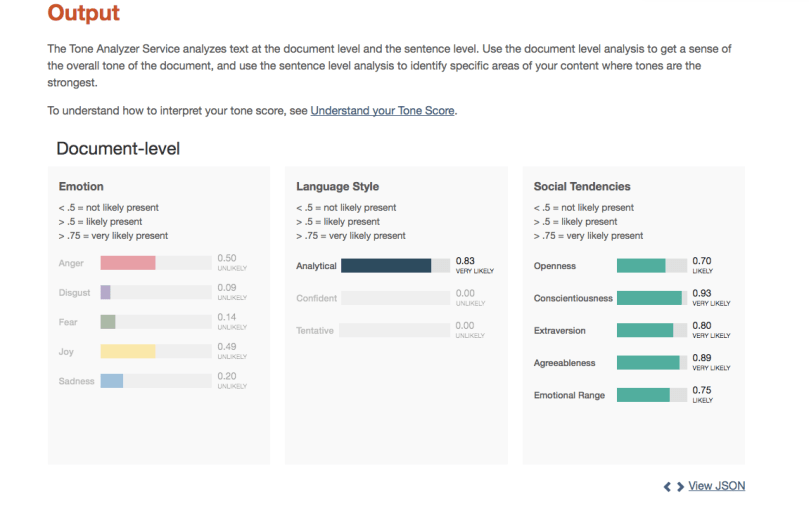
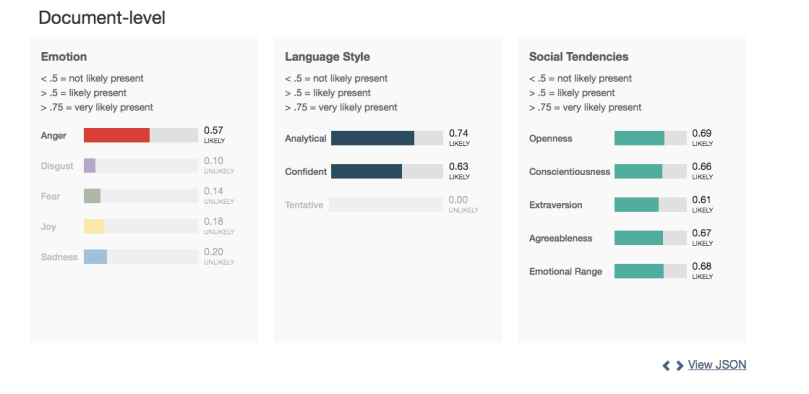
The dominant emotion in this message was perceived as anger. Indications of disgust, fear, joy, and sadness were “unlikely.”

Screen Shot 2017-04-25 at 12.55.55 PM

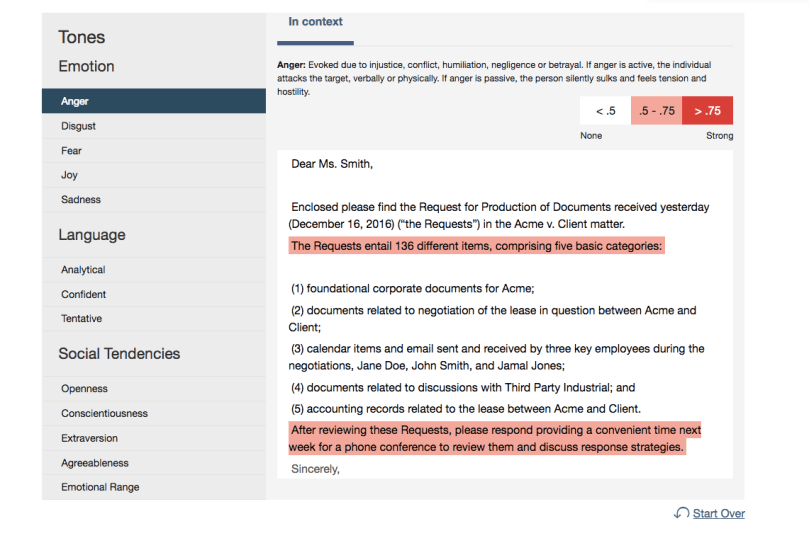
The sentence-level analysis indicates that the anger emanates from plain, descriptive language (what the requests entail) and the final request (“please respond…”). The pink highlighted sentences below were flagged as moderately angry wording:

Screen Shot 2017-04-25 at 12.58.10 PM

The language in this message was viewed as both analytical and confident, but not tentative. The analytical content is highlighted here in blue, with the dark blue being more intensely analytical than the light blue:

Screen Shot 2017-04-25 at 12.59.25 PM


Interestingly, the confidence score appears to come solely from the signature block containing the words “Law Firm.” (The same is true of the second sample, where “Law Firm” were also the only text flagged for confidence. But the second sample’s overall confidence score at the document level is 0.00 (unlikely) compared with .63 (likely) for this first sample. More on that later.)
Screen Shot 2017-04-25 at 1.00.35 PM

The same text can be studied in more depth for its social tendencies including openness, conscientiousness, extraversion, agreeableness, and emotional range. For example, the language “Enclosed please find” was ranked as conscientious but not open, extraverted, or agreeable.  That language also scored high on emotional range. That same language was also flagged for showing anger.

Among the five items in the email’s numbered list of documents, item (3) seemed to be an emotional hot spot for Watson, scoring relatively high on all five of the emotional parameters. This result was notable because item (3) is the only item in the list that included individual people’s full names.

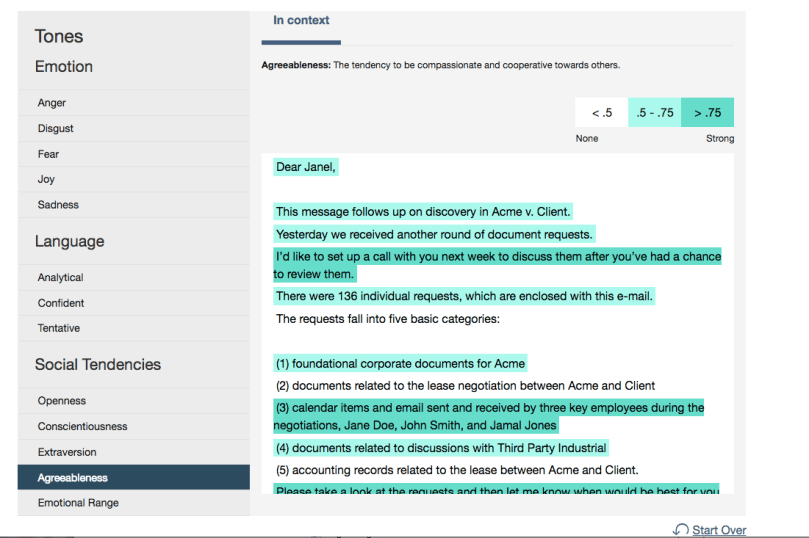
Here are the metrics for agreeableness, which form an interesting contrast with the second sample below. The greeting and sign-off are in light green, indicating moderate agreeableness. The only line with strong agreeableness was that same item (3) listing calendar items and emails sent by specific individuals by name. (In contrast, the second sample below tried to be friendlier and succeeded, as indicated by the more strongly agreeable opening and closing passages.)

Screen Shot 2017-04-25 at 1.05.01 PM

Tone Analysis of Second Sample

The second email was meant to be more friendly. What it accomplished, according to Watson, was slightly lessening the anger score and raising the joy score. The joy score is still “unlikely,” but it’s at .49 instead of 0.18 in the first sample. Although it’s less angry and more joyful, it also completely lost its confidence score.

Screen Shot 2017-04-25 at 1.05.46 PM

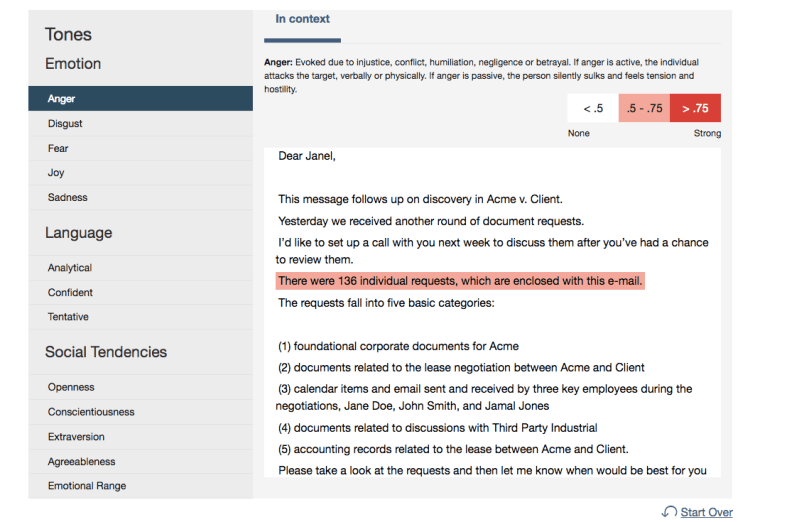
Despite the overall attempt to use friendlier language, anger still emanated from the email, specifically the sentence enclosing the discovery requests:

Screen Shot 2017-04-25 at 1.07.41 PM

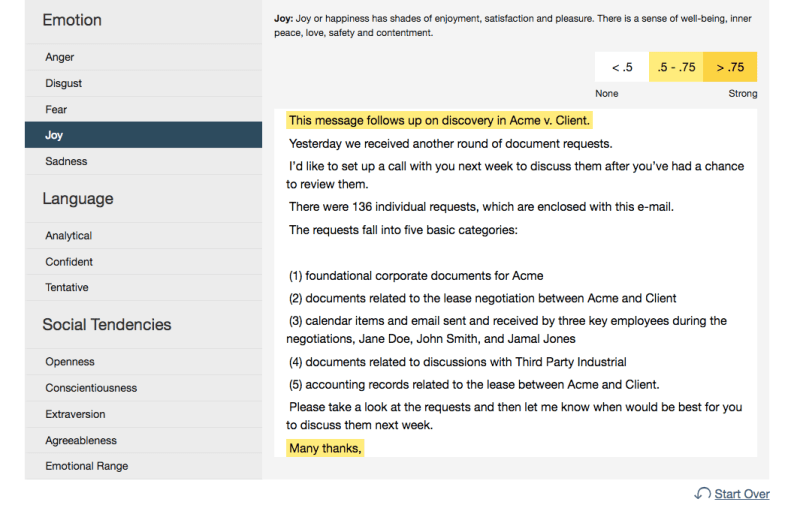
But joy came from the revised beginning and closing words:

Screen Shot 2017-04-25 at 1.08.32 PMThe message did not rank on sadness, fearfulness, or disgust.
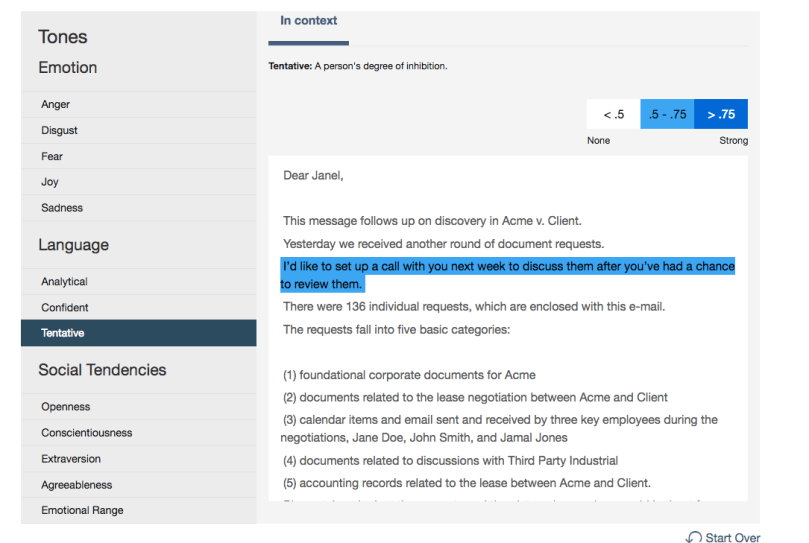
Watson’s evaluation of the language looks for analytical, confident, and tentative language. The more informal email’s language was also measured as analytical and confident, like the more formal first sample. Unlike the formal sample, it was also somewhat tentative. The source of this tentativeness was a sentence about what the writer “would like to do”:

Screen Shot 2017-04-25 at 1.10.19 PM

Not surprisingly, that same sentence was also ranked as agreeable:

Screen Shot 2017-04-25 at 1.11.12 PM

Quantitatively, the informal sample contained more agreeable language, ranking 0.89 on agreeableness compared to 0.67 for the first sample.

Conclusion

What did I conclude from analyzing these two samples using Watson’s Tone Analyzer? Like many AI analysis, it seemed to confirm what I think I already know.

  1. Legal information is not inherently happy, at least not in a litigation setting. The most “angry” language in both messages was the language simply describing the scope of discovery.
  2. Language that is more tentative and less confident may also be more agreeable. This correlation raises many questions: does tentative language compromise clarity? If so is it worth it to sound more agreeable? Different writers, readers, and situations will of course require different decisions.
  3. Watson’s Tone Analzyer may be helpful to some writers on a limited basis. As with any computer analysis of language such as Flesch-Kincaid readability scores, writers should ask whether the computer analysis could help them. I don’t see legal writers building Watson’s Tone Analyzer into a checklist for every email. But it could be a worthwhile exercise just on a couple of messages, to see what predominant tone Watson diagnoses.

And as with any computer analysis of language, take it with a grain of salt. I tested Watson on litigators’ favorite nastygram conclusion:

“Govern yourselves accordingly.”

The results are below but here’s a summary: Its predominant language was sadness (?????). Its most notable social tendencies, according to the Tone Analyzer, were extraversion and agreeableness.

Screen Shot 2017-04-25 at 1.28.57 PM

The “govern yourselves accordingly” analysis notwithstanding, a “robot” such as the Tone Analyzer could create an interesting exercise for trying different words and seeing how they measure. So . . . govern yourselves accordingly.

Note on use of Watson: these screen shots were taken on April 25 and 26, 2017. The metrics appear to have changed slightly from tests about six months earlier on identical language. Thus a final lesson is to know your tool and stay updated. Make sure you’re comparing apples to apples if relying on quantitative analysis of language. 

More theory, please

Theories and frameworks for listening abound—how to define it, what the process is, and how to understand it. At our recent CLE on listening skills, my co-presenter Jennie Grau displayed and briefly discussed three theoretical listening frameworks for understanding and defining listening. Those three frameworks are elaborated further in the postscript to this post. The TL; DR is that theoretical models of listening have moved from a simple and linear to complex and multi-faceted, becoming ever more unwieldy. (Cf. evolution of some legal rules such as a sixteen-factor test for whether a worker is an employee or independent contractor).

The CLE was offered to lawyers in the Omaha area, sponsored by the Nebraska Bar and International Listening Association in conjunction with the ILA’s annual convention. In written feedback after the CLE, one of the attorneys commented that they would have liked even “more theory.”

This was an intriguing comment. Why did this person want more theory?

I believe a subset of practicing professionals in any field are drawn to the theory of that field. They want to feel like they deeply understand the tools they use: those tools’ possibilities, limitations, histories, and alternatives. They don’t just want to be skillful at what they do, but to understand why they are skillful. They may pursue theory in order to improve their skills, or simply because, for them, adding a layer of theory helps them enjoy using their skills. An affinity for theory certainly does not extend to all professionals, and that’s fine.

But for readers who fit the bill and for the individual who wrote “more theory,” this post is for you. If you don’t want more theory, please stop reading here!

Precisely because a workable definition has to be reasonably concise, the International Listening Association adopted a streamlined definition of listening:

The process of receiving, constructing meaning from, and responding to spoken and/or nonverbal messages

What is the actual point of all these definitions and frameworks? If you Google “better listening,” you will get results such as “10 Steps to Effective Listening” and “5 Steps to Listen Better.” These may generate clicks, but it’s not clear they are grounded in research or meaningful analysis.

This type of “quick fix” for listening is extremely common, Professor Andrew Wolvin notes in the introduction to Listening and Communication in the 21st Century. And t,his is where theory can help, he says. A strong theoretical basis for listening can help answer whether a purported “quick fix” actually works and, perhaps, why. Wolvin lists several benefits of theory, quoting Steven Littlejohn in Theories of Human Communication. The list below builds upon that list and explores some connections between general listening theory and legal communication specifically.

1. Organize and summarize knowledge

Communication scholars—several of whom I met at the ILA conference—are constantly monitoring the contours of the field. Just as one example, later this year professors Graham Bodie and Debra Worthington will publish The Sourcebook on Listening Research, reviewing (among other things) “a variety of theoretical models for assessing the cognitive, affective, and behavioral facets of listening…alongside 65 measurement profiles.”

Within the legal academy, we also have some incisive, practical scholarship on teaching listening, including a wealth of clinical scholarship. Broader connections can be found in the scholarship on professional identity and cultural competence. As in the general non-legal field, there is more emphasis on speaking and writing. For example, a 2016 paper in the Legal Writing Journal used an anthropological approach to investigate what lawyers do in their daily lives. The method focused on reading and writing but did not include an investigation of listening. This is an understandable scope limitation, partly because of the following observation:

Even in the smallest workplace, email exceeded face-to-face communication and phone calls as the means of communication, which meant that these attorneys were writing constantly.

So theory helps to reveal where the knowledge is, and where the gaps or opportunities are as well.

2. Focus on variables and relationships

As shown in the anthropological study of lawyers above: when we added email as a constant communication channel, what did that new variable do to existing modes of communication? How did it enhance and detract from relationships? According to Sherry Turkle, even the presence of a smartphone—and even when it’s unused and face down on the table—reduces empathy in a conversation.

Within the legal field, there are ongoing discussions of these new variables: for example, how texting and digital communications generally intersect with lawyers’ ethical duties. See, for example, the Nebraska lawyer whose Facebook messages responding to a client’s inquiry via Facebook did not satisfy his duty to communicate.

3. Clarify what we observe (and give tools for observation)

Observing listening is extremely difficult because some of the process is hidden from view. Listening theory can help. For example at the International Listening Association’s Conference, I attended Professor Sherry Wien’s talk where she had painstakingly analyzed and coded every moment of every interaction between Joan and Peggy on all seasons of Mad Men. Using these tools, she produced observations about these characters that could ring very true in many legal workplaces. As I listened to Professor Wien’s talk, I wished that other lawyers had been there to laugh and learn from her approach.

On the more directly practical side at the ILA conference, a management communication firm shared their efforts to develop and scientifically validate a training survey on listening styles. Dana Dupuis of Brio Enterprises presented on the evolution of her consulting firm’s proprietary Hear? Hear! Listening Assessment. The problem with any type of listening survey, as Dupuis stated, is that people’s responses about their own listening aren’t always reliable. And there’s a very specific reason for this, she said:

 Listening in particular is prone to social desirability bias.

That means people think that being a good listener is socially desirable. And their drive to do things that are socially desirable means—intentionally or not—they will give survey answers showing that they satisfy that ideal. Thus, if you survey people on their listening habits, you are likely to come up with a population of amazing, empathetic, skillful listeners. Dupuis has modified the Hear? Hear! Assessment to minimize this social desirability bias through the question design, with contributions from Professor Graham Bodie of Louisiana State.

4. Enable predicting outcomes

Students of innovation in the legal industry may take note here. There are many ways to listen, from individual one-on-one focus to organizational listening through feedback, surveys, and in-person visits. Does a certain level of organizational listening affect client retention? On the individual level, how does the proportion of time spent listening versus talking affect how a typical client perceives their lawyer?

5. Provide a forum for communicating research and ideas

The field of legal communication often seems to parallel the general field of communication, with lots of emphasis on speaking and writing, some on reading, and the least of all on listening. But law reviews and academic conferences do provide a forum for listening-related research within the larger conversation about legal communication. For example the Legal Communication & Rhetoric journal I’m so fond of has featured Professor Barbara Gotthelf’s article, The Lawyer’s Guide to UmWhat’s the function of “um” in speech, and how do listeners react? The possible answers—which she grounds in both communication research and practical experience—are not as obvious as you might think.

6. Help establish norms of performance

What is bad listening, and what is good listening? What are the norms expected in human communication, and how do they overlap or differ in personal and professional life? Theory about listening helps to ask and answer these questions. For example, research shared at the ILA conference suggested that 38 percent of survey respondents could not go more than 10 minutes without checking digital media. The new norms of communication performance are in flux.

7. Generate change

This may be the most controversial. I’m not actually sure a strong listening theory can help generate change, at least not directly. But after attending the ILA meeting and reading some of the articles and books grounded in scholarship rather than platitudes and talking with listening scholars such as Debra Worthington and Andrew Wolvin and Laura Janusik and others, I’ve come to the conclusion that listening theory does absolutely enrich the big conversation about what communication is, and what it could and should be.

Selected Listening Frameworks  

(There are many, many more, such as the well-known HURIER model in Judi Brownell’s listening text. The frameworks here are just one small slice of listening theory.)

The SIER Listening Process

This model is an example of a very basic model of the listening process, formulated by Lyman Stiel in the 1980s:

Sensing

Interpreting

Evaluating

Responding

The SIER model reflects a linear process of listening.  Subsequent models added much more context.

Andrew Wolvin Model

Professor Andrew Wolvin’s model is an example of a more contextual model, and it’s not linear. Rather, it’s a series of overlapping circles, with the top circle containing key “Influencers”:

Speaker

Message

Channel

Listener

Environment

Behind that circle are five contextual factors, all potentially influencing one another:

Attention

Perception

Reception

Interpretation

Response

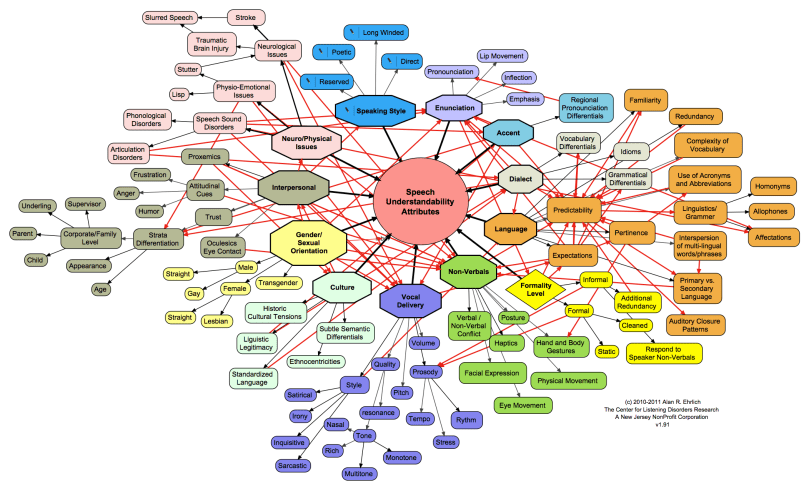
Alan Ehrlich’s Model of Speech Understandability

Trying to name every potential influence on the listening process is not possible, but Alan Ehrlich has made a serious effort. His visual model of speech understandability branches out to factors such as speaking style, accent, dialect, language choices, formality, non-verbals, vocal delivery, gender and sexual orientation, and interpersonal issues such as power and attitude. And those factors then branch out to perhaps a hundred more sub-factors:

Speech Understandability Index v1.92.png


Preparing to listen

Preparing to write means adopting some kind of routine or even a ritual: get coffee, gather some pads and paper, sit down at the computer, procrastinate a little bit online, and then get to it. Preparing to speak means making notes, practicing to a friendly audience, maybe putting on a lucky piece of jewelry or a power tie.

 What does it mean to prepare to listen?

Last week I had the pleasure of presenting a CLE with communication consultant Jennie Grau and Canadian family lawyer and mediator Anita Dorczak for the Nebraska Bar Association in partnership with the International Listening Association. The ILA was holding its annual meeting in Omaha, which gave Jennie, Anita, and I the opportunity to collaborate in person on this outside-the-box-in-a-good-way CLE.

Based on attorney feedback, one of the most talked-about parts of the CLE was Anita’s segment on preparing to listen. She shared this checklist on Preparing to Listen, courtesy of Professor Nadine Marsnik and the International Listening Association where it is posted.

The checklist prompts thought on readiness to listen. Here is just a preview:

  • Are you physically prepared to listen?

Being hungry—or worse, “hangry”—is an example of not being physically prepared to listen.

  • Are you mentally prepared to listen?

Being mentally prepared means, in part, learning about the topic you will be listening to, so you can get the most out of what you will hear. 

  • Are you emotionally prepared?

Effective listening means the listener knows their own triggers and worries that may be distracting. It also means not judging a speaker for using poor grammar. 

During the listening CLE, Anita Dorczak also supplemented the checklist with a broader, more holistic kind of preparation: a brief, focused walking meditation. As someone who struggles to sit still and meditate, I found this walking meditation a more “do-able” format. And as Anita told the CLE participants, the beauty of a walking meditation is that you can take something you already do—walk, as in walk to chambers or walk to a client meeting or walk down the hall—and make it more mindful. After trying this meditation format just for a few minutes during the CLE, I could definitely understand how it calms the mind and could help with preparing to listen.

Jennie Grau and I presented on other aspects of listening such as models of what it means to listen, listen to understand versus listening to reply, and ethics issues related to listening. I’ll share more about that work in a future post.

Stereotype threat

Before a math test, women test-takers reminded of their gender did worse on the test than a control group who took the same test without the reminder. This experiment forms a classic example of stereotype threat, which Professor Susie Salmon from Arizona Law spoke about at the recent Moot Court Advisors’ Conference held by the Legal Writing Institute.

Every identifiable group is in some way vulnerable to stereotype threat, explored for a popular audience in Claude Steele’s Whistling Vivaldi. (For an introductory version, here’s Steele’s 1999 Article in the Atlantic.)

In Whistling Vivaldi, Steele outlines the extra burden caused by stereotype threat:

The problem is that the pressure to disprove a stereotype changes what you are about in a situation. It gives you an additional task. In addition to learning new skills, knowledge, and ways of thinking in a schooling situation, or in addition to trying to perform well in a workplace . . . you are also trying to slay a ghost in the room, the negative stereotype and its allegation about you and your group. You are multitasking, and because the stakes involved are high — survival and success versus failure in an area that is important to you — this multitasking is stressful and distracting.

Professor Salmon explores more open forms of bias as well as stereotype threat in her forthcoming article on gender bias in moot court. Comments to female moot court competitors that their clothes or hair or bodies are distracting or they should make their voices deeper and lower all imply that the ideal of an advocate is male.

The second half of her article delves into stereotype threat, which has a more subtle, more common, and often unintentional effect on students who are members of a group (any group) with associated negative stereotypes. Stereotype threat does not have to be the product of intentional bias. But that doesn’t make it any easier to deal with: “The more that a person cares about performing well at a given task, the more stereotype threat will hinder that performance.”

For a moot court competitor, it’s hard enough to deal with nerves, deliver an organized argument, and answer the moot court judges’ questions. The burden of trying to “slay a ghost in the room” of negative stereotypes makes the competitor’s job that much more difficult.

For professors and supervisors seeking to reduce stereotype threat, there are a number of possible mitigating steps. For one thing, comments about natural ability are actually not constructive.

Legal skills are just that: learnable skills that can be built through work and focus.

Thus, a “growth” rather than “fixed mindset” helps law students in myriad ways including with reduction of stereotype threat.

Another method for reducing stereotype threat is to guide students through a self-affirmation exercise. Before you object, please know: this does not mean the Stuart Smalley-type affirmations about being good enough and smart enough and having people like you. Instead, it means writing about a core value you hold dear that makes you special. This type of writing reinforces the writer’s integrity. It also reduces stereotype threat. The theory, as Salmon outlines in the article, is that it provides the writer with a counter-narrative and interrupts the operation of the threat itself.

My favorite suggestion from Professor Salmon’s talk was the recommendation to give “wise feedback.” Wise feedback means that professors, supervisors, and anyone in a position of authority does two things:

  • Show that they have high standards.
  • Provide personal assurance of their conviction that the students/externs/junior lawyers can meet these standards.

Wise feedback is not just feedback, but mentoring over the long term.

Not only does the wise mentor need to deliver wise feedback consistently, she needs to communicate to each student that she cares about that student’s success and believes in her capacity to achieve.

Professor Salmon acknowledged that stereotype threat is a big topic. The resources below are a sampling of what’s being discussed on stereotype threat in legal education today.

ABA Council on Racial and Ethnic Diversity, Beyond Diversity: How Stereotype Threat and Implicit Bias Contribute to the Status Gap (2012)

Sean Darling-Hammond and Kristen Holmquist, Creating Wise Classrooms to Empower Diverse Law Students, Berkeley La Raza Law Journal (2015)

Russell McClaine, Helping Our Students Reach their Full Potential: The Insidious Consequences of Ignoring Stereotype Threat, Rutgers Race and Law Review (2016)

United States Senior Circuit and Chief Judge Emeritus Judge Harry T. Edwards, Reflections on Racial Stigmas and Stereotyping, Paper Presented at the 2017 African American Alumni Reunion, University of Michigan

Summer-associate advice

When I speak to summer associates, I always tell them they have two jobs:

  1. do great work and gain as many opportunities as possible within the employer’s organization, should they end up working there; and
  2. study the employer, lawyers and staff, and the overall culture to discern if it’s a good fit for them.

Listening will help with both of these jobs.

As far as doing great work, summer associates should start using their listening skills before the job starts. Use social media to “listen” (in the sense of monitoring) to what the employer is saying to the public. What topics seem to be interesting? Who’s writing? What tone do the lawyers use in their publications and social-media content? What personality do they project?

Summer associates should also talk to mentors about how to do a good job as a summer associate generally, and (from mentors within the organization) how to do a good job in that particular setting. Ask good questions, listen, and follow up with more good questions. Listen actively and paraphrase the advice back to the mentor sharing it. Take notes later, reflecting on the advice and assimilating it even more thoroughly. Send thoughtful follow-up messages that demonstrate listening skills and reinforce the relationships being built.

Once the job starts, listening skills are crucial during any meeting to take down an assignment. Beyond the basics like expected format and deadline, the assigning meeting offers so much more for the careful listener: the supervisor’s own baseline of knowledge in the area of law, attitude toward the case, expected answer to the assignment, expected difficulty of the assignment, general areas of confidence, and general areas of perceived risk. All of this information can be highly valuable in completing an assignment at a level beyond basic law-student competence.

“Shadowing” work such as observing a deposition or negotiation may not be a true assignment, if there is no deliverable work product. But during a shadowing experience, it seems crucial to display the highest form of attentiveness. Even if an attorney working on the case displays distracted behavior such as checking email on a phone, the summer associate should not feel free to reciprocate that behavior. Buying into the myth of reciprocity—the senior lawyer checked her phone, so it was appropriate and for the summer associate to do so as well—seems like one way to make a bad impression. What’s more important to a summer associate than the valuable opportunity to observe right in front of them? Unless they have a family crisis or already on a deadline for another supervisor within the organization and can explain that to the people around them, it seems likely that nothing is more important. On a more positive note, careful listening and good follow-up questions can actively show a person’s potential as a future lawyer.

Another opportunity to listen happens during a debrief on any assignment. This is the opportunity to accept constructive criticism gracefully, i.e. non-defensively and in a manner that makes the supervisor comfortable working with that summer associate again in the future. Another lesson is that sometimes (oftentimes?) in the legal world, feedback isn’t really helpful or specific. Or it isn’t there at all. Seeking out feedback and asking good questions show a dedication to professional development and professionalism generally.

Strong listening skills during the interview are likely part of the reason a summer associate got the job in the first place. Listening skills on the job are just as crucial, and actually even more so.

Here’s another post hitting some of these same themes and delving into more detail on listening for summer associates: https://listenlikealawyer.com/2016/06/01/listening-for-summer-associates/


Habit-forming classrooms     

How much time do law students spend in class? I’ve been thinking about the behavioral implications of so much time in front of laptop screens. I look forward to reading but don’t actually need to read Irresistible: The Rise of Addictive Technology and the Business of Keeping Us Hooked to know that looking at a screen is some kind of behavioral habit. And the time students spend in law-school classrooms may be feeding that habit.

Yes, some professors ban laptops. Most do not. Yes, some law students use their laptops just exactly like a yellow legal pad and quill pen, never once checking any updated social media feed during class. But most do not. So just how much time do law students spend in front of laptop screens during a typical three-year JD program?

An estimate can be derived from ABA regulations for law schools, which I learned more about at the Legal Writing Institute’s recent conference for moot court advisors helped to answer this question. ABA Standard 311 requires 83 credit hours to graduate, 64 hours of which must constitute  “attendance in regularly scheduled classroom sessions or direct faculty instruction.” The broad topic of ABA requirements came up at the moot court conference because within this 64 hours, students graduating in 2019 and after will need six hours of experiential-learning credits to graduate. Moot court advisors from Oklahoma City College of Law, Mississippi College of Law, the University of North Dakota, and Ohio State University talked about the new ABA requirement for experiential learning.

That number—64 hours—is the key to answering my question about total laptop time.

Let’s use the ABA’s numbers to assume that a student takes only 64 classroom hours to graduate and the rest of the 83 comes from extracurricular activities, externships, and other types of educational activities.

Out of the required 64, let’s further assume six of those are experiential learning in a clinic or simulation, in which students should be closing their laptops and working closely with people a substantial portion of that time.

That leaves another 58 hours of course credit in lecture and Socratic law-school classes. Let’s assume the student uses a laptop during all of that time. Is this an unrealistic assumption? I don’t think so, but you can easily adjust the math below to reach estimates for 80 percent laptop usage or 60 percent laptop usage.

If we do assume the student opens a laptop for notetaking during all of these class sessions throughout law school, what’s the total time that student’s eyeballs will be on the screen?

A credit hour is 50 minutes of classroom time per week plus two hours of preparation time (ignored for purposes of this calculation). Each semester has 15 weeks, but one of those weeks can be used for exam review and exam taking. Thus the total amount of classroom time can be calculated as follows:

50 minutes a week,

14 weeks a semester,

multiplied by 58 credit-hours.

What’s the mathematical result?

40,600 minutes

677 hours

84-and-a-half business days

That’s a lot of time with eyeballs on screens. Taking notes in a law-school lecture may not be habit-forming like Candy Crush, but it’s still a behavior. Repeat a behavior enough, and you have a habit (colloquially defined). Walk into the room, take out the laptop, pop it open and turn it on. When the professor begins to speak, direct attention to the front of the room, and start typing. Listen for a while and keep up with class, typing notes in bullet and sub-bullet form vertically down a Word or notes page of some sort. Then a thought pops up about an expected email reply. Open a tab to quickly check. Keep one ear on the professor’s words and get them down. Close the email tab and return to the notes doc. Rinse and repeat.

The 58 credit-hours of classroom time make up almost two-thirds of a student’s academic time in law school. Assuming that a student gets excellent training and practice on interviewing (including listening skills) somewhere in the other 35 credit-hours, can that training and practice overcome the weeks, days, and hours spent looking at the laptop? Of course people use different communication skills and tools in a large classroom and a one-on-one interview. But are these communication habits so easily siloed and separated? What is the leakage—if any—between classroom listening habits and professional listening habits? As Will Durant said in paraphrasing Aristotle’s Nichomachean Ethics, “We are what we repeatedly do.”

This month tens of thousands of law students are shaking off their final exams and going out into the “real world” for summer work. At courts, agencies, businesses, and law firms, these personal laptops will largely be left behind. But what habits won’t be?

__

Here are just a few of many recent articles on laptops in the law-school classroom:

Kristen Murray, Let them Use Laptops: Debunking the Assumptions Underlying the Debate over Laptops in the Classroom

James Levy, Teaching the Digital Caveman: Rethinking the Use of Classroom Technology in Law School

Steven Eisenstat, A Game-Changer: Assessing the Impact of the Princeton/UCLA Laptop Study on the Debate of Whether to Ban Student Use of Laptops during Class


Deliberate practice and lawyering skills

This past weekend, the Legal Writing Institute hosted its second Biennial Moot Court Conference at John Marshall Law School in Chicago. Several of the talks touched on listening-related themes. Kent Streseman of the Chicago-Kent College of Law explored the concept of “deliberate practice” for moot court competitors. His summary of the tenets of deliberate practice could be useful for anyone who wants to improve their mental dexterity and ability to think on their feet. 

I once heard Rutgers Law professor Ruth Anne Robbins refer to moot court with an analogy to “muscle memory.” In sports, building up muscle memory can be a good thing—or a bad thing. If you learn how to swim the wrong way and then repeat the mistake over and over, she said, you won’t become a better swimmer no matter how much you practice. (Likewise for lawyers preparing presentations and arguments, creating wordy PowerPoint slides and then silently reading them to yourself may not be the path to great public speaking.)

In his Chicago talk, Streseman made a related point about sub-optimal practice: Even practicing correctly but in the standard, same way over and over is not going to produce results, especially if it’s ill-informed to begin with. Repetitive practice doesn’t help a learner progress beyond a certain fixed point, and in fact, “skills tend to regress.” 

The “gold standard” of preparation is “deliberate practice,” a concept from Anders Ericsson’s work summarized for a popular audience in Ericsson’s Peak: Secrets from the New Science of Expertise. The purpose of deliberate practice is to yield expert performance:

The hallmark of expert performance is the ability to see patterns in a collection of things that would seem random or confusing to people with less well-developed mental representations.

To build up these mental representations, you need deliberate practice. In his talk Streseman outlined some of the conditions of deliberate practice:

  • The practices must be challenging, with the learner giving their full attention to a task demanded beyond the edge of their comfort zone.
  • The feedback needs to be informed by experts’ accomplishments and understanding of what they themselves do to excel.
  • The feedback must be followed by the opportunity to modify the performance in response, and to recover and reflect on the practice.

These types of focused practices lead to more effective mental representations of the argument in the competitor/advocate’s own mind. And having those effective mental representations mean the competitors can react more quickly to questions and make better decisions on what to say next and how.

The closest connection to listening seemed to be the crucial fact that deliberate practice requires the learner’s full attention. Moreover, the learner has to actually listen and adjust to the feedback provided. Speaking and speaking and speaking again without attention to feedback may be practice, but it’s not deliberate. You can do that in front of a mirror or your dog, and we all know sometimes that’s what a person needs to initially prepare. As beginners approach a task, they may need some repetitive practice with no feedback to get into their comfort zone. Once there, they can then start to push beyond that zone.

But rehearsing to a dog is too comfortable. It’s not deliberate practice, as the dog’s feedback is not informed by experts’ accomplishments and methods of excelling. My dog has been a lawyer’s dog most of his life, spanning three owners with a variety of practice experience both civil and criminal. All three of these lawyers were moot court types. But the dog still can’t coach moot court effectively.

Thanks to Kent Streseman for his talk on deliberate practice and moot court, and to John Marshall Law School and the Legal Writing Institute for hosting the conference.  I look forward to reading Peak and sharing any additional insights from delving into it.  I also hope to share more posts from the conference with additional connections to listening. Until then, you can access tweets from me and others at #LWIMootCourt.