What do we hear when we hear vocal fry?

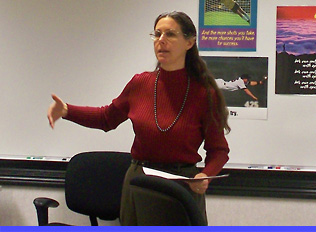
Tennessee professor Michael Higdon has followed up his 2009 Kansas Law Review piece on nonverbal persuasion with a thoughtful new essay,   “Oral Advocacy and Vocal Fry: The Unseemly, Sexist Side of Nonverbal Persuasion.”

If you’re not familiar with vocal fry, check out this MSNBC video at minute 3:30 for an example drawn from law practice (“Um, I don’t really think that evidence is sufficient.”) The video briefly explores a few themes expanded upon in much greater depth in Professor Higdon’s piece: Is the problem with women using vocal patterns that diminish their appearance of competence? Or is the problem with managers and society scrutinizing and judging women harshly yet again? Higdon quotes Amanda Hess describing the joint perils of vocal fry and “upspeak”:

So we’re wrong when we raise our voices, and we’re wrong when we lower them.

Higdon takes this debate into the realm of law and the individual choices women law students and lawyers must make. He also places vocal fry into a larger framework of nonverbal persuasion including body language such as gestures, the use of space, the relationship to the speaking environment as well as any props or other instruments, physical appearance, the use of time, and other factors. “Vocalics” or what the speaker sounds like is the factor raising these questions.

Higdon and many others eschew the easy answer that women should stop vocal fry simply because it hurts others’ perception of them.

What is a female attorney to do? Does she scrupulously monitor and adjust her professional nonverbal behavior to match those qualities that social science tells her tend to be perceived more positively? Or does she ignore this research and what it might mean within her own career and instead follow her own preferences on how to present herself? Clearly, this essay cannot definitively answer that question—it is instead a personal question that must be answered by each person individually.

He points out that not all critiques of nonverbal behaviors are complicated: for example, lawyers should avoid pointing at their audience, especially when that audience consists of judges sitting as a court of law. But preferences about some nonverbal behaviors such as women’s vocal inflections raise harder questions of underlying bias. Higdon’s discussion reminded me of the discussion—how can this discussion still be happening?—whether women make a mistake by going to court in pants suits rather than skirts.

[W]hat one gains in the short term by presenting herself as in line with societal expectations can create problems in the long term by making it that much easier for everyone to ignore the sexism motivating those preferences.

Some would say the women lawyer’s identity shouldn’t matter. If she’s going to court where a judge has previously expressed disdain for women in pants suits and if she takes seriously her role as an advocate for the client, then she should grin and wear it (the skirt, that is). Likewise if society is saying vocal fry makes a woman sound incompetent and if a woman lawyer wants to represent clients effectively in said society, then stop with the vocal fry. As Higdon acknowledges, failure to comply can be damaging.

But he urges a deeper analysis that makes room for identity even as it contemplates audience:

[T]he preferences people have for certain behaviors are almost always motivated by something other than the behavior itself. Typically there is a connection in the audience member’s mind between that discrete behavior and something else—and it is the “something else” that requires more inquiry.

I recommend this article, especially as a companion to Higdon’s foundational article on nonverbal persuasion, previously reviewed here on the blog.

Listening is for losers

Listen Like a Lawyer is happy to bring you this guest post from a lawyer who wished to remain anonymous.

E-mail is really my favorite way to communicate. It’s just so much better. You can figure out exactly what you want to say before you send. You have a record of what you said and what the other person sent. And it’s good to see their words on the page so you can figure out the best way to react in the situation. Being able to email back and forth with people helps me keep my work day clear.

Clients don’t really care about a lot of hand-holding and face time. It takes up their time and mine. I bill for every minute I spent with them, and we all already know what we need to do. So what is the point anyway? We need to get on with it and get our work done. If they want to give me feedback, they can email their comments on whatever I send them when it’s most convenient for them.

When I do meet face to face with clients, what they really want is to be dealing with me an expert who knows the answer—right then. They want answers. But it’s a lot of pressure to come up with “the” answer right there on the spot. Being an effective lawyer means I have to think about what I’m going to say when they’re still talking.

Real conversations generally waste my time anyway. The other person thinks out loud and drones on and on. They’re not even sure what they’re really saying. Or they’re venting about their issue, and that’s just not productive. When I’m stuck in a long meeting or conversation, everyone understands that I will be checking my phone. As a lawyer, I have to keep up with what could be more urgent in that moment.

The truth is I’m a bad listener, and there’s nothing I can do about it. It’s not like a person can get better at listening. I’ll never be able to dunk the basketball or sing an aria, and I’ll never be a good listener. People who work with me get used to it after a while.

Happy April Fools’ Day!


Is teamwork the same as collaboration?


Earlier this week Listen Like a Lawyer discussed Google’s teamwork study investigating the qualities of effective teams. In the post I mentioned that teamwork is so important in part because many cases are too complex for one person to manage. One bit of feedback on the post agreed that teamwork is “vital now for successful legal practices.”

Shortly thereafter I ran across this post from Lisa Needham at the Lawyerist, “Too Much Teamwork is Terrible.” The post ends with a plea:

Ban teamwork. Or at least reduce it drastically.

Both the Google article in praise of effective teams and the Lawyerist post against teams cite the same Harvard Business Review study concluding “the time spent by managers and employees on collaborative activities has ballooned by 50% or more.”

So if teamwork is so good, why is it so bad?

I think the real issue is the difference between formal teams and informal collaboration throughout an organization.

The Google study profiled in the New York Times seemed to focus on formal work groups—groups formed by assignment to address some specific task or role over time. These work groups seem analogous to a group of lawyers assigned to a client service team or a specific deal, trial, or other project.

The Harvard Business Review article on collaboration appears to be addressing a much broader phenomenon. It’s not just about the dynamics inside individual work groups assigned to discrete projects, but also about collaboration throughout an organization. Collaboration may take the form of sharing information, sharing social resources, or sharing one’s own time and energy—which, unlike the first two categories of collaboration, is a finite and exhaustible resource. These can happen within a formal team or in broader, more diffuse ways throughout an organization. A person who is willing to collaborate with others may be subject to “escalating citizenship” in which workers who want to help become so over-burdened that they become a burned-out bottleneck. To quote the article, the “virtuous cycle” of collaboration turns “vicious.”

I’m no Adam Grant, but if this distinction is correct, then the Google study and the Lawyerist post are also both correct. Complex long-term problems and strategic goals cannot be solved by lone-wolf lawyers. Therefore, lawyers working in formal teams can benefit from studying their group norms and seeking to collaborate most effectively. These types of teams should not be disbanded or reduced in scope.

On the other hand, managers should monitor the collaborative burdens across their organization to avoid inefficient, inequitable demands on “extra milers” (quoting the HBR article) being asked to collaborate beyond the scope of their roles.

Of course there is a challenging question in the middle of this: work groups formed not for direct legal service but for internal firm/agency management. In other words, firm committees. These groups can certainly benefit from studying dynamics in the spirit of the Google study. But the HBR study and Lisa Needham’s critique raise the question: what is the reward structure of the firm or organization, and is collaborative committee work compromising individuals’ capacity to participate in that reward structure?

For insight into this question, I would first recommend Helen Wan’s great novel The Partner Track.

On a more quantitative note, the HBR study suggests collecting and assessing data about who is doing what. It also suggests employee surveys and 360 feedback. To take a 50,000-foot view of these suggestions, it seems that one way to begin to address this question is by listening.


Teamwork for lawyers

The thing I’ve most wanted to share here in recent months has been “What Google Learned from Its Quest to Build the Perfect Team,” published in the New York Times Magazine’s recent Work Issue. Building perfect teams—or at least more effective ones—is pretty important for the legal profession. For law firms, the complexity of many legal matters demands collaborative work. Yet client teams—and other types of teams such as deal teams and trial teams—are more likely to fail without a good understanding of team dynamics. And “law students baulk at the idea of group work.”


To understand why some of its teams performed better than others, Google launched a large study. At first no patterns emerged. Eventually, the key issue was something a bit more abstract than any specific metric. The issue was “group norms”:

Norms are the traditions, behavioral standards and unwritten rules that govern how we function when we gather: One team may come to a consensus that avoiding disagreement is more valuable than debate; another team might develop a culture that encourages vigorous arguments and spurns groupthink. Norms can be unspoken or openly acknowledged, but their influence is often profound.

The impact of group norms on team performance was critical. It could make a team of individually “average” performers out-perform other groups. And it could make a team of individual rock stars perform poorly.

So if effective teams could be built upon consensus of any type—either to argue all the time or to build consensus all the time—then is there really any content to the idea of effective group norms? Actually, yes. The Google study found two common traits of good teams. This is where listening comes in:

Actually, yes. The Google study found two common traits of good teams. This is where listening comes in:

First, on the good teams, members spoke in roughly the same proportion, a phenomenon the researchers referred to as ‘‘equality in distribution of conversational turn-taking.’’ On some teams, everyone spoke during each task; on others, leadership shifted among teammates from assignment to assignment. But in each case, by the end of the day, everyone had spoken roughly the same amount. ‘‘As long as everyone got a chance to talk, the team did well,’’ Woolley said. ‘‘But if only one person or a small group spoke all the time, the collective intelligence declined.’’
Second, the good teams all had high ‘‘average social sensitivity’’ — a fancy way of saying they were skilled at intuiting how others felt based on their tone of voice, their expressions and other nonverbal cues. One of the easiest ways to gauge social sensitivity is to show someone photos of people’s eyes and ask him or her to describe what the people are thinking or feeling — an exam known as the Reading the Mind in the Eyes test. People on the more successful teams in Woolley’s experiment scored above average on the Reading the Mind in the Eyes test.

The broader impact of these two traits is that team members felt “psychological safety.” The New York Times article cited a study by Harvard professor Amy Edmondson describing psychological safety as “a sense of confidence that the team will not embarrass, reject or punish someone for speaking up.”

This article and the concepts it describes should, in my view, be required reading for any law school activity based on teams. It seems like a pretty good idea for law-firm managers as well. The lead researcher on Google’s Project Aristotle study became interested in the topic while attending graduate business school. She had one team that didn’t click, didn’t exactly fail but also didn’t prosper, and didn’t stick together for future projects. And she had another team that clicked and succeeded in competitive environments even though the group dynamics didn’t feel internally competitive.

Law students who’ve done any sort of group work and lawyers working collaboratively have similar stories. This article helps to explain why these teams end up the way they do. And it begins to address even more difficult questions about taking steps to create effective team dynamics from the outset and to make existing teams more effective.

Better Lawyering Through Better Listening

What are your key strengths and weaknesses as a listener? How can you, as a lawyer or legal professional, actually become a better listener? What listening techniques can lawyers use to be more effective with clients, witnesses, judges and mediators, and others (perhaps loved ones)?

I’m pleased to be collaborating on a CLE workshop that will help attendees explore these questions and gain a better understanding of listening skills for lawyering.The workshop will take place in Tucson, Arizona, on March 10 in conjunction with the International Listening Association‘s annual convention.

Jennie Grau
Jennie Grau

Presenters Jennie Grau and Anita Dorczak will facilitate the session in person, and I am working on video contributions right now. One fun project has been working with several wonderful colleagues and students at my law school on video demonstrations of “bad” and “good” listening skills in legal settings. I must confess it was easier to write and create the bad examples. I’ve also been rounding up a variety of statistics related to listening and lawyering. (Blog post coming soon.) There’s a lot of great research out there, but also several widely accepted yet unsupported urban myths of listening.

Anita is a Canadian family lawyer and mediator, and Jennie is a communications consultant and speaker. Collaborating with these presenters has been a wonderful experience because they are not only smart and creative and talented speakers but also—not surprisingly—such skillful listeners. Arizona lawyers who attend the session are in for a unique experience including role-plays and the opportunity to take an individual “listening inventory.” Boring PowerPoint and lecture, this is not.

Anita Dorczak
Anita Dorczak

The International Listening Association is an eclectic group with connections to many disciplines such as health care, business, spirituality, cultural studies, teaching, and research.

Lawyers, mediators, and other legal professionals are invited to attend the conference for a one-day rate (4 hours of CLE). The full information can be found here. Fees for the session go to the International Listening Association. This is a labor of love for the presenters—which is actually the theme of the whole convention, Listening: A Labor of Love.

Listening under the influence

5273144526_30b460d7d2_z
Flickr/Keoni Cabral/CC by 2.0

What is the effect of drinking on listening skills?

This matters for lawyers who will be networking over a glass of wine or taking clients to dinner where alcohol is served. What appears to be a still-valid 1975 psychiatric study predicted that drinking would have a variety of effects on communication:

In a group setting, low to moderate doses of alcohol would increase the amount of verbal communication, increase disruptions in communication, and decrease the level of acknowledgment of the other speaker’s communication.

This hypothesis was indeed supported by the study, a study with a most interesting protocol.

Participating couples (married or good friends for several months, and between the ages of 21-30) showed up a testing facility for an afternoon of mild intoxication and testing, or a placebo event. They consumed a “low dose” of either “80-proof vodka in a peppermint-flavored cocktail” or “the masking cocktail without vodka.” In the low-dose experiment, women drank .83 ml per kg of weight, so (after a bit of math) about 1.4 ounces for a 110-pound woman. Men drank 1 ml per kg of weight, so 2.7 ounces for a 175-pound man. In sessions separated by about a week, they tested the other option. And some test subjects came back for another alcohol test at 1.5ml per kg of weight.

After consuming the alcohol, they did some coordination tests and then a 20-minute conversation session. The second 10 minutes of the conversation were transcribed for study. Then participants were “fed and detained” until signs of intoxication wore off, and driven home.

The study’s main finding seems fairly intuitive:

Overall, alcohol appeared to make social communication more disorganized and intoxicated subjects seemed less likely to follow conventional rules of etiquette in their speech.

The specific behavioral findings were a little more complex. The study found “an increase in the amount of interrupting or overlapping speech” that was even more pronounced with the higher dose. Essentially: the more you drink, the more you interrupt.

Separately, the study found with the low dose, participants talked more in the sense of initiating more conversations, and used more words. With the higher dose, these trends reversed. Thus the more intoxicated participants interrupted more but used fewer words and started fewer conversations. And there was a modest but noticeable effect on what the study called acknowledgment, or “the degree to which [a statement] responds, in terms of the content and intent” to the prior statement.

The study authors weren’t exactly sure how these effects happened. They could be from the “disinhibition” and “egocentricity” of drinking, or they could be from “decreased auditory discrimination” and “impaired memory” which had been proven in a similar previous experiment. 

The authors recommended further study. They also ended with a caveat on the “dyadic” setup of the study—meaning just two people speaking one-on-one to each other. The one-on-one setup may have made it relatively easier for participants to maintain the conversation. They noted prior work showing alcohol diminishes participants’ ability to hear complex auditory stimuli. Thus they suspected that intoxicated participants would show greater impairment, relative to the placebo, in a more complicated social situation with more people. Something like an attorney networking event, perhaps.

Postscript to this research: Here’s a 2004 master’s thesis on “alcohol in social context.” The study gathered 54 men (strangers) and assigned them to groups of three, then served them alcohol or a placebo while they stayed seated in their groups for 30 minutes. The study assessed their social behavior and emotional states, finding that the drinking groups did not necessarily talk more on a word count basis, but did engage in more socially coordinated communication within the group. In other words, more members of the group contributed to talk within the group as a whole. The study author reported mild surprise that study participants did not report “improved affect” or a better mood after the experiment. The author suggested that the participants may not have enjoyed the forced interaction of drinking and socializing with strangers. This brings us full circle back to networking.

What are the implications for attorneys who want to drink while still communicating effectively?

Above the Law’s Elie Mystal has some classic advice: “You have to know yourself and what constitutes ‘tipsy’ for you.” Some more excellent advice: “when it starts to feel more like a party and less like work, leave.”

He was writing in 2012 about alcohol and networking, prompted by a Greedy Associates’ post with a “Drink-by-Drink Guide for Networking Events.” Instead of “5 Tips for Networking,” that post organized itself around a sequence of five hypothetical “drinks” from the first drink (“the icebreaker”) to the fifth drink (essentially, go home and send a bunch of LinkedIn invitations). The strategy for the “third drink” was to “shut up and listen” by “resist[ing] the urge to talk about yourself the whole night.”

The Greedy Associates’ post wasn’t actually encouraging networking lawyers to consume five drinks at any networking event. And that is a good thing. One takeaway from the present post is the following: if you get to that third drink too fast, shutting up and listening is probably not going to be an easy option.

___

Any article on attorneys and alcohol consumption would be incomplete without noting the study released just in the past week about substance abuse among attorneys. “The level of problem drinking and mental health problems in the legal profession appear to be higher than indicated by previous studies,” reported the ABA Journal. Self-reported problem drinking was at 20.4 percent of the profession. Behavioral questions revealed problem drinking among 36.4 percent of the profession. The ABA article ended in calls for help such as training, mentoring, and bar assistance programs. 

Habits of cross-cultural lawyering

What if a lawyer from a modest financial background is working with relatively wealthy clients for the first time? What if a commercial litigator at a large firm takes on a pro bono project interviewing kids in juvenile detention? What if a young female lawyer is representing an international client with a serious legal problem and a seriously sexist attitude?

These are just a few examples drawn from my own experience. The common thread is cross-cultural competence. One might also call it cross-cultural literacy or cultural consciousness or simply cross-cultural lawyering. Whatever you call it, it’s a really big topic.

The culturally competent lawyer is one who can work—effectively—with clients, co-workers, judges, and people in general from a wide variety of ethnic and cultural backgrounds.

There’s no such thing as “culture-neutral” lawyering; debunking that claim is a beginning point in the landmark 2001 publication of Susan Bryant’s Five Habits: Building Cross-Cultural Competence in Lawyers. Differences in cultural backgrounds affect many aspects of the lawyer’s role, even as seemingly simple a lawyer’s request to a client that the client ask for clarification if the client doesn’t understand something or the lawyer is not being clear. Those two different ways of phrasing the request may generate different reactions—or what seems like non-cooperation—depending on the client’s background. Cultural competence connects with core professionalism requirements such as competence and communications, as this Oregon Bar article points out. Lack of cultural competence could also cost a firm in terms of employee and client retention.

In this post, I will briefly summarize the “five habits” framework developed by Bryant and Peters. (They refer to teaching law students, so that is the terminology used below, but obviously the concepts are meant to apply far beyond the walls of any law school class.) At various times this year, the blog will highlight related articles, ideas, and practical recommendations.

Habits One and Two

The beginning of the five habits requires thinking about similarities and differences with clients—not just what those similarities and differences are, but how the process of thinking about them affects the relationship and the law student’s effectiveness. How can a law student find similarities with a client from a very different background? What if a law student identifies as so similar to a client that she misses other important differences?

More broadly for analyzing and managing the client’s case, how do the similarities and differences affect interactions between the client, law student, and judge (or other decision-maker)? How strong is the client’s legal claim, and can the law student shape the legal argument to encompass more of the client’s claim and situation?

Habit Three

When a law student and client come from different backgrounds, the student may miss what the client is intending to communicate. And nothing hurts communication more than the illusion it has taken place (said George Bernard Shaw). The student may believe the interaction is productive when in fact the student is negatively judging the client. Maybe the client even senses that judgment and withholds information accordingly. Maybe the lawyer later finds out that the client has in fact not shared all the relevant information.

Part of the cure for these problems is “parallel universe” thinking in which the student looks for multiple interpretations of the facts. The point is to reach a deeper, less judgmental understanding of the client’s perspective and actions.

Habit Four

Communication is a huge part of cross-cultural competence. Thus, students should think about “pitfalls and red flags.” One pitfall is the problem of “scripts.” Scripts are habitual templates lawyers may use in repeated situations. Rather than using scripts, students are encouraged to bring out the client’s own story with attentive listening and to gauge the client’s own sense of engagement and understanding. (Here I will note the connection to Ken Grady’s exploration of how lawyers are prone to rely on mental shortcuts just as much as non-lawyers.)

Red flags would include signs that real communication is actually not taking place, such as a client who tries to dominate a conversation or another one who withdraws and takes no notes. Law students have to overcome their sensitivity and move past communication challenges; they need a “broad repertoire” of communication skills for gauging clients’ understanding.

Habit Five

The final habit is the most difficult, which is why Bryant and Peters place it last. It asks students to confront their own biases and stereotypes, an uncomfortable process to say the least. To develop this habit, students can “create settings in which bias and stereotype are less likely to govern.” Because people are more affected with bias when they are under stress, Bryant and Peters encourage law professors and students to proactively address stress. Professors can “promote reflection and change of perspectives with a goal of eliminating bias.”

Communication skills are critical

Communication skills run throughout the habits. For example, “remaining present with the individual client is an essential part of cross-cultural competence.” More specifically, good cross-cultural lawyers have to be good listeners:

Intercultural communication skills include deep listening skills and capacities to focus on content rather than style, the ability to read verbal and non-verbal behavior, and the ability to adapt conversation management behaviors and style. These are communication skills that lawyers need in every situation and more so in cross-cultural situations.

The original Five Habits paper is now 15 years old. Bryant and Peters have collected a wealth of materials here at LegalED, including resources on listening.  The discussion of cross-cultural lawyering has continued vigorously, with a recent burst of work on implicit bias.

In this blog’s continuing exploration of additional articles, ideas, and recommendations, the goal will be what Ascanio Piomelli wrote in 2006, surveying the field of teaching about cross-cultural lawyering:

[C]ross-cultural materials are at their best . . . when they spark generous curiosity, nurture engaged, nonjudgmental inquiry, and foster real connection with others.


You should watch The People v. O.J. Simpson

To echo what many have said, I now know what I’ll be doing for the next ten Tuesday nights. The People v. O.J. Simpson: An American Crime Story (FX Networks) is as incredible as everyone is saying. For viewers who lived through the spectacle, it brings back memories (“Where was I the night of the white-Bronco chase?”) and forces connections (an even closer look at the Kardashian family, which didn’t seem possible). More broadly and as the New York Times has pointed out, the opening scenes of the Rodney King beating and subsequent riots (mediated through TV news) set the stage not just for the investigation and “Trial of the [20th] Century” but for connections to police brutality and the Black Lives Matter movement today.

The People v. O.J. Simpson is also a story about lawyers and lawyering, with a deeper view than anyone got in real-time, drawing from Jeffrey Toobin’s book The Run of His Life: The People v. O.J. Simpson (interview with Toobin here).

There’s the distracted Marcia Clark cradling a landline and feeding cereal to her cute but ungrateful kids while she learns about the murders. (Actor Sarah Paulson told the Wall Street Journal: “I didn’t understand what I do now—that it was a great failure of women everywhere to not have come out rallying behind her in what was a real assault on her by the media.”) There’s Robert Shapiro holding court about his greatness in a posh restaurant when he’s interrupted to take O.J.’s call. There’s Robert Kardashian patting his friend O.J.’s shoulder, his eyes widening perhaps just a bit when Shapiro suggests that he reactivate his law license and join O.J.’s defense team. There’s Christopher Darden in an unguarded moment with Johnnie Cochran before either of them knows what is about to hit.

During the first episode, I tried to watch with an eye toward blogging something about listening. The most obvious scene was Shapiro’s show of meeting alone with O.J. to ask him if he did it. O.J. looks him back in the eye and says, “No. I loved my wife.” The police demonstrated some really poor listening and questioning skills in their early taped interview with him, sending Marcia Clark into paroxysm and foreshadowing trouble for the prosecution. (Later listening to the tape, an officer notes how hard it is to question a famous guy like The Juice.) Yet there’s the initially positive and collaborative environment within the prosecutors’ legal team, fueled by confidence at the story they perceived to be coming together.

By the end of the episode, however, I turned off the analytical brain and just watched. Even now, it was too much. How did this all happen? I couldn’t parse it objectively from a distance. And I guess that’s the problem and one of the show’s essential points.

Do you know it when you hear it?


When taking a deposition, can you immediately recognize the testimony you want to quote in a later dispositive motion? Do the words jump out at you like a “nugget” in a “treasure hunt”?

Legal writing and nonfiction writing have a lot in common, as a recent New Yorker article by John McPhee suggested. I studied his work in journalism school and continue to follow it more as a hobby than anything strictly related to lawyering. But McPhee’s article on selecting material is very much relevant to what lawyers do in taking depositions and conducting witness examinations to generate powerful, memorable words later used in writing such as motions and briefs.

The article is Omission: Choosing What to Leave Out (September 14, 2015). This post explores his essay and draws some points of contrast with legal writing, before arriving at the real connection to listening, which is the art of the quotation. McPhee is partly a luxury for the novelists disguised as lawyers among us, but here’s the pragmatic sell:

Lawyers who can elicit, recognize, remember, and effectively frame quotations in writing have an advantage in their writing and advocacy just as creative nonfiction writers do. In other words, being an effective listener leads to more persuasive writing and lawyering.

McPhee’s broad point in Omission was to explore the experience and process of cutting his own work and having it cut. From the beginning to the end, “[w]riting is selection”:

Just to start a piece of writing you have to choose one word and only one from more than a million in the language. Now keep going. What is your next word? Your next sentence, paragraph, section, chapter?

And then when the draft is complete, it may need to be cut in order to fit on a magazine page, or just because readers may not persevere through 40,000 words about a topic such as oranges. It’s not surprising that he wrote 40,000 words on oranges because, according to McPhee, the decision to leave something in should be based on whether it is “interesting to you.”

And by “you,” he means the “you” doing the writing, not the hypothetical “you” doing the reading:

At base you have only one criterion: If something interests you, it goes in—if not, it stays out. That’s a crude way to assess things, but it’s all you’ve got. Forget market research. Never market-research your writing. Write on subjects in which you have enough interest on your own to see you through all the stops, starts, hesitations, and other impediments along the way.

This writer-centric view is very different from client-driven legal writing such as trial and appellate advocacy. If you as a lawyer writing on behalf of a client and putting something in because it interests you personally, you may be on the wrong track. In some cases, I’ve seen writers insert comments in their memos and briefs such as “Interestingly, . . . .”

These types of comments are rarely effective. And in that sense, the tenets of good legal writing and good nonfiction writing come back into accord, as McPhee instructs: “If you see yourself prancing around between subject and reader, get lost.”

After exploring these thoughts on how to select material, McPhee narrowed the focus to selecting quotations. He received the following inquiry from a reader:

“I was curious—do you know right away when you hear a quote you want to include in the story, or do you usually mine for it through your notes?”

He responded in part as follows:

Dear Minami—Across my years as a writer and a writing teacher, I have been asked myriad questions about the reporting and compositional process but not before now this basic one of yours. And the answer comes forth without a moment’s contemplation: I know right away when I hear a quote I’ll want to include in the story.

McPhee is a master of weaving themes throughout his writing. (For anyone who likes thinking about themes and structures in writing—such as modifications to the “IRAC” format taught and derided in legal writing—read McPhee’s incredible essay, Structure.)

In the essay on omission, the theme comes back again and again:

Writing is selection.

He doesn’t explicitly mention listening very much, but it runs throughout.

McPhee takes copious notes so he can have lots to choose from later. (In a separate article, Elicitation, he goes into more depth about creating conversational settings for interviews, and how he uses a tape recorder unobtrusively when possible.)

He doesn’t need good notes to recognize a “nugget” in the “treasure hunt” immediately when he hears it.

And he brings affection to his work; about one subject, he says, “I loved just listening to him talk.” The joy McPhee described is perhaps not exactly what a lawyer experiences sitting at the deposition table for hours on end—until that moment of hearing a perfect quote that will ice the dispositive motion. (Forget about the Bluebook;

Forget about the Bluebook; block-quote it for emphasis even if it’s only one word.

That’s a type of joy unto itself.